
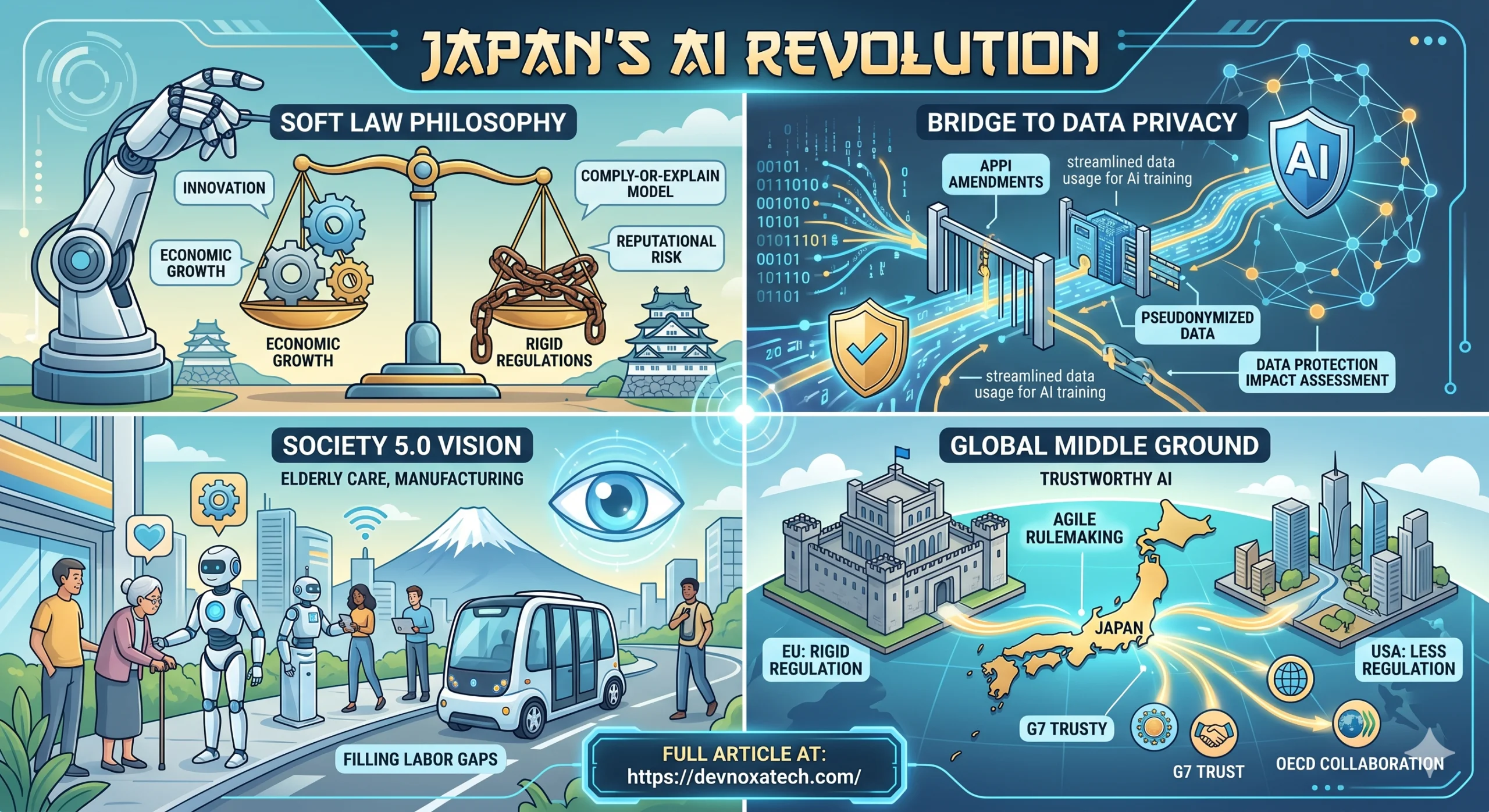

In a world where governments are racing to build fences around artificial intelligence Japan AI Regulation News has reached a pivotal turning point, offering a stark and fascinating contrast to the heavy-handed legislative approach seen in Europe. While the European Union’s AI Act has become famous for its rigid risk tiers and eye-watering fines, Japan is doubling down Today, the conversation in Tokyo isn’t about what AI is forbidden to do, but how it can be integrated into the very fabric of society to solve some of the nation’s most pressing challenges.
The Strategy of Soft Power
At the heart of the latest news is the full implementation of the Act on Promotion of Research and Development, and Utilization of AI-related Technology—commonly referred to in policy circles as the AI Promotion Act. Enacted last year and now in its full operative phase, this law is a “fundamental law.” In Japanese legal tradition, this means it serves as a North Star for the government rather than a list of crimes and punishments.
Unlike the EU, Japan has notably avoided mandatory audits and financial penalties for AI developers. Instead, the government, led by the AI Strategic Headquarters under the Prime Minister, uses a “comply-or-explain” model. Businesses are encouraged to follow the newly updated AI Guidelines for Business (Version 1.2), released just this spring. If a company deviates from these guidelines, they aren’t hit with a fine; instead, they are expected to explain their reasoning to regulators and the public. In the Japanese corporate world, where reputation is often more valuable than liquid capital, the threat of “reputational risk” acts as a powerful, self-regulating invisible hand.
Bridging the Gap: Data Protection and Privacy
While the AI Promotion Act is gentle, Japan is not leaving the industry entirely to its own devices. The most significant news today involves the convergence of AI development and data privacy. The Cabinet recently approved major amendments to the Act on the Protection of Personal Information (APPI).
This is a massive win for AI developers. The 2026 amendments introduce a specific exception that allows companies to use personal data for AI training without obtaining fresh consent from every individual, provided the data is “pseudonymized” and the company can prove they have implemented strict safety safeguards.
This move is designed to supercharge the development of domestic Large Language Models (LLMs). By streamlining the path to high-quality data, Japan is effectively telling the world that it is open for business. However, this freedom comes with a catch: the “Data Protection Impact Assessment” (DPIA) has moved from being a suggestion to a practical necessity. Companies must document exactly how they are protecting people, or they lose the right to use that data.
The Human-Centric Vision: Society 5.0
Japan’s regulatory path is deeply rooted in its “Society 5.0” vision. The country faces a unique demographic crisis—a rapidly aging population and a shrinking workforce. For Tokyo, AI isn’t just a shiny new tool; it is a vital survival mechanism.
Current news highlights the government’s push to use AI to fill labor gaps in elderly care, manufacturing, and even rural transportation. Because the social need is so high, the regulatory environment is intentionally designed to be “agile.” The Ministry of Economy, Trade and Industry (METI) has made it clear that they believe rule-based regulations would move too slowly to keep up with the breakneck speed of AI evolution. By using guidelines instead of rigid laws, they can update their expectations every few months as the technology changes, rather than waiting years for a new bill to pass through the Diet.
Addressing the Dark Side: Deepfakes and Security
Of course, it isn’t all sunshine and progress. Japan is acutely aware of the risks. Recent headlines have focused on the rise of “AI-assisted attacks.” In early 2026, Japan saw a spike in sophisticated cybercrimes and sexual deepfakes created with generative AI.
In response, the AI Strategic Headquarters has initiated a situational review. While they still avoid blanket bans, they are utilizing existing criminal laws—like the Unauthorized Access Prohibition Act—to prosecute those who use AI for harm. The message is clear: the technology is free to grow, but the misuse of it remains a crime. There is also a growing push for “transparency duties” for digital platforms, requiring them to disclose when content is AI-generated and providing users with better “opt-out” mechanisms.
A Global Model for the Future?
Japan is positioning itself as the “middle ground” between the regulatory heavy EU and the largely unregulated (at the federal level) United States. By focusing on “Trustworthy AI” through international collaboration with the G7 and OECD, Japan hopes to prove that you can have safety without stifling the creative spark of innovation.
For tech founders and global investors, Japan has become an incredibly attractive sandbox. With no pre-launch approvals and a low barrier to entry, it is often the first place new models are being tested and deployed. The focus is on a “human-centric” approach where AI serves the person, not the other way around.
As we look at the headlines today, Japan’s experiment is a bold bet on human responsibility. They are betting that clear guidelines and strong ethics can do more for the future of technology than a thousand pages of restrictive laws. Whether this “soft law” approach can survive the inevitable challenges of the AI era remains to be seen, but for now, Japan is leading the way in showing how a modern society can embrace the future with open arms. devnoxa tech