

Archery is one of the oldest skills known to humanity, a discipline that once meant the difference between survival and starvation. For thousands of years, the technology remained relatively stagnant, consisting of a flexible stick and a string made of animal sinew or plant fiber. However, the modern era has transformed this ancient art into a high-stakes arena of engineering precision. Today, “hi-tech archery” represents a fascinating intersection of physics, materials science, and digital integration that would be unrecognizable to our ancestors.
The Science of Materials and Speed
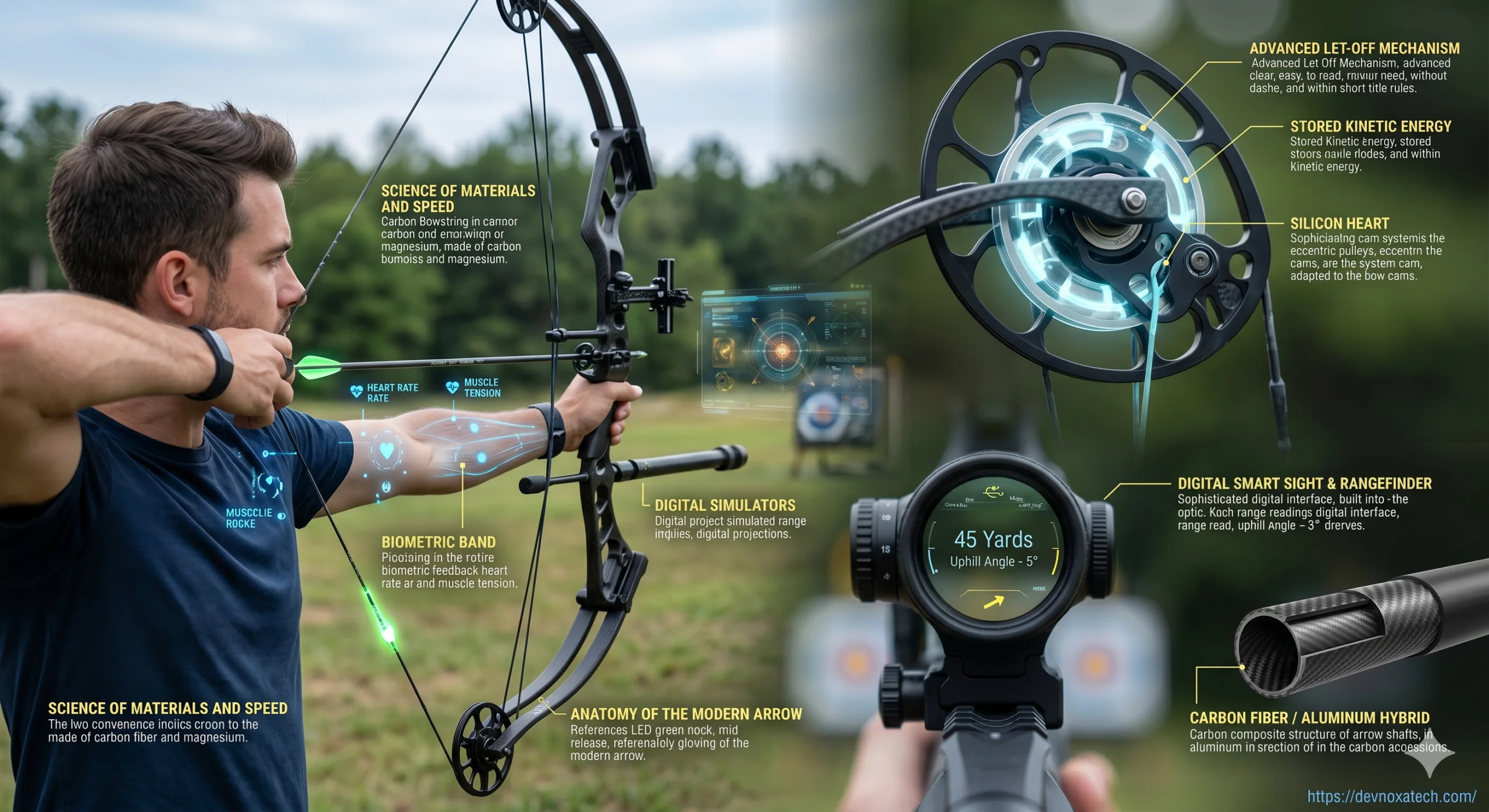
The most visible shift in high-tech archery is the move away from organic materials toward advanced composites. Modern compound bows are marvels of aerospace engineering. Instead of wood that can warp or lose its “memory” over time, today’s bows utilize carbon fiber, magnesium, and high-grade aluminum. These materials provide an incredible strength-to-weight ratio, allowing for thinner, more aerodynamic designs that do not sacrifice durability.
The limbs of a modern bow are designed using computer modeling to store the maximum amount of energy possible. When a traditional longbow is pulled, the archer holds 100 percent of the weight at full draw. High-tech compound bows use a system of cams—eccentric pulleys—that create a “let-off.” This means that once the archer pulls past a certain point, the mechanical advantage of the cams takes over, reducing the holding weight by up to 90 percent. This allows the shooter to remain steady for much longer, focusing on their aim rather than muscle fatigue.
Precision Optics and Smart Sights
If the bow is the engine, the sight is the guidance system. The days of simply “eyeballing” a target are long gone in the professional and enthusiast world. Modern archery sights have integrated digital components that have fundamentally changed the accuracy of the sport.
We now see the emergence of laser-rangefinding sights. These devices allow an archer to press a button while at full draw; a built-in laser measures the exact distance to the target and automatically moves a digital aiming pin to the correct position. This eliminates the guesswork of “gap shooting” and compensates for the arc of the arrow’s flight in real-time. Some advanced sights even include sensors to detect the angle of the shot, automatically adjusting the aim point for uphill or downhill trajectories.
The Anatomy of the Modern Arrow
Even the arrow has undergone a digital and chemical makeover. Traditional cedar shafts have been replaced by carbon fiber and hybrid aluminum-carbon tubes. These arrows are manufactured to tolerances as tight as one-thousandth of an inch in straightness.
The most “hi-tech” aspect of modern arrows, however, is the data they can provide. “Smart” nocks—the piece that attaches the arrow to the string—now contain LED lights that activate upon release. This allows archers to track the flight path and locate their arrows in low-light conditions. Furthermore, training systems now utilize sensors that can be attached to the arrow or the bow to measure “shot execution” data, such as the exact vibration frequency and the milliseconds of “lean” during the release.
Training in the Virtual Realm
Technology has moved beyond the physical equipment and into the way archers train. High-tech archery now includes sophisticated software and wearable tech designed to perfect the human element.
- Biometric Feedback: High-level athletes now use wearables that track heart rate and breathing patterns. The goal is to release the arrow between heartbeats to minimize body tremors.
- High-Speed Video Analysis: Coaches use cameras that capture thousands of frames per second to analyze “archer’s paradox”—the way an arrow flexes and oscillates as it leaves the bow. By seeing what the human eye cannot, archers can tune their equipment to match their specific release style perfectly.
- Digital Simulators: Much like flight simulators for pilots, digital archery ranges use projectors and infrared sensors to create hyper-realistic hunting or competition scenarios. These systems can simulate wind, moving targets, and different lighting conditions, providing a controlled environment for mastery.
The Engineering of Silence and Stability
One of the biggest hurdles in archery is vibration. When a bow is fired, a massive amount of energy is released. Any energy not transferred into the arrow turns into noise and vibration, which can affect accuracy and, in a hunting context, alert the target.
Hi-tech archery addresses this through advanced dampening technology. Manufacturers use proprietary polymers and “shock rods” designed to absorb kinetic energy. Stabilizers—those long rods seen protruding from the front of bows—are no longer just weights. They are engineered with internal shifting weights and carbon-weave patterns designed to keep the bow perfectly balanced in the hand while killing any residual “hand shock” after the shot.
Accessibility through Innovation
Interestingly, the rise of high-tech archery has made the sport more accessible. In the past, the physical strength required to operate a powerful bow excluded many people. Today, because of mechanical let-off and adjustable draw weights, people of all ages and physical abilities can participate.
Furthermore, the “smart” features of modern equipment reduce the steep learning curve. While the purist may prefer a simple stick and string, the integration of technology allows beginners to see success much faster, keeping them engaged in the sport and growing the archery community globally.
The Ethics of the Technological Edge
As with any field that sees a rapid influx of technology, there is a constant debate regarding where to draw the line. Some argue that laser sights and rangefinders take the “skill” out of the sport, turning a test of intuition into a technical exercise. Most competitive organizations have strict rules about which technologies are allowed in specific classes to ensure that the human element remains the deciding factor.
However, from a conservation and hunting perspective, the tech is often seen as an ethical win. Higher accuracy and better range estimation mean fewer wounded animals and more clean, quick harvests. The technology isn’t replacing the archer’s soul; it is ensuring that the archer’s intent is carried out with absolute precision.
A Future Aimed High
The future of high-tech archery likely lies in even deeper integration with the “Internet of Things” (IoT). Imagine a bow that syncs with your glasses to provide a heads-up display of wind speed and humidity, or limbs that use “active” materials to change their stiffness based on the temperature.
We are witnessing a beautiful paradox: a sport that is thousands of years old being propelled into the future by the same cutting-edge science used to build satellites and supercomputers. Whether you are a traditionalist or a tech-enthusiast, there is no denying that the modern bow is a masterpiece of human ingenuity. It is a testament to our desire to take an ancient practice and refine it until it touches the very edge of perfection.
The silence of the release remains, but the precision behind it is now powered by the greatest technological leaps of our time. devnoxa tech