
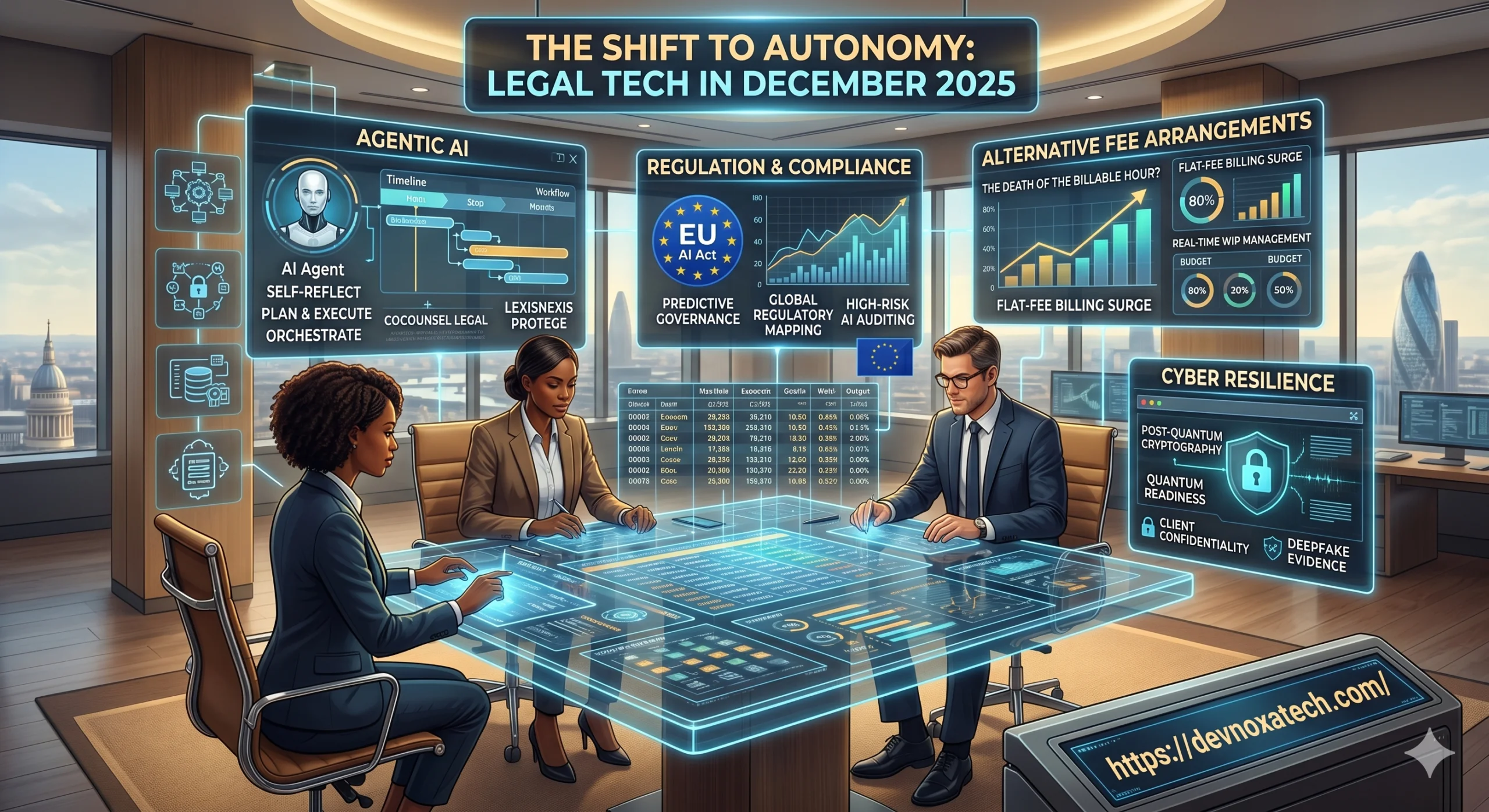

As December 2025 draws to a close, the legal tech news landscape looks vastly different than it did just twelve months ago. If 2024 was the year of the “chatbot,” 2025 has been the year of the “agent.” The industry has moved past the novelty of generative AI and into a phase of deep, functional integration. Law firms and corporate legal departments are no longer just asking AI to summarize a memo; they are deploying autonomous systems capable of executing multi-step workflows with minimal human intervention.
The final month of the year has highlighted several pivotal shifts that are setting the stage for 2026. From the rise of agentic AI to the hardening of global regulations, the legal profession is undergoing a fundamental structural change.
The Era of the Legal Agent
The biggest news in December 2025 is the maturity of Agentic AI. Unlike standard generative AI, which requires a prompt for every single output, agentic systems—like the recently expanded Protégé from LexisNexis and Thomson Reuters’ CoCounsel Legal—operate as digital associates.
These agents can now:
- Self-Reflect: They review their own work for hallucinations before presenting it to a human.
- Plan and Execute: They can break down a complex litigation task into research, drafting, and filing steps without being told how to do each part.
- Orchestrate: They act as a bridge between different software tools, moving data from a document management system into a court filing portal automatically.
Harvey, the high-profile legal AI startup, capped off the year by reporting an 80% increase in daily active usage. This suggests that AI is no longer a “side project” for lawyers but a core component of their daily toolkit. The narrative has shifted from “Will AI replace lawyers?” to “How many tasks can a lawyer delegate to their AI agent?”
Regulation and the “Compliance Crunch”
December has also been a month of intense preparation for the EU AI Act, which is set to become fully enforceable in 2026. Because AI used in legal services is classified as “high-risk,” firms have spent the end of the year auditing their tech stacks.
We are seeing the emergence of Predictive Governance. Legal teams are moving away from reactive compliance. Instead, they are using AI to scan global regulatory horizons and automatically map new requirements to their internal controls. In Europe and the UK, the focus has shifted toward transparency—ensuring that if a computer helps make a decision, the logic behind that decision is fully traceable.
The Death of the Hourly Bill?
For decades, the billable hour has been the bedrock of legal finance. However, the efficiency gains seen in late 2025 are making this model increasingly difficult to sustain. With AI tools now automating up to 20% of routine lawyer tasks, firms are facing a “productivity paradox.”
In response, December has seen a surge in Alternative Fee Arrangements (AFAs). According to recent surveys, over 80% of firms now offer some form of flat-fee billing. To manage this without losing profit, firms are adopting “Real-time WIP (Work in Progress) Management” tools. These AI-driven platforms flag when a project is deviating from its budget in real-time, allowing for proactive adjustments rather than awkward end-of-month conversations with clients.
Cyber Resilience in a Post-Quantum World
As we look toward 2026, cybersecurity remains the top concern for Chief Information Officers at major firms. The rise of AI hasn’t just helped lawyers; it has helped hackers. “Deepfake” evidence and sophisticated phishing attacks have become common enough that the Law Society and other regulatory bodies issued fresh guidance this month on the “Definition of Computer Evidence.”
Furthermore, “Quantum Readiness” has entered the legal tech lexicon. With the threat that quantum computing could eventually break current encryption standards, forward-thinking firms began migrating to post-quantum cryptographic standards this December to protect long-term client confidentiality.
Key Takeaways for 2026
The legal tech trends of December 2025 point toward a future that is integrated, autonomous, and highly regulated.
- From Prompting to Context: Lawyers are spending less time “engineering prompts” and more time “engineering context”—ensuring their AI has the right data and internal knowledge to be accurate.
- The Human Edge: As routine drafting becomes a commodity, the value of a lawyer is shifting back to high-level strategy, ethics, and emotional intelligence.
- Unified Ecosystems: The days of jumping between twenty different apps are ending. The “intelligent assistant” is becoming ambient, living inside Word, Outlook, and the browser.
The legal industry, often accused of being slow to change, has reached a tipping point. The technology is no longer a luxury; it is the infrastructure upon which the next decade of law will be built. devnoxa tech