
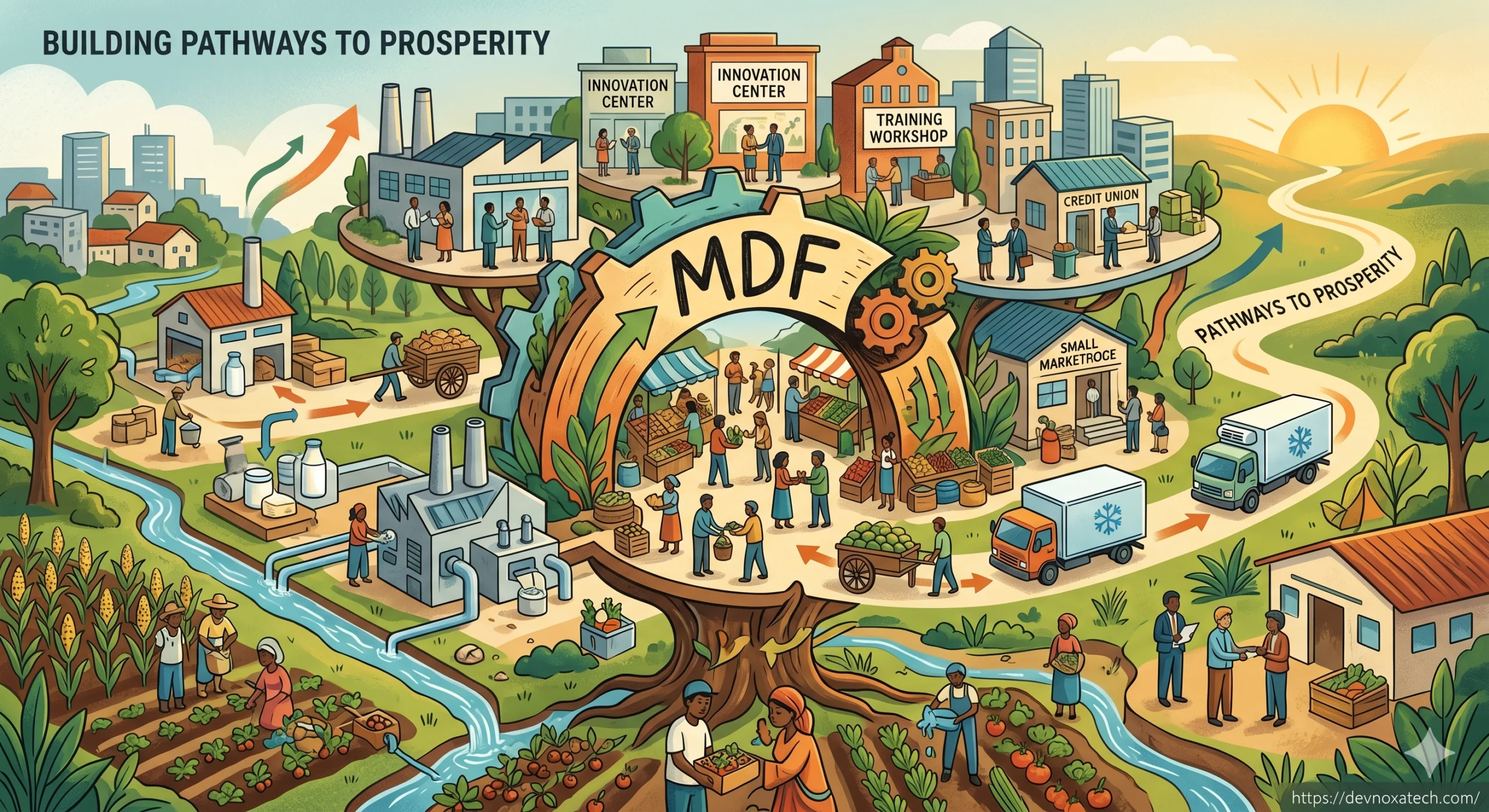

Market systems are the invisible engines of our daily lives. From the coffee you drink in the morning to the smartphone in your pocket, thousands of interconnected players—farmers, processors, transporters, and retailers—work together to bring products to your doorstep. However, in many developing nations, these engines are stalled. Farmers can’t find quality seeds, small businesses can’t access credit, and innovators lack the technical know-how to scale. This is where a Market Development Facility, or MDF, steps in.
An MDF isn’t a traditional charity or a simple grant-giving body. It is a sophisticated, multi-sector program designed to stimulate economic growth by fixing the “broken” parts of a market. Instead of handing out fish, or even just teaching people how to fish, an MDF works to ensure the entire fishing industry functions better for everyone involved.
What Makes an MDF Different?
The traditional approach to aid often involves direct delivery. If a community lacks water, an organization digs a well. While noble, this often fails when the pump breaks and no one has the parts or the profit motive to fix it. A Market Development Facility operates on the principle of systemic change. It looks at the big picture and asks: Why isn’t the private sector solving this problem on its own?
By identifying these systemic bottlenecks, an MDF acts as a catalyst. It partners with local businesses, entrepreneurs, and government bodies to pilot new ways of doing business. The goal is to create a “win-win” scenario where a business increases its profits while simultaneously providing better opportunities or services to the poor. This is often referred to as the Making Markets Work for the Poor (M4P) approach.
The Strategy of Partnership
One of the most human elements of an MDF is its reliance on relationships. It doesn’t walk into a country with a rigid blueprint. Instead, it hires local and international experts who spend months talking to market players. They listen to the frustrations of a dairy farmer who loses half his milk to spoilage and the struggles of a distributor who can’t find reliable cold storage.
Once a specific barrier is identified—let’s say a lack of refrigerated transport—the MDF doesn’t buy trucks for the farmers. Instead, it might partner with a logistics company. The MDF might offer to co-invest in the first few refrigerated trucks to reduce the company’s financial risk. In exchange, the company agrees to extend its routes into underserved rural areas. If the pilot is successful, the company sees the profit potential and expands the service using its own capital. Other competitors see the success and jump in too. Suddenly, a whole new service industry is born, and the farmers’ spoilage problem is solved permanently.
Diversifying the Economic Landscape
MDFs are uniquely flexible. They don’t just stick to agriculture. While farming is often the backbone of developing economies, a Market Development Facility might work in tourism, manufacturing, or digital services.
In the tourism sector, an MDF might notice that a beautiful coastal region lacks international visitors because local hotels don’t meet global safety standards. Rather than paying for the renovations, the facility might work with a local vocational school to create a certification program. They might also partner with a marketing agency to put the region on the map for eco-tourists. By upgrading the skills of the workforce and the visibility of the destination, they create a self-sustaining cycle of tourism that employs thousands of locals.
Sustainability and the Exit Strategy
The ultimate measure of success for a Market Development Facility is its own obsolescence. A well-designed MDF is always looking for the exit. If the facility stays involved forever, it hasn’t actually fixed the market; it has just become another permanent crutch.
Sustainability is baked into every partnership. When an MDF co-invests with a business, the business must always put “skin in the game.” This ensures that the partner is genuinely committed to the new business model. As the market begins to function more efficiently, the MDF slowly withdraws its support. The goal is to leave behind a market that is more inclusive, more resilient, and entirely self-sufficient.
Addressing Gender and Climate
Modern Market Development Facilities are also at the forefront of social and environmental change. They recognize that markets are not neutral; they often exclude women or harm the environment.
A gender-smart MDF looks for ways to break down the barriers that keep women from participating in the economy. This might mean working with banks to create loan products that don’t require land titles as collateral—a common hurdle for women in many cultures. It might mean supporting mobile childcare services so mothers can work in processing plants.
Similarly, “climate-smart” market development focuses on resilience. As weather patterns become more unpredictable, an MDF might partner with seed companies to distribute drought-resistant varieties or work with insurance firms to create affordable “index-based” insurance for smallholders. By making the market work for the environment, they protect the long-term viability of the economy.
The Ripple Effect of Innovation
The beauty of the MDF model lies in its ripple effect. When one business innovates and succeeds, it sends a signal to the entire industry. It proves that there is money to be made in serving the “bottom of the pyramid.” This triggers a wave of imitation and competition that drives down prices and increases quality for consumers.
Furthermore, a stronger economy leads to a stronger social fabric. When parents have steady incomes, they send their children to school. When local businesses grow, they pay taxes that fund clinics and roads. The Market Development Facility is the spark that starts this engine, but the local people and businesses are the ones who keep it running.
Challenges in the Field
It would be dishonest to suggest that market development is easy. It is high-risk and requires immense patience. Not every partnership works. Sometimes a business partner fails, or a sudden political crisis disrupts the entire market.
Because the MDF approach is about changing systems rather than just hitting “numbers of people reached” in the short term, it can be difficult to explain to donors who want quick, visible results. It takes courage to invest in a five-year strategy that focuses on changing how a sector functions rather than just handing out supplies. However, the long-term impact of a functioning market far outweighs the temporary relief of a handout.
A Vision for the Future
As we look toward a future where global challenges like food security and unemployment become more pressing, the role of Market Development Facilities will only grow. We need systems that empower people to solve their own problems through commerce and innovation.
By acting as a bridge between the public interest and private profit, the MDF model offers a dignified path to development. It respects the agency of local entrepreneurs and recognizes that the most powerful tool for ending poverty is a fair, inclusive, and efficient market.
In the end, a Market Development Facility is about more than just economics. It is about hope. It is about creating a world where a person’s hard work is rewarded because the system around them finally works. It is about building a foundation for prosperity that will last for generations to come. devnoxa tech