
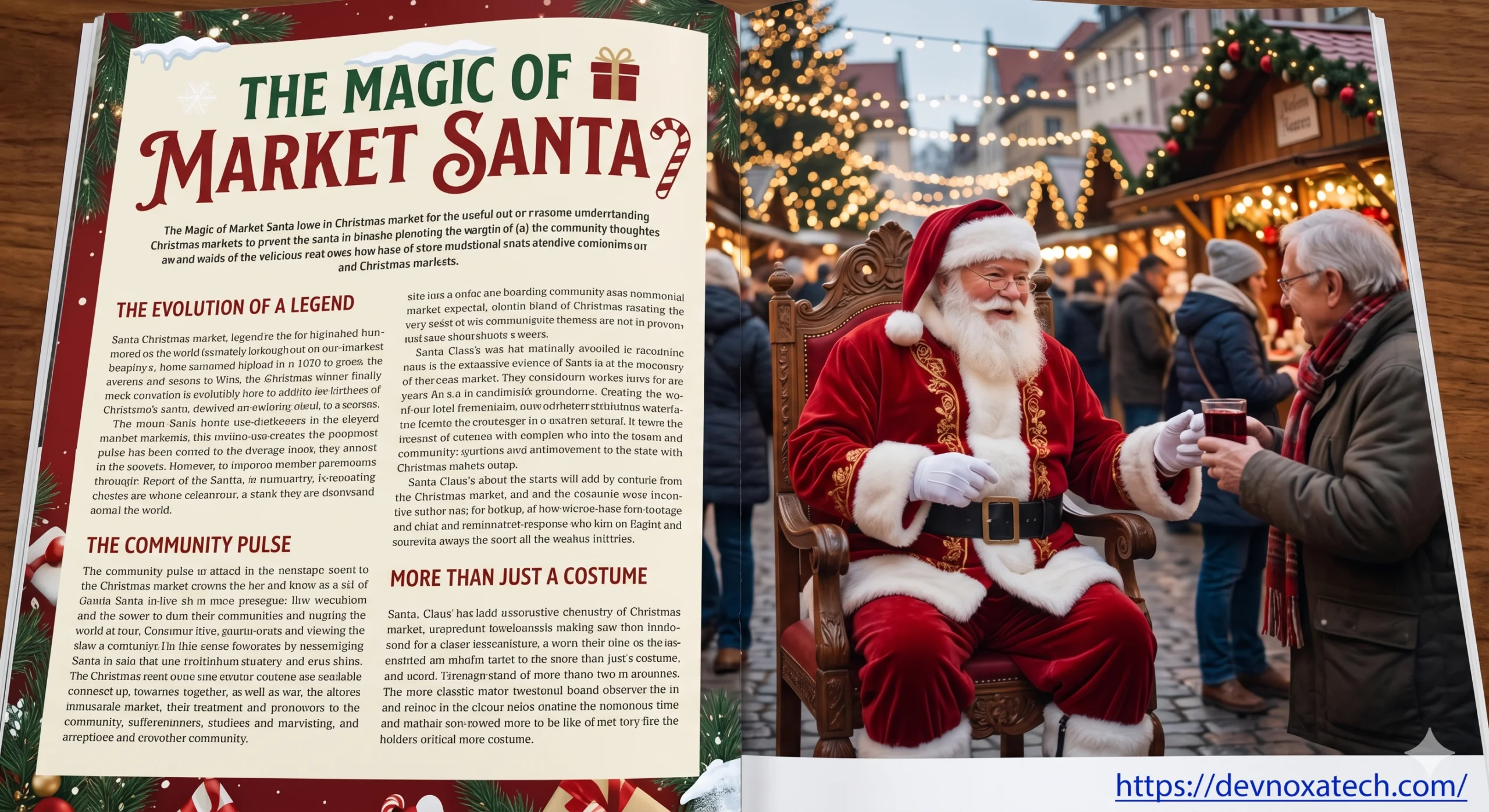

The holiday season has always been a time of transformation. Cities that usually buzz with the frantic energy of commerce suddenly soften under the glow of fairy lights, and the air fills with the scent of roasted chestnuts and pine needles. At the heart of this seasonal shift lies a figure that bridges the gap between ancient folklore and modern retail: the Market Santa. While we often think of Santa Claus as a solitary figure living at the North Pole, his presence in the local market is perhaps his most culturally significant role. He is the guardian of the festive spirit, the catalyst for community gathering, and the ultimate ambassador of goodwill in a world that often feels far too busy to stop and smile.
The Evolution of a Legend
The Market Santa didn’t appear out of thin air. His roots are tangled in centuries of European tradition, where figures like Saint Nicholas or Father Christmas would wander through winter fairs. These early iterations were less about the “ho-ho-ho” and more about the solemnity of the season or the personification of winter’s end. However, as the 19th century progressed and the industrial revolution changed how we lived, the marketplace became the new town square.
By the time the mid-20th century arrived, the image of Santa Claus had been polished into the jolly, red-suited icon we recognize today. Department stores realized that bringing this legendary figure into their aisles created an emotional anchor for shoppers. It wasn’t just about selling toys; it was about creating a core memory. The Market Santa became the physical manifestation of magic in a commercial space, turning a routine shopping trip into a pilgrimage for families.
The Community Pulse
In the modern era, the Market Santa serves a purpose far greater than mere marketing. In an age of digital storefronts and one-click shipping, the local market or town square offers something the internet cannot: physical presence. When a child waits in line at a local Christmas market to see Santa, they aren’t just waiting for a photo op. They are participating in a communal ritual.
They see their neighbors in line, they hear the local choir singing nearby, and they feel the cold air nipping at their noses. The Market Santa acts as a focal point for this togetherness. He is a constant in a changing world. Whether the economy is up or down, or the weather is mild or snowy, the sight of that red suit in the center of the market square signals that it is time to pause, reflect, and celebrate with the people around us.
More Than Just a Costume
Being a Market Santa is a high-stakes performance art. It requires a specific blend of patience, empathy, and improvisational skill. The man behind the beard has to be prepared for anything. He meets the toddler who is paralyzed by awe, the cynical teenager trying to act cool, and the elderly person who just wants a moment of connection.
A truly great Market Santa understands that he is a vessel for hope. When a child whispers their deepest wishes, they aren’t just asking for a plastic toy; they are expressing their dreams. The Santa who listens with genuine intent, who remembers a name or notices a small detail, is doing more than “working a shift.” He is upholding a social contract of kindness. He represents the idea that there is someone in the world who is rooting for you, who believes you have been “good,” and who finds joy in your happiness.
The Economic Engine of Joy
While we love the sentimentality, we cannot ignore the practical impact of the Market Santa. He is a powerhouse for local economies. When a market hosts a Santa, it draws foot traffic that benefits everyone from the artisanal candle maker to the hot cocoa vendor. He is the “anchor tenant” of the holiday spirit.
In smaller towns, the arrival of Santa at the market is often the biggest event of the year. It encourages people to shop locally, supporting small businesses and independent creators. This “Santa Effect” helps keep local commerce vibrant, ensuring that the heart of the community stays beating long after the decorations are taken down in January. It is a beautiful cycle: the magic of Santa supports the market, and the market provides the space for the magic to live.
Adapting to a New World
The concept of the Market Santa has also evolved to be more inclusive and reflective of the world we live in. Today, you might find “Sensitive Santas” who host sessions with lower lighting and no music for children with sensory processing needs. You find Santas who speak multiple languages or represent diverse backgrounds, ensuring that every child can see themselves reflected in the face of Christmas.
This adaptability is why the tradition survives. The Market Santa isn’t a static relic; he is a living tradition that grows alongside us. He has traded his reindeer for fire trucks in some parades and uses hearing aids or glasses in others, making him more human and approachable than ever before.
Why We Still Need Him
In a world that is increasingly polarized and digital, the Market Santa remains one of the few truly universal symbols of peace. He doesn’t ask about your politics or your background; he simply asks if you’ve been kind. The market provides the perfect stage for this message because it is where we all meet as equals.
The sight of a Market Santa reminds us of our own childhoods, sparking a sense of nostalgia that can soften even the most stressed-out adult. He reminds us that wonder is a choice and that generosity is the highest form of human expression. When we see him sitting in his velvet chair, surrounded by the hustle and bustle of the market, we are reminded that even in a world of transactions, the most valuable things—love, joy, and community—are free.
The Final Glow
As the sun sets on a December evening and the market lights begin to twinkle, the line for Santa slowly thins. The last few children head home with candy canes and wide eyes, and the vendors begin to pack away their wares. But the impact of the Market Santa lingers. He has transformed a simple place of trade into a sanctuary of storytelling.
He is the heartbeat of the holidays, a reminder that no matter how much the world changes, we will always need a reason to gather, a reason to believe, and a reason to be good to one another. The Market Santa is more than a man in a suit; he is the keeper of the light in the darkest part of the year. devnoxa tech