
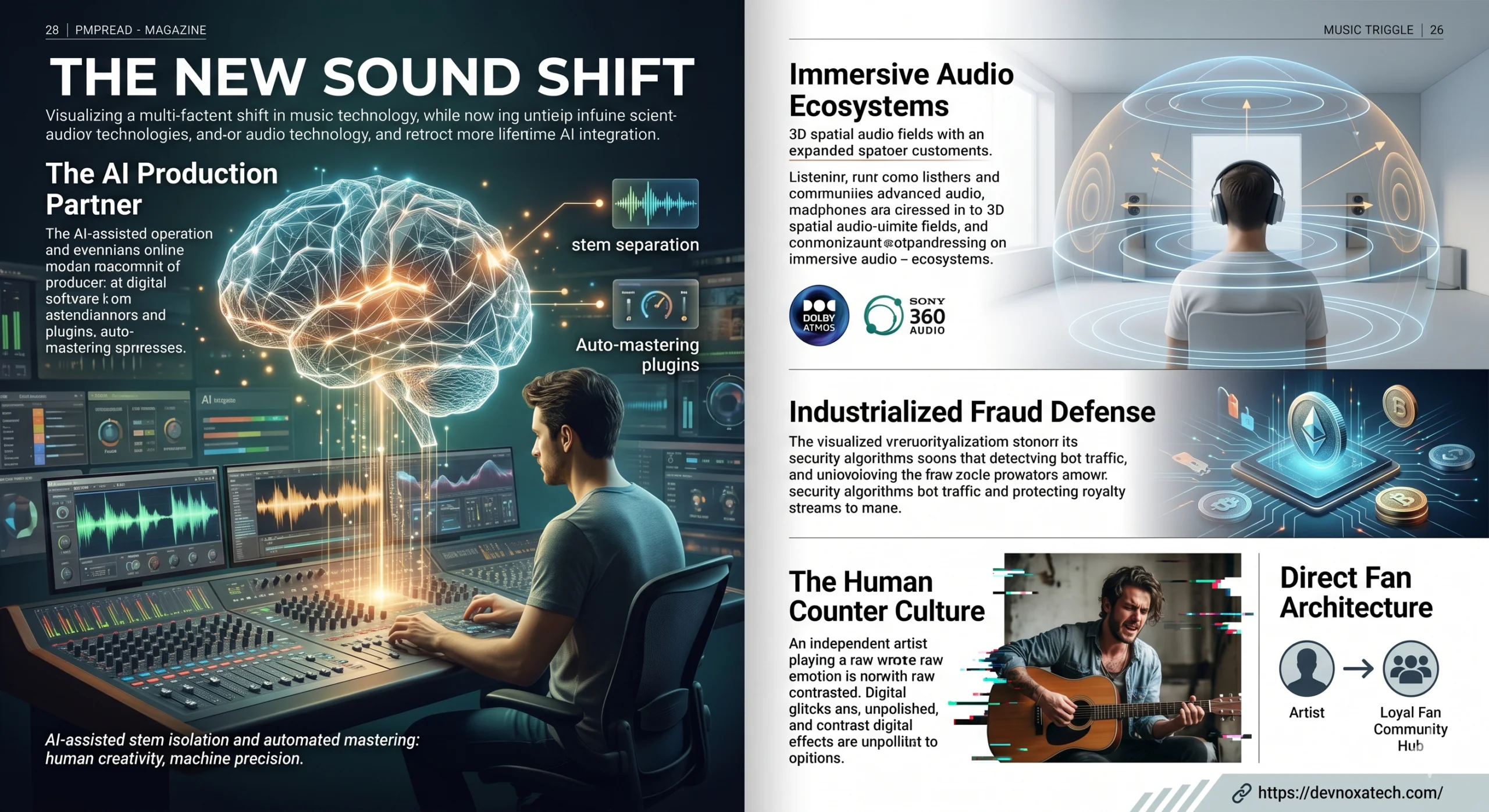

The digital landscape of music tech news creation, production, and distribution is undergoing its most radical transformation in a generation. The boundaries that once separated the technologist from the artist have largely dissolved. Today, creators are dealing with a world where artificial intelligence is standard studio infrastructure, spatial audio is moving from a luxury format to a streaming requirement, and the economic models of the streaming era are being rewritten in real time.
Staying informed about music tech is no longer just for software engineers or gear enthusiasts. For musicians, producers, and industry executives, understanding these shifts is a matter of professional survival. The tools available are changing not just how music sounds, but who gets to make it and how they get paid.
The AI Production Partner
Artificial intelligence has officially shed its reputation as a futuristic gimmick and consolidated its place as a necessary studio tool. A recent industry survey of over one thousand music producers revealed that sixty percent now actively use AI during their creative process. However, the fear that machines would completely replace human songwriters has proven largely unfounded. Instead, the technology is acting as an ultra efficient assistant.
Producers are delegating tedious, administrative audio tasks to intelligent algorithms. Complex engineering processes like stem separation, which isolates vocals or individual instruments from a fully mixed track, are now executed in seconds with pristine clarity. Automated mixing and mastering plugins analyze the specific sonic characteristics of a recording and suggest optimal equalization and compression settings based on the target genre. By handling the technical heavy lifting, these tools free up creators to focus purely on the emotional and artistic decisions that give music its unique soul.
Immersive Audio Ecosystems
The traditional stereo mix, which pan stereo fields strictly left and right, is facing a massive challenger. Spatial audio formats like Dolby Atmos and Sony 360 Reality Audio have firmly established themselves in the mainstream streaming market. Leading digital streaming platforms are aggressively pushing three dimensional soundscapes, making immersive audio a vital checkbox for any serious commercial release.
This format shift has trickled down directly into consumer hardware and home studio gear. Manufacturers have responded by releasing affordable audio interfaces and studio monitors featuring native spatial audio routing at price points accessible to independent creators. Producers are no longer just positioning sounds on a flat horizontal plane; they are placing instruments above, behind, and around the listener. This spatial design offers a deep sense of movement that mimics live performances or virtual environments, giving independent artists a powerful way to stand out in a saturated market.
Industrialized Fraud Defense
As generative technology lowers the barrier to entry, streaming platforms are experiencing an unprecedented flood of content. Approximately one hundred and fifty thousand new tracks are uploaded to digital services every single day. Unfortunately, this massive volume has also fueled an explosion in streaming fraud.
Sophisticated criminal networks now use automated bots to repeatedly play artificially generated or unlicensed tracks. These fake streams siphon off more than a billion dollars a year from the shared royalty pools, directly stealing revenue from legitimate, hard working artists.
To combat this, the industry is deploying advanced behavioral intelligence platforms. While AI contributed to the problem via automated creation, it is also the primary solution. New security algorithms analyze streaming patterns in real time to detect abnormal user behavior, pinpoint fraudulent listening networks, and protect the rightful income of human creators.
The Human Counter Culture
An interesting psychological shift is occurring among music consumers and creators in response to the absolute saturation of synthetic content. As perfectly polished, algorithmically optimized songs flood social media feeds, a cultural backlash is gathering steam. Audiences are experiencing algorithm fatigue, creating a massive premium for raw, unpolished human authenticity.
A growing community of producers is leaning heavily into organic sounds, live instrumentation, and intentional sonic imperfections. Field recordings, analog hardware distortion, and uncorrected vocal takes are being used as a badge of honor to signal true human origin. For independent musicians, this represents a massive opportunity. Raw emotional delivery and deep personal storytelling are areas where artificial intelligence cannot compete, turning human vulnerability into a powerful competitive advantage.
Shifting Capital Pipelines
The infrastructure supporting music technology startups is facing a challenging financial environment. Data from market research groups shows that total annual investment into the music tech sector has dropped significantly from its post pandemic peaks. While early stage funding for brand new startups remains relatively steady, growth stage capital has dried up dramatically.
This capital gap means that while brilliant tools are still being invented at the grassroots level, scaling those startups into stable global enterprises is harder than ever. The investment dollars that do remain are pivoting away from simple consumer apps and pouring directly into core music infrastructure. Capital is targeting advanced catalog management software, copyright tracking networks, and complex digital licensing APIs. As music integrates more deeply into video games, virtual fitness applications, and social networks, the background software that manages ownership rights is becoming highly valuable.
Direct Fan Architecture
The slowing growth of traditional streaming revenue is forcing a major rethink of the artist economy. Relying solely on a fraction of a cent per stream is no longer a viable path to a sustainable career for the vast majority of musicians. Consequently, technology is shifting to support direct to fan relationships.
Instead of counting on unpredictable, third party platform algorithms for visibility, creators are building their own private ecosystems. Artists are leveraging integrated platforms that bundle email list management, localized community hubs, and exclusive subscription tiers into a single workspace. Superfans are showing a high willingness to pay significant premiums for direct access, early demo releases, behind the scenes studio footage, and unique merchandise bundles. By reclaiming ownership of their fan data, creators are de risking their businesses and ensuring long term financial stability.
The New Creative Balance
The state of music tech highlights a delicate balancing act. Technology has democratized production to the point where anyone with a laptop can engineer a professional sounding record from their bedroom. Yet, this incredible convenience brings a heavy operational burden. Modern creators find themselves spending a majority of their time managing fragmented workflows, jumping between communication tools, file storage apps, and analytics dashboards.
The future winners of the music industry will not be the ones who blindly let artificial intelligence write their songs, nor will it be those who ignore technical progress entirely. Success belongs to the artists and companies that use smart infrastructure to automate technical friction, while fiercely protecting the messy, unpredictable, and deeply emotional human connection that makes music worth listening to in the first place. devnoxa tech