
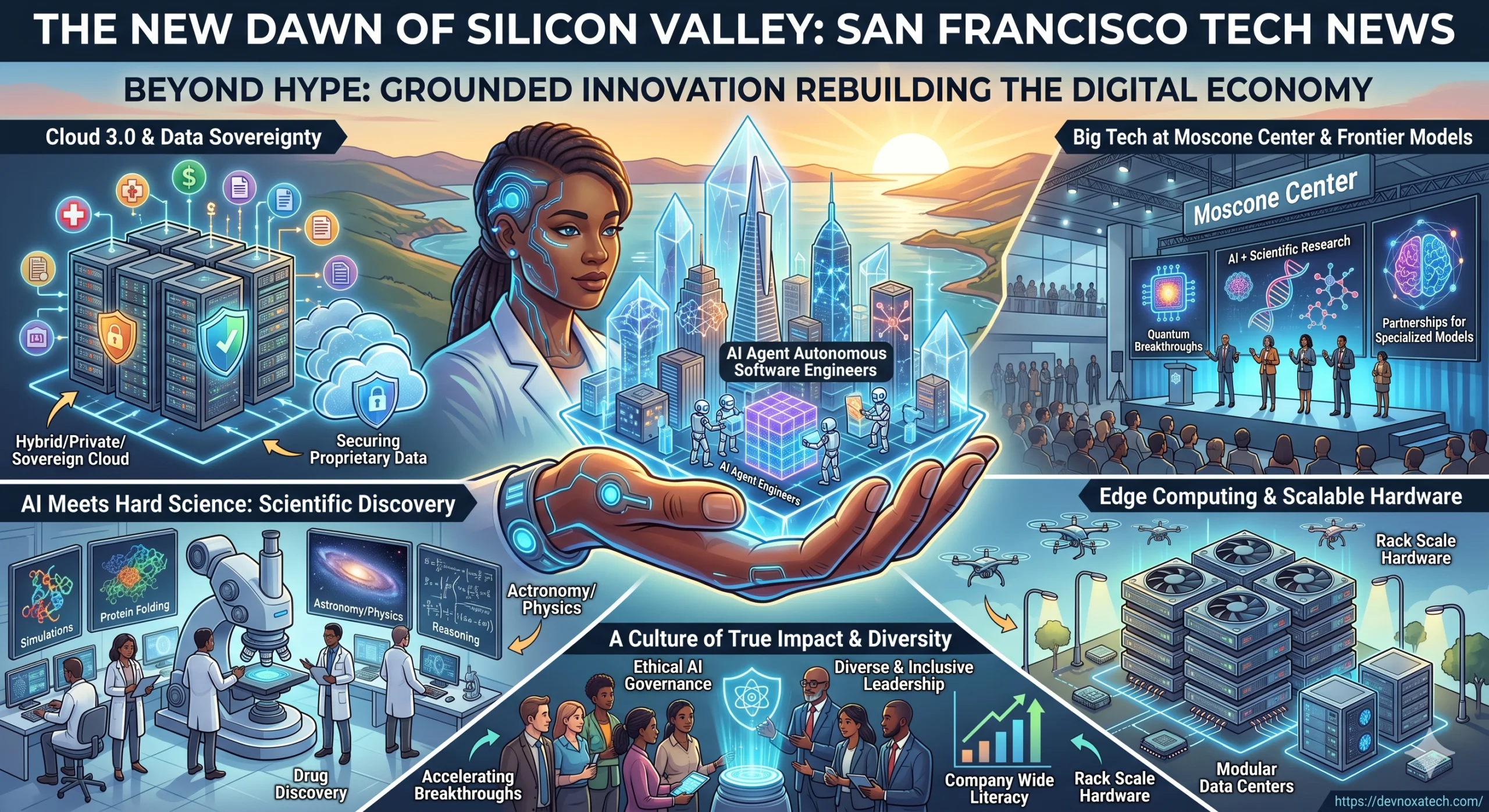

San Francisco is undergoing a profound structural shift. The initial wave of frantic experimentation has cooled, making way for something far more stable, mature, and deeply integrated into our daily lives. The city streets, once crowded with hopeful founders chasing fleeting crypto trends, are now the epicenter of a grounded industrial renaissance led by advanced artificial intelligence, next generation computing, and a complete overhaul of corporate infrastructure.
If previous years were about showing what technology could do, the current era is about proving its permanent value. From massive enterprise conferences to quiet, high stakes funding rounds, the Bay Area tech scene is actively rebuilding the digital economy from the ground up.
From Chatbots to Autonomous Software Engineers
The nature of software creation is undergoing a radical evolution right here in the city. For a long time, the tech world viewed AI as a helpful assistant that could write a few lines of code or draft an email. Today, that narrative has shifted completely toward autonomous systems capable of executing complex, multi step engineering tasks without human intervention.
A prime example of this shift is the massive financial momentum behind local AI agent laboratories. Companies focused on creating autonomous software engineers have seen their valuations skyrocket, with major players securing billions of dollars in fresh capital from eager venture capitalists. These systems allow developers to express their core intent rather than writing tedious code line by line. The software essentially learns to assemble and heal itself, changing the competitive edge for local startups from manual coding speed to high level orchestration and governance.
Big Tech Sets Up Camp at Moscone
The physical heart of San Francisco tech news remains tied to major industry gatherings at the iconic Moscone Center. Global tech giants continue to use the city as their primary stage for launching foundational shifts in hardware and cloud architecture.
During recent major developer conferences hosted on the ground in San Francisco, the focus heavily veered toward the intersection of hardware efficiency and specialized models. Industry leaders unveiled highly anticipated advancements in quantum computing, showcasing hardware breakthroughs like next generation processors that operate at unprecedented microsecond speeds.
Furthermore, tech conglomerates are increasingly stepping away from generic, one size fits all AI models. The new strategy focuses on massive partnerships with institutions outside the tech sphere, such as major healthcare networks, to develop highly specialized frontier models. These models are designed to handle sensitive scientific research and expand global access to expert services, moving technology closer to solving real world systemic challenges.
The Rise of Cloud Three Point Zero
As local companies attempt to scale these massive intelligent systems, they are running into the physical limitations of classical public cloud architectures. The heavy computational demands of running real time simulations and processing proprietary data have given rise to what industry insiders call Cloud 3.0.
San Francisco enterprises are leading the transition toward a diversified ecosystem of hybrid, private, and sovereign clouds. Businesses are no longer comfortable sending their most sensitive, proprietary data to a passive, centralized infrastructure layer. Instead, the cloud has become an active, intelligent partner capable of managing data sensitivity, ensuring absolute tech sovereignty, and providing the incredibly low latency required for real time AI inference. This structural rebuilding ensures that local innovations remain secure, compliant, and highly resilient against global supply chain or cybersecurity disruptions.
AI Meets Hard Science
Perhaps the most inspiring trend echoing through Silicon Valley is the merging of artificial intelligence with the physical sciences. At recent scientific summits held throughout the Bay Area, researchers and capital allocators gathered to look past the boundaries of traditional computing power.
Rather than focusing merely on making language models larger, the industry is throwing its weight behind scientific reasoning and knowledge discovery. AI is quickly transforming from a digital novelty into the baseline infrastructure for drug discovery, advanced materials science, mathematical reasoning, and complex physical simulations. By shrinking product development cycles and reducing the historical reliance on massive manual labor and physical experimental resources, local biotech and engineering firms are accelerating breakthroughs that used to take decades.
Edge Computing and Scalable Hardware
The sheer volume of data generated by these advanced operations requires localized processing power, driving massive interest in edge computing. San Francisco modular data center producers have successfully raised hundreds of millions of dollars in oversubscribed funding rounds, proving that investors are highly focused on the physical infrastructure supporting the digital bloom.
At the same time, major semiconductor companies are preparing for massive summer showcases in the city, detailing how rack scale hardware and adaptive systems will handle the next phase of token consumption and physical robotics. The conversation has clearly transitioned from abstract software concepts to the tangible, industrial realities of power, chips, and physical data centers.
A Culture of True Impact
What makes the current atmosphere in San Francisco unique is the newfound maturity across the workforce. Local tech companies are actively moving away from isolated, fragmented pilots. Instead, businesses are focusing on deep internal education, organizing company wide initiatives to build true technological literacy across every single department, from HR to legal.
The city is also taking intentional steps to celebrate diversity and inclusion within this rapidly expanding ecosystem. Local business publications have recently honored outstanding LGBTQ+ leaders who are driving technology transactions and steering artificial intelligence groups toward ethical governance. This focus on inclusive, stable leadership is helping create a more robust corporate culture that balances aggressive innovation with deep societal responsibility.
San Francisco has weathered countless economic cycles, but its current chapter might be its most resilient yet. By shifting its focus from speculative hype to durable infrastructure, autonomous capability, and scientific triumph, the city is cementing its role as the definitive architect of the global future.
To keep up with the latest technological developments and structural innovations driving businesses forward, visit devnoxa tech