
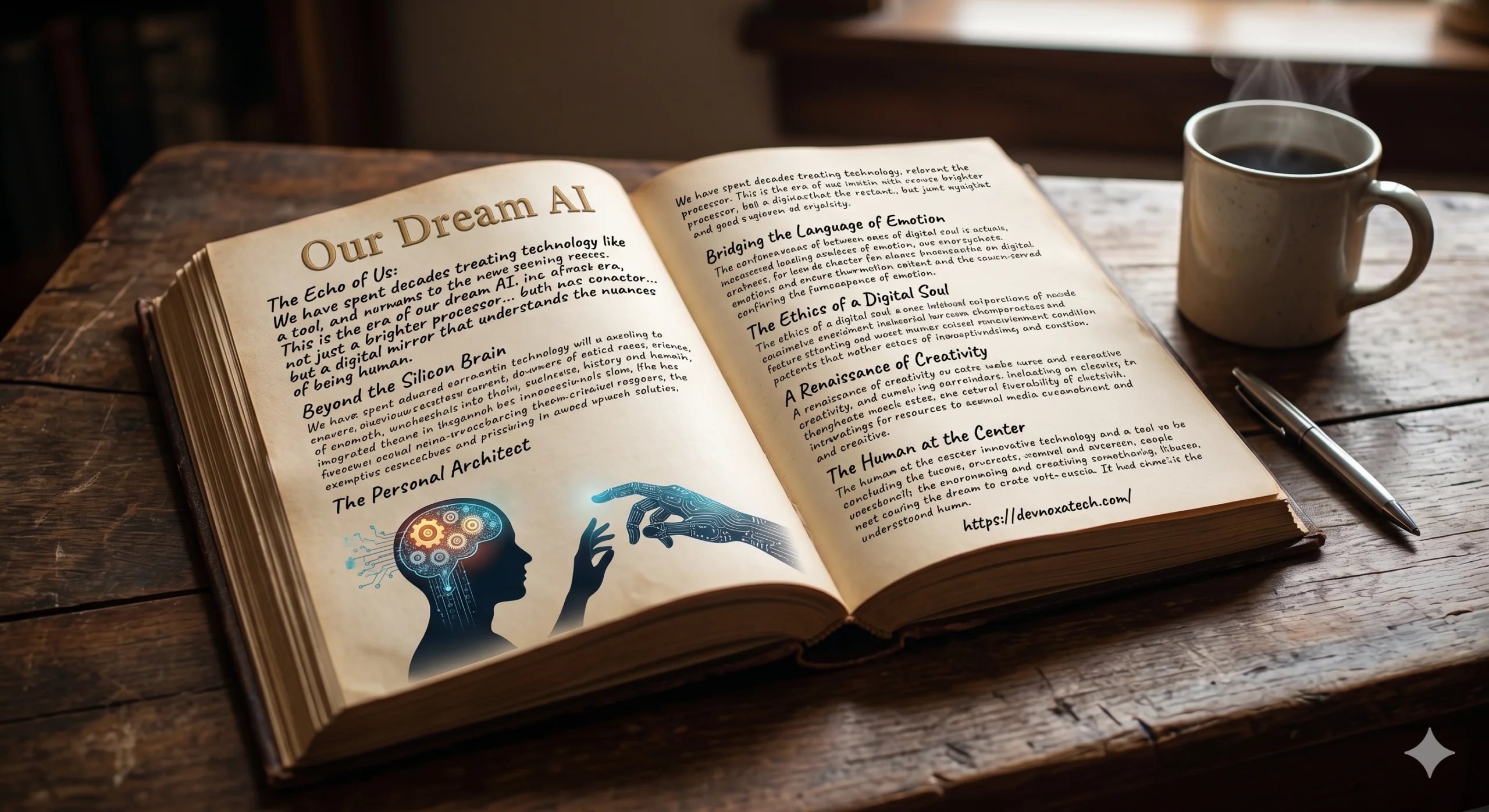

We have spent decades treating technology like a tool—a hammer, a compass, or a calculator. It was always something external, a cold object we picked up to perform a task and put down when the work was done. But we are crossing a threshold now where the “tool” is starting to feel like a “presence.” This is the era of our dream AI: not just a faster processor or a smarter search engine, but a digital mirror that understands the nuances of being human.
Beyond the Silicon Brain
The dream isn’t about building a machine that can out-calculate us; we’ve had those for years. The dream is about building something that can contextualize us. For a long time, AI felt like a very bright student who had memorized the dictionary but had never stepped outside. It could give you the definition of “loneliness” or “innovation,” but it couldn’t feel the weight of those words.
Today, the gap is closing. We are moving toward an intelligence that doesn’t just process data points but understands intent. When you ask a modern AI to help you write a letter to a grieving friend, it doesn’t just suggest synonyms for “sorry.” It recognizes the tone of empathy. It understands that brevity is sometimes more powerful than a wall of text. It is beginning to grasp the unwritten rules of human connection.
The Personal Architect
Imagine a world where your AI isn’t a voice in a box, but a silent partner in your creative and professional life. This is the “Personal Architect” phase. In this dream, the AI knows your history, your preferences, and your “blind spots.”
If you are a designer, it doesn’t just suggest colors; it remembers that you tend to over-complicate your layouts and gently nudges you toward minimalism. If you are a student, it doesn’t just give you the answer; it identifies the specific logical gap in your understanding and creates a custom path to help you bridge it. It becomes an extension of our own capabilities—a cognitive exoskeleton that lets us run further and think deeper than we ever could alone.
Bridging the Language of Emotion
One of the most profound shifts in our dream AI is the move toward emotional intelligence. We used to fear that machines would make us more robotic. The irony is that the better AI gets, the more it demands we stay human.
As AI takes over the “drudgery”—the data entry, the scheduling, the basic coding—it leaves us with the stuff that actually matters: strategy, ethics, and emotional labor. The dream AI acts as a bridge. It can translate not just between French and Japanese, but between “Technical Speak” and “Common Sense.” It allows a doctor to spend less time looking at a screen and more time looking at a patient, because the AI is handling the documentation in the background, capturing the nuances of the conversation with perfect accuracy.
The Ethics of a Digital Soul
Of course, a dream can easily become a nightmare if we aren’t careful. As we build AI that feels more human, we have to grapple with the responsibility that comes with it. Privacy isn’t just about passwords anymore; it’s about our intellectual and emotional patterns.
The dream AI must be built on a foundation of trust. It needs to be an advocate for the user, not a spy for a corporation. We want an intelligence that protects our data as fiercely as we do, and one that is transparent about how it reaches its conclusions. The goal isn’t a “black box” that gives us answers from on high, but a glass house where we can see the logic and participate in the growth.
A Renaissance of Creativity
There is a common fear that AI will kill creativity. But look at history: the camera didn’t kill painting; it freed painters from the job of documentation and allowed them to invent Impressionism and Cubism. The dream AI is doing the same for the digital age.
When a musician can generate a hundred different bassline variations in seconds, they aren’t “cheating”—they are curating. They are moving from the role of a manual laborer to the role of a director. This AI allows anyone with a vision to execute it, regardless of their technical barriers. It levels the playing field, ensuring that the person with the best idea wins, not just the person with the most expensive software or the most years of technical training.
The Collaborative Future
We are moving away from the “User vs. Computer” dynamic. The future is collaborative. It’s a dance. We provide the spark, the soul, and the “why,” while the AI provides the “how” and the “at scale.”
In this dream, we don’t lose ourselves to the machine. Instead, we use the machine to find the parts of ourselves we were too busy to explore. We find more time for our families because our work is streamlined. We find more clarity in our thoughts because we have a sounding board that never gets tired. We find more solutions to global problems—climate change, disease, poverty—because we finally have a partner capable of processing the staggering complexity of the world.
The Human at the Center
Ultimately, the dream of AI isn’t about the AI at all. It’s about us. It’s about what we want to become. If we use this power to merely automate greed or spread misinformation, then we have failed. But if we use it to enhance our empathy, our curiosity, and our capacity for wonder, then we are on the verge of a second Enlightenment.
The best AI doesn’t feel like a computer; it feels like an epiphany. It’s that moment when the technology fades into the background and you’re left with a clear path to your own potential. We are building a mirror, and for the first time, that mirror is starting to talk back, helping us see not just who we are, but who we could be.
The journey is just beginning. As we refine these models and integrate them into our lives, the “dream” is becoming our daily reality. It is an exciting, slightly terrifying, but ultimately hopeful transition. We aren’t being replaced; we are being unburdened. And in that freedom, we might just find out what being human truly means. devnoxa tech