
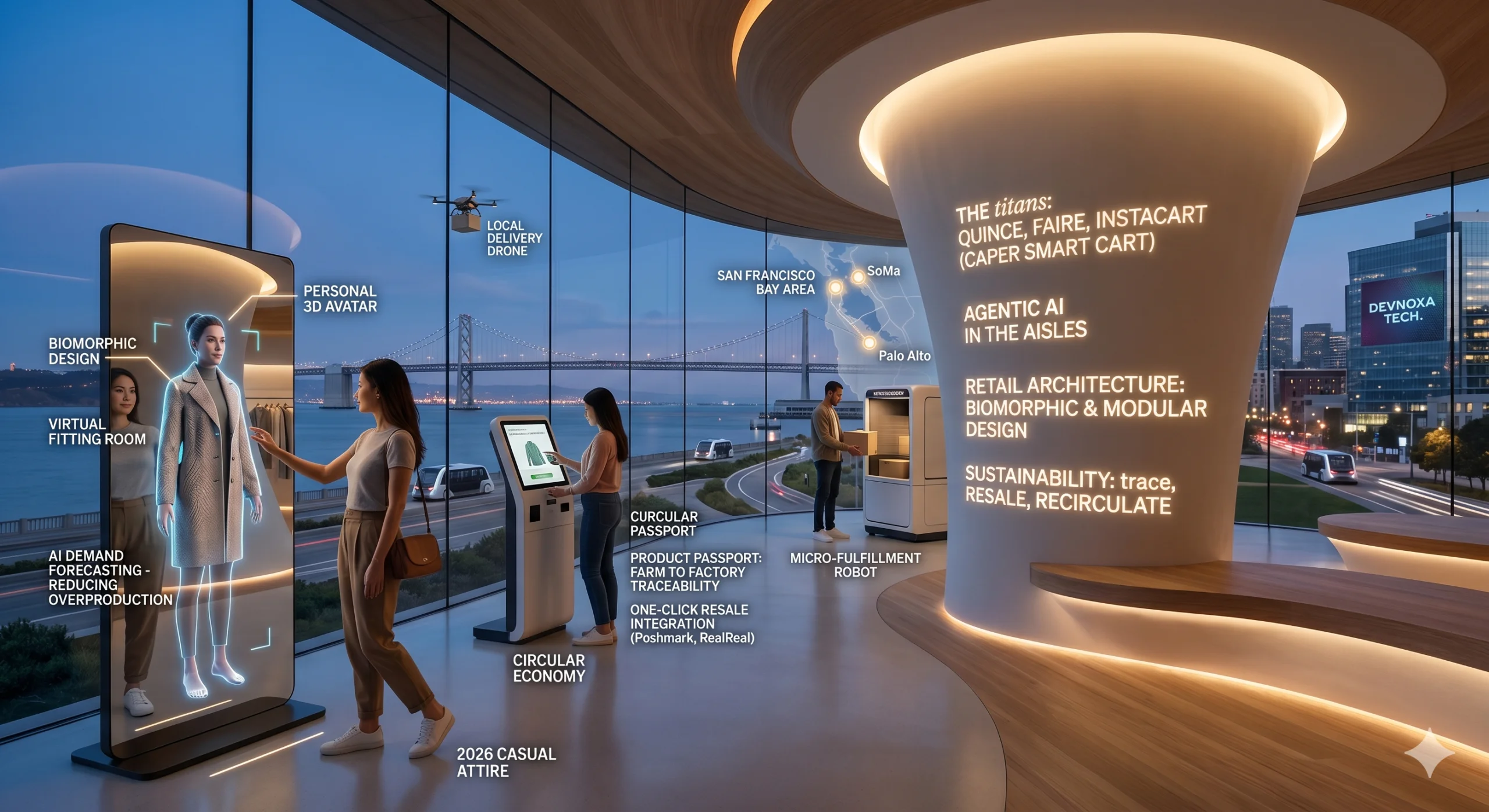

In 2026, a “retail tech company” in the Bay isn’t just a place that sells clothes online; it is a software powerhouse that uses predictive modeling to manufacture goods before a customer even clicks “buy.” From the high rises of San Francisco’s SoMa district to the sprawling campuses of Silicon Valley, these companies are redefining what it means to go shopping.
The Titans of the New Retail Era
When we look at the leaders in the Bay Area retail tech space today, we see a shift away from traditional “Big Box” mentalities toward agile, data driven platforms.
1. Quince: The Direct to Consumer Disrupted
Based in San Francisco, Quince has become the poster child for “affordable luxury” in 2026. By contracting directly with factories and utilizing sophisticated AI to forecast demand, they have eliminated the traditional “middleman” markups that defined the fashion industry for decades. Their recent $500 million Series E funding round, which valued the company at over $10 billion, proves that the market has immense faith in their “Manufacturer to Consumer” (M2C) model.
2. Faire: Empowering the Local Shop
While giants like Amazon dominate the mass market, Faire has carved out a massive niche by focusing on independent retailers. Their wholesale marketplace uses machine learning to match local shop owners with unique brands that fit their specific neighborhood’s aesthetic. By removing the inventory risk for small business owners, Faire is ensuring that the “future of retail is local,” even in a hyper digital age.
3. Instacart and the Logistics of Immediacy
Now a mature veteran of the Bay Area tech scene, Instacart has evolved into a retail infrastructure company. Beyond just delivering groceries, they provide the “Caper” smart carts and AI driven inventory management systems that power physical stores across the country. They are the invisible digital layer that makes old school grocery stores feel like futuristic warehouses.
The AI Revolution in the Aisles
In 2026, the “buzz” in Bay Area retail is almost entirely centered on Agentic AI. This goes beyond simple chatbots; we are seeing the rise of AI agents that act as personal shoppers, supply chain navigators, and even creative directors.
- Demand Forecasting: Companies are using AI to analyze social media sentiment on platforms like Reddit and TikTok to predict the next viral fashion trend. This allows retailers to adjust their production schedules in real time, drastically reducing the environmental impact of overproduction.
- Virtual Fitting Rooms: The “fit problem” has been the bane of online retail for twenty years. Bay Area startups are finally solving this using high fidelity spatial computing and personal 3D avatars. In 2026, you can “try on” a coat in a digital mirror that accurately simulates how the fabric drapes over your specific body type.
- Hyper Personalization: Retail tech firms are moving away from generic newsletters. Today, AI agents curate individual “storefronts” for every user, showing products that align with their past purchases, current climate, and even upcoming calendar events.
The Transformation of Physical Space
Despite the growth of online shopping, physical retail in the Bay Area is having a massive “re imagining” in 2026. Tech companies are helping retailers downsize their physical footprints while increasing their “experience” value.
Biomorphic and Modular Design
The clinical, stark aesthetics of the past are gone. Today’s retail spaces in San Francisco and Palo Alto use biomorphic design natural shapes and flowing lines to create comfortable, high end environments. Technology is hidden behind the scenes; instead of intrusive LED screens, stores use Smart Surfaces and fabric displays that are easier to update and more pleasant for the customer to interact with.
The Rise of Micro Fulfillment
Retailers are repurposing parts of their stores into micro fulfillment centers. By using robotics and local delivery drones, a store in the Mission District can act as a hub that delivers an online order to a nearby customer in under thirty minutes. This “omnichannel” approach is what allows Bay Area retailers to compete with the speed of global giants while maintaining a local presence.
Sustainability as a Core Metric
In 2026, “Green Retail” is no longer an optional marketing slogan; it is a technical requirement. Bay Area startups are at the forefront of Circular Economy tech.
- Traceability: Using blockchain and IoT sensors, companies now provide “Product Passports” that show a customer the entire lifecycle of a garment from the farm where the cotton was grown to the factory where it was sewn.
- Resale Integration: Platforms like Poshmark (Redwood City) and The RealReal (San Francisco) have integrated so deeply with primary retailers that you can often “one click” list an item for resale directly from your original purchase history. This keeps high quality goods in the economy longer and reduces the pressure on landfills.
Why the Bay Area Still Holds the Crown
While tech hubs have emerged in Austin, New York, and Miami, the San Francisco Bay Area remains the “brain” of retail innovation. The proximity to venture capital, the density of AI talent, and a culture that is comfortable with “vibecoding” and rapid prototyping create a perfect storm for disruption.
A retail tech company founded here doesn’t just look at how to sell a product; they look at how to rebuild the entire architecture of consumption. They are asking: How can we make shopping faster, more sustainable, and more human?
The Road Ahead: 2026 and Beyond
As we look toward the end of the decade, the line between “tech” and “retail” will likely disappear entirely. Every successful merchant will be a tech company at its core, and every tech giant will have a hand in the physical movement of goods. The Bay Area is the place where this merger is being designed, tested, and shipped to the rest of the world.
For those looking to build their own digital presence or seeking a partner to navigate the high stakes world of modern development and retail transformation, the journey begins with understanding the framework of the future. devnoxa tech