
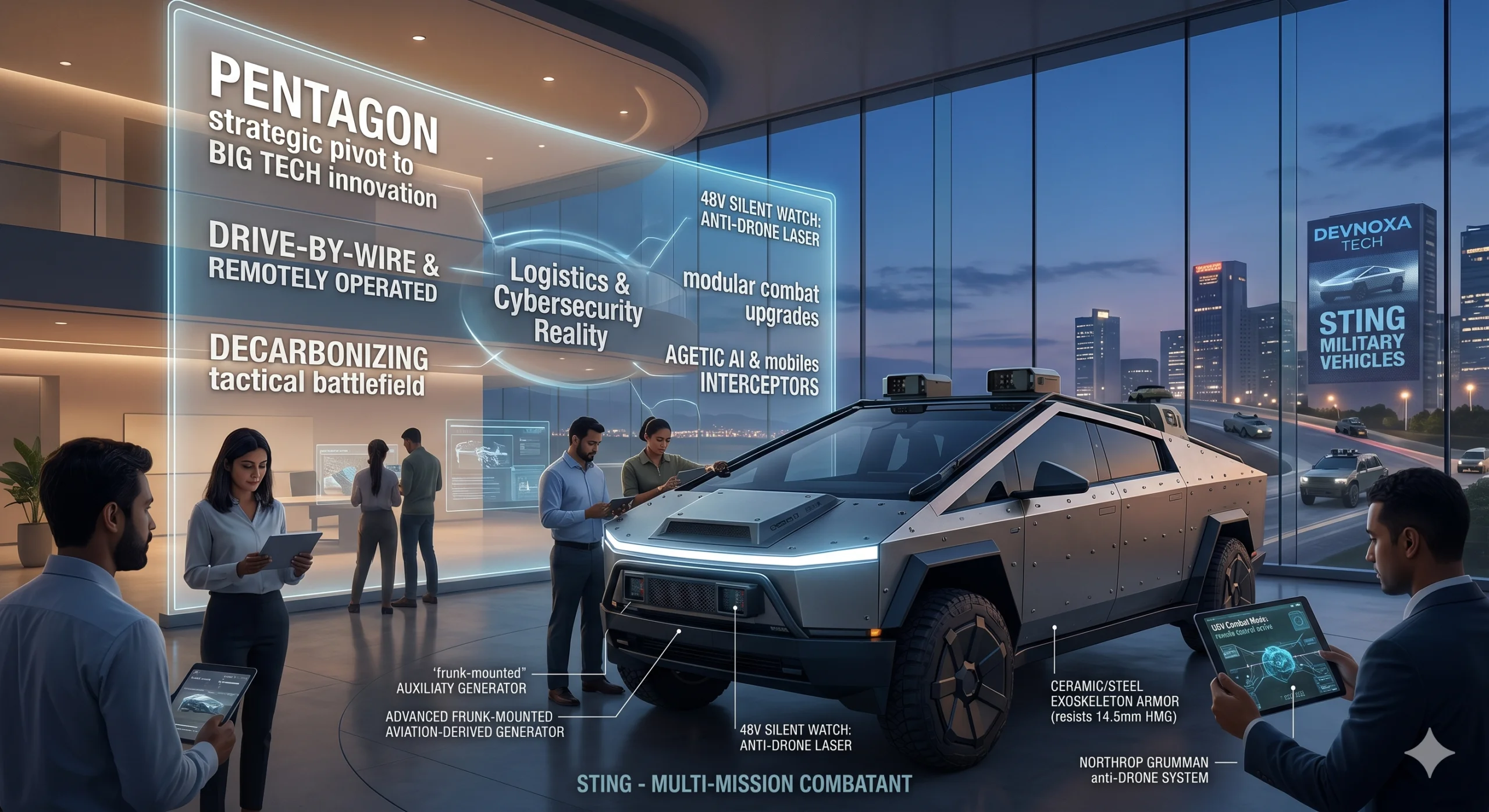

In 2026, the intersection of Pentagon defense strategy and Big Tech Tesla Cybertruck innovation has produced one of the most visually striking and controversial developments in modern warfare: the militarization of the What started as a polarizing consumer pickup has officially crossed the threshold into the defense sector, serving as a high-tech testbed for the future of the tactical battlefield.The relationship between Silicon Valley and the Department of Defense has shifted from simple software contracts to the deployment of physical, autonomous, and electric hardware. As the military seeks to decarbonize its fleet and leverage “Agentic AI,” the Cybertruck has moved from the driveway to the proving ground, representing a new era of “Silent Watch” and remote-operated combat.
The Pentagon’s Strategic Pivot to Silicon Valley
The Pentagon’s interest in Tesla is part of a much larger 2026 initiative to integrate “dual-use” technology—commercial products that can be rapidly adapted for military use. By working with firms like Tesla, the Department of Defense is attempting to bypass the slow, traditional procurement cycles of legacy defense contractors.
In 2025 and early 2026, the U.S. Air Force and Army confirmed that they had acquired Cybertrucks for specific training and testing scenarios. While some of these vehicles were destined for “live-fire” targets to test how futuristic, angular exoskeletons hold up against modern munitions, others were designated as experimental platforms for autonomous reconnaissance.
Why the Military Wants the Cybertruck
- Silent Watch and Stealth: The electric powertrain allows for “Silent Watch” capability, where the vehicle can run advanced sensors and communications for hours without the acoustic or thermal signature of an idling diesel engine.
- 48V Architecture: The Cybertruck’s modern 48-volt electrical system is far more efficient for powering high-energy military equipment, such as anti-drone lasers or advanced jamming arrays.
- Exoskeleton Durability: The cold-rolled stainless steel body provides a level of native protection against small arms and shrapnel that traditional unarmored commercial trucks cannot match.
From Civilian Pickup to “STING” APC
While Tesla produces the base vehicle, the true transformation happens through specialized defense contractors. In 2026, firms like Archimedes Defense and Unplugged Performance have introduced the STING series—a range of modular upgrades that turn the Cybertruck into a legitimate armored personnel carrier (APC).
These “bolt-on” armor packages are designed to withstand 7.62mm assault rifle rounds, with the most advanced versions featuring ceramic plating capable of resisting 14.5mm heavy machine gun fire. Perhaps the most critical military modification is the “frunk-mounted” aviation-derived generator. This allows the truck to recharge its own batteries using jet fuel or diesel in remote areas where EV charging infrastructure is non-existent.
The Rise of the Unmanned Ground Vehicle (UGV)
The most profound “Tech Tale” of the Cybertruck in 2026 is its potential as a remotely operated combatant. Because the Cybertruck is “drive-by-wire” and highly connected, it is easier to convert into a massive, unmanned ground vehicle than almost any other truck on the market.
Military planners are currently testing Cybertrucks equipped with Northrop Grumman anti-drone systems. By removing the human crew and operating the vehicle via satellite or mesh networks, the Pentagon can deploy these “mobile interceptors” into high-risk zones without putting soldiers in harm’s way. This aligns with the 2026 “Defense Tech Roadmap,” which prioritizes autonomy and edge-computing as the primary frontiers of national security.
Counter-Drone Applications
In modern conflict zones like Ukraine, drones have made traditional armored movements difficult. A fleet of autonomous, low-heat-signature Cybertrucks equipped with chain guns and mid-air detonation sensors could potentially clear the skies for ground troops, acting as a high-speed, cost-effective alternative to purpose-built military robots.
Challenges: Cybersecurity and Logistic Realities
Despite the hype, the integration of Big Tech into the Pentagon’s motor pool is not without its “bugs.” The very connectivity that makes the Cybertruck an asset also makes it a target for cybersecurity threats. A vehicle that can be updated “over the air” is a vehicle that could, theoretically, be hijacked by an adversary with enough digital sophistication.
Furthermore, the logistical burden of maintaining high-tech EVs in a “mud and blood” environment is still being debated. While electric motors have fewer moving parts, repairing a sophisticated 800V battery system in a field workshop is significantly more complex than fixing a traditional combustion engine.
The Blurred Line Between Civilian and Combat
The Cybertruck’s presence in military testing signals a permanent change in the American approach to national security. The demarcation between civilian technology and military application is becoming increasingly blurred. For investors and tech experts, this “Pentagon-Tesla” narrative is a clear indicator that the next generation of defense will not be built solely by the “Old Guard” of contractors, but by the same companies that build our laptops and family cars.
As we move toward 2030, the “Renaissance” of purposeful engineering will likely see even more “Silicon Valley” DNA in our defense systems. The Cybertruck is just the beginning—a stainless steel symbol of a military that is trading its heavy armor for high-speed data and silent, electric power.
For those looking to build their own technical foundations or seeking a partner to navigate the high-stakes world of digital growth and defense-tech innovation, the journey begins with understanding the framework of the future. devnoxa tech
Follow-up Question: Are you more interested in the technical specs of the armored “STING” packages, or the broader geopolitical implications of Big Tech’s growing role in Department of Defense contracts?