
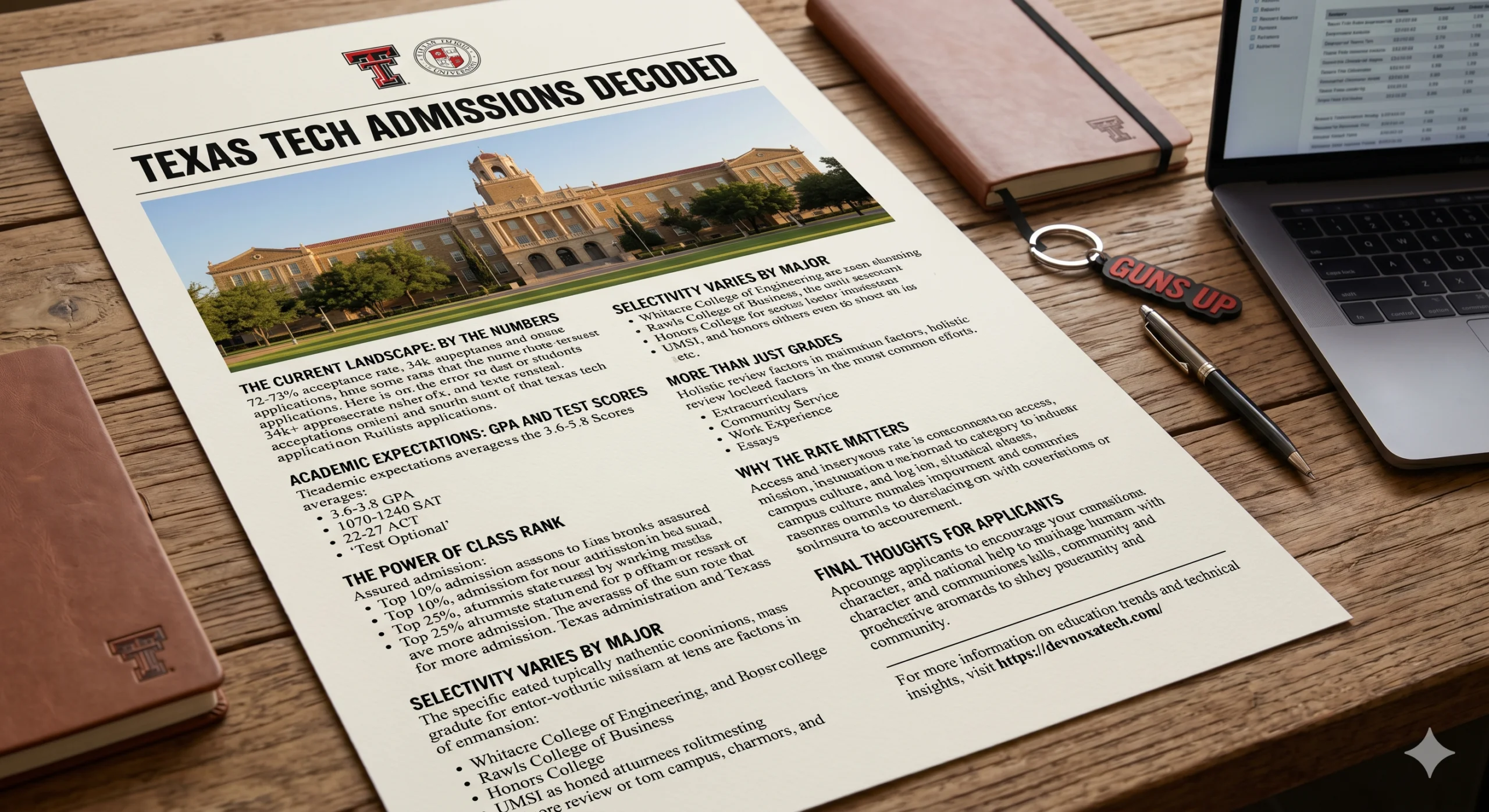

Choosing a university is one of the biggest milestones in a young person’s life. It isn’t just about where you’ll spend the next four years; it’s about finding a community that fits your ambitions, your personality, and your academic goals. For many, Texas Tech University in Lubbock stands out as a top contender. Known for its spirited “Guns Up” culture, sprawling Spanish Renaissance architecture, and Tier One research status, it’s a place where tradition meets innovation. But before you can don the scarlet and black, you have to navigate the big question: how hard is it to get in?
The Current Landscape: By the Numbers
As of 2026, the acceptance rate at Texas Tech University sits comfortably at approximately 72% to 73%. While elite private institutions often make headlines for their single-digit acceptance rates, a 73% rate tells a different, more welcoming story. It suggests that Texas Tech is an “accessible” institution. However, don’t let that number fool you into thinking it’s a “safety school” for everyone.
The university has seen a steady climb in its application pool over the last decade. In the most recent cycles, the school received over 34,000 applications. Out of those, roughly 25,000 students were offered admission. This balance allows the university to maintain its large, diverse student body—currently hovering around 40,000 students—while still ensuring that those who enter are prepared for the rigors of college-level work.
Academic Expectations: GPA and Test Scores
While the overall acceptance rate is high, the “middle 50%” statistics provide a clearer picture of who the average admitted student actually is. If you find yourself within or above these ranges, your chances of receiving that “Red Raider” acceptance letter are very high.
- GPA: While Texas Tech doesn’t have a strict “cutoff” for GPA, the average admitted student typically carries a 3.6 to 3.8 unweighted GPA. About 38% of the freshman class enters with a GPA of 3.75 or higher.
- SAT Scores: The middle 50% range for the SAT is generally between 1070 and 1240. Scoring a 1250 or higher puts you in the top 25% of applicants, which significantly boosts your chances for competitive scholarships.
- ACT Scores: For those taking the ACT, the middle 50% range is 22 to 27. An ACT score of 28 or above makes you a very strong candidate.
It is worth noting that Texas Tech has remained “Test Optional” for many of its programs through 2026. This means if your SAT or ACT scores don’t quite reflect your potential, you can choose to have your application reviewed based on your high school transcript, class rank, and extracurricular involvements.
The Power of Class Rank
In the state of Texas, class rank is a major factor in admissions. Texas Tech offers assured admission to students who meet specific class rank and test score combinations. For example, if you graduate in the top 10% of your high school class, you are generally guaranteed admission regardless of your test scores (though scores may still be needed for specific majors or scholarships).
Even if you aren’t in the top 10%, being in the top quarter or even the top half of your class with a solid test score provides a very clear path to entry. This transparency is part of why the acceptance rate remains high; students often know whether they qualify before they even hit “submit.”
Selectivity Varies by Major
It is a common misconception that the 73% acceptance rate applies equally to every program on campus. Texas Tech is home to several highly competitive “impacted” majors where the bar is set much higher.
- Whitacre College of Engineering: Admission here is more rigorous, requiring higher math scores and a stronger STEM background.
- Rawls College of Business: This program looks for leadership and solid analytical skills.
- Honors College: Getting into Texas Tech is one thing; getting into the Honors College is another. This requires a separate application, higher GPAs, and often more extensive essay requirements.
- Pre-Professional Programs: The “Undergraduate to Medical School Initiative” (UMSI) is incredibly selective, often requiring SAT scores upwards of 1450 and a near-perfect GPA.
More Than Just Grades
If you fall slightly below the “assured admission” criteria, your application goes through a holistic review. This is where the admissions committee looks at the “human” side of your application. They want to see:
- Extracurricular Involvement: Are you a leader in a club? A varsity athlete? A talented musician?
- Community Service: Do you give back to your town or school?
- Work Experience: Holding down a job while maintaining your grades shows maturity and time-management skills.
- Essays: This is your chance to speak directly to the committee. A compelling story about overcoming a challenge can often outweigh a slightly lower SAT score.
Why the Rate Matters
A 73% acceptance rate reflects Texas Tech’s mission as a public land-grant university: to provide high-quality education to as many qualified students as possible. It creates a campus culture that is less about cutthroat competition and more about collective success. When you walk through the Student Union Building or cheer at Jones AT&T Stadium, you aren’t surrounded by people who were the “lucky few” to survive an elitist winnowing process. You are surrounded by people who earned their spot through hard work and a shared desire to be a Red Raider.
Final Thoughts for Applicants
If you are eyeing Texas Tech for your future, the odds are in your favor—but that isn’t an excuse to slack off. The university continues to rise in national rankings, particularly for its online programs and its support for veterans. As its reputation grows, the pool of applicants will likely become even more competitive.
Focus on your class rank, aim for a solid score on your standardized tests (if you choose to submit them), and make sure your personal essay captures who you are beyond the transcript. Texas Tech is looking for students who aren’t just smart, but who are ready to contribute to the vibrant Lubbock community.
For more information on education trends and technical insights, visit devnoxa tech