
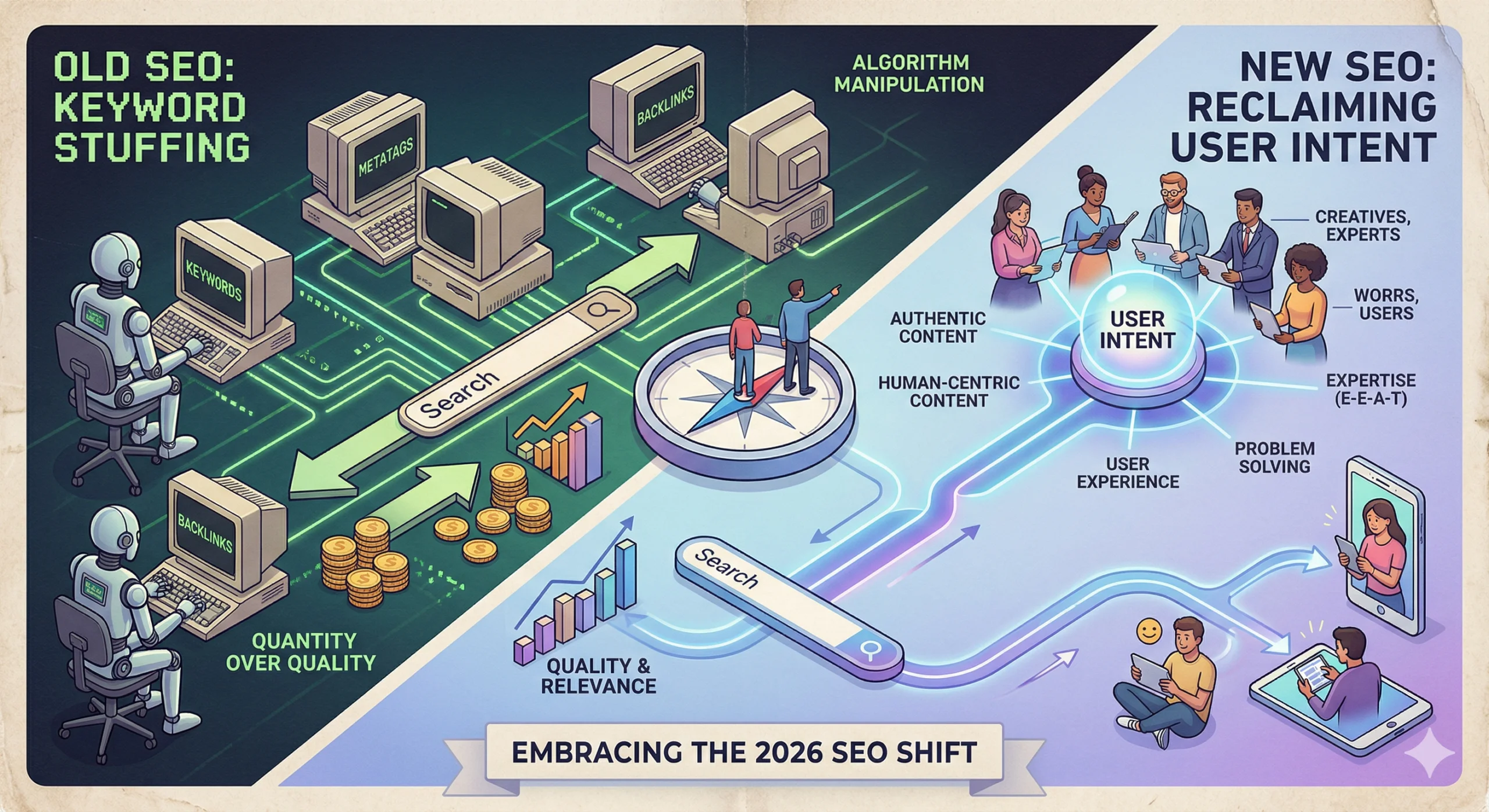

For years, the world of Search Engine Optimization (SEO) felt like a game of cat and mouse between creators and algorithms. We spent our time obsessing over keyword density, exact-match anchor text, and trying to “decipher” the latest Google updates. But as we move deeper into 2026, the landscape has fundamentally changed. The era of tricking a search engine is dead; the era of Total User Satisfaction has arrived.
If you are looking at your analytics right now and wondering why traditional strategies aren’t hitting the same way they did two years ago, it’s because the “Search” in SEO has evolved into “Answers.”
The Death of the “Keyword” (As We Knew It)
In the past, if you wanted to rank for “best cloud hosting,” you’d make sure that exact phrase appeared in your H1, your first paragraph, and your meta description. In 2026, search engines are far more sophisticated. With the full integration of advanced Large Language Models (LLMs) into search results, Google doesn’t just look for your words; it looks for your meaning.
Today, an article can rank for a specific query without ever actually mentioning the keyword itself. Why? Because the search engine understands the context of your content. This shift means that “White Hat” SEO isn’t just a suggestion anymore—it’s a requirement for survival. Creating thin, keyword-stuffed content is the fastest way to get ghosted by search crawlers. Instead, the focus has shifted toward E-E-A-T (Experience, Expertise, Authoritativeness, and Trustworthiness) with a heavy emphasis on that first “E”—Experience.
Experience: The New King of Content
With AI now capable of generating “factual” articles in seconds, search engines have doubled down on rewarding content that provides unique, human perspectives. Readers (and algorithms) are looking for:
- Original Research: Data or insights that can’t be found elsewhere.
- Personal Anecdotes: “How I solved this specific technical bug” rather than “How to solve bugs.”
- Case Studies: Real-world examples of projects that succeeded or failed.
This is where many tech sites struggle. It is easy to rewrite a manual; it is hard to document a year of hands-on experimentation. In 2026, the sites that win are the ones that act as a bridge between complex technology and human implementation.
The Rise of Programmatic SEO and “Parasite” Caution
While the goal is high-quality content, the way we build sites is also changing. Programmatic SEO has become a powerful tool for scaling. By using data to generate thousands of high-quality, intent-specific pages (like “Top Tech Services in [City Name]”), creators can capture long-tail traffic that was previously too time-consuming to target manually.
However, 2026 has also brought a crackdown on “Parasite SEO”—the practice of posting low-quality content on high-authority third-party sites to “piggyback” on their ranking. Google’s latest core updates have made it clear: if the content doesn’t belong on the host site or adds no value to the reader, it will be de-indexed. This serves as a reminder that building your own “digital house” on your own domain is always the safer, more sustainable long-term play.
The Technical Backbone: Speed and Semantic Internal Linking
Even the best article will fail if the technical foundation is shaky. In 2026, Core Web Vitals are no longer a “bonus”—they are the baseline. If your site doesn’t load instantly on a mobile device, your bounce rate will skyrocket before the user even reads your first sentence.
Furthermore, how you link your content matters more than ever. We’ve moved away from simple “click here” links. Semantic Internal Linking involves connecting related topics in a way that helps the search engine map out your site’s expertise. If you write about AI integration, your internal links should naturally lead to articles about API management or data security, creating a “cluster” of authority that tells the algorithm you are a master of that niche.
The Future of “Search” is Conversational
We must also acknowledge that many users aren’t even visiting websites anymore; they are getting answers directly from AI Overviews. To stay relevant, your site needs to be the source of those answers. This means formatting your data clearly, using proper Schema markup, and answering the “Who, What, Why, and How” of your topic in the very first few paragraphs.
The goal for the rest of 2026 shouldn’t be to get the most clicks, but to be the most helpful. When you provide genuine value, the traffic, the authority, and the rankings follow naturally.
Master Your Tech Strategy
In an ever-changing digital world, staying ahead of the curve is the difference between growth and obsolescence. Whether you are scaling a new project or optimizing an established platform, the principles of quality and transparency remain the ultimate “growth hack.”
For more technical insights and deep dives into the future of tech, visit: devnoxatech.com