
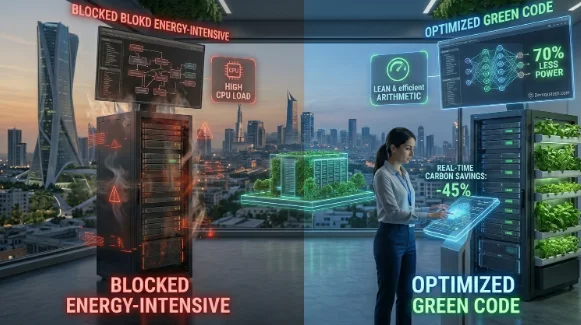

For decades, the software development world adhered to a single, relentless mantra: “Speed at all costs.” Developers were rewarded for how quickly they could ship features, often at the expense of messy code and bloated architectures. But as we move through 2026, the cost of that bloat has become impossible to ignore. The tech industry is facing a reckoning due to skyrocketing energy prices and new global carbon regulations.
The solution? Green Coding. At Devnoxatech, we are seeing a fundamental shift in how enterprise clients evaluate software. It is no longer enough for an application to be fast and functional; it must also be sustainable. Green Code isn’t just about “saving the planet”—it’s about building lean, high-efficiency software that slashes operational costs and delivers a superior user experience.
What is Green Code?
Green Code (or Sustainable Software Engineering) is the practice of designing, writing, and deploying software that minimizes energy consumption. In 2026, data centers are estimated to consume a significant portion of the world’s electricity. Every inefficient loop, every redundant database query, and every unoptimized image in your application contributes to that massive energy footprint.
Green coding turns “software efficiency” into a science. It involves:
- Algorithmic Efficiency: Choosing the math that requires the fewest CPU cycles.
- Data Minimization: Only transferring and storing the data that is absolutely necessary.
- Resource Awareness: Designing software that “knows” when to go into low-power modes.
The Business Case for Sustainability
Many executives initially view “green tech” as a charitable initiative or a marketing buzzword. However, at Devnoxatech, we demonstrate to our partners that Green Code is actually a massive strategic advantage.
1. Drastic Reduction in Cloud Costs (GreenOps)
In the 2026 cloud-native world, you pay for what you use. Inefficient code that hogs CPU and memory doesn’t just hurt the environment—it inflates your monthly AWS or Azure bill. By optimizing your code for sustainability, you are effectively performing FinOps. We have seen clients reduce their cloud overhead by up to 30% simply by refactoring legacy code into more “green” microservices.
2. Enhanced Performance and UX
There is a direct correlation between “green” code and “fast” code. Lean applications load faster, respond quicker, and consume less battery on mobile devices. In an era where a one-second delay in page load can cost millions in lost conversions, green coding is the ultimate tool for performance optimization.
3. Regulatory Compliance and ESG Reporting
By 2026, “carbon reporting” will have become a standard requirement for public companies and their vendors. Software is no longer exempt. Implementing Green Code allows your business to include measurable digital carbon reductions in your ESG (Environmental, Social, and Governance) reports, making you a more attractive partner for global enterprises.
How Devnoxatech Implements Green Engineering
Transitioning to a sustainable tech stack requires more than just a “green” mindset; it requires a specialized engineering approach.
The “Green” Tech Stack
Not all programming languages are created equal. In 2026, we are seeing a resurgence in high-performance, energy-efficient languages like Rust and Go for backend services. These languages offer the safety of modern tools but with the raw efficiency that traditional, “heavier” frameworks lack.
Serverless and Event-Driven Architecture
The most “green” server is the one that isn’t running. We help our clients migrate toward serverless architectures, where resources are only consumed during the exact millisecond a function is executed. This eliminates “idle waste”—the thousands of hours of server time spent waiting for a request that never comes.
AI-Driven Optimization
We leverage AI tools to audit our clients’ codebases for “energy leaks.” These tools can identify redundant processes or inefficient data structures that a human eye might miss, automatically suggesting “greener” alternatives that maintain the same functionality with half the power draw.
Conclusion: Engineering a Cleaner Digital Future
The era of “infinite resources” is over. In 2026, the most successful digital products will be those that respect the constraints of our physical world. By embracing Green Code, you aren’t just checking a box for corporate responsibility; you are future-proofing your business against rising costs and evolving regulations.
At Devnoxatech, we don’t believe you should have to choose between innovation and sustainability. Our mission is to prove that the cleanest code is also the most powerful code.
Is your software architecture negatively impacting your profitability and brand reputation? Let’s build a leaner, greener, and faster future together.
Ready to Optimize Your Digital Carbon Footprint?
Discover how our sustainable software solutions can drive your business forward.
Visit us at https://devnoxatech.com.