

For the last decade, the “cloud” has been the undisputed king of the tech world. We were told that the answer to every business problem was to move it to a centralized data center. And for a long time, that worked. With the explosion of IoT devices, autonomous systems, and real-time AI requirements, the “round-trip” journey data takes to the cloud and back is becoming a costly bottleneck.
This is where edge computing steps in—not as a replacement for the cloud, but as its essential partner. At DevoxaTech, we assist our clients in transitioning from centralized models to decentralized, “edge-first” architectures to maintain their competitive edge.
What Exactly is Edge Computing in 2026?
In simple terms, edge computing is the practice of processing data near the “edge” of the network—where the data is actually being generated—instead of in a warehouse-sized data center thousands of miles away.
Think of it like a global pizza chain. If every single order in the world had to be processed by one giant kitchen in Italy and then shipped out, the pizza would arrive cold, soggy, and hours late. Instead, the chain has local kitchens in every neighborhood. The “Edge” is that local kitchen. It processes the order immediately, ensuring a fast, fresh result. In the digital world, the “kitchen” is a local server, a router, or even the device in your hand.
The Death of Latency
In the world of software development, latency is the enemy of user experience. A delay of even half a second can cause a user to abandon a mobile app or, more seriously, lead to a malfunction in an automated factory line.
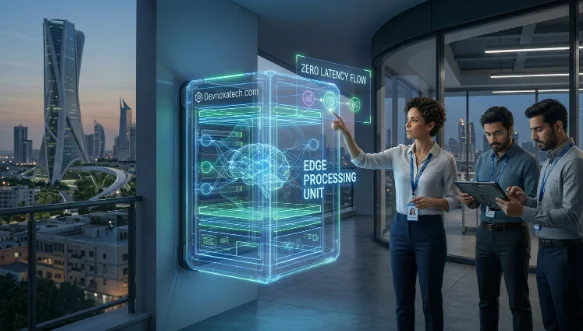
In 2026, we are seeing the rise of “instant-action” applications. Whether it’s a remote surgery robot or a self-driving delivery van, these technologies cannot wait for a 200ms ping to a server in Virginia. By implementing Edge solutions, we allow these devices to make split-second decisions locally. The next generation of tech is building upon this “Zero Latency” environment.
Why Your Business Needs an Edge Strategy Now
1. Bandwidth Optimization and Cost Reduction
Sending massive amounts of raw data to the cloud is expensive. If you have 5,000 smart cameras in a facility, uploading 4K video 24/7 will destroy your IT budget. Edge computing allows the device to analyze the video locally and only upload the relevant bits (e.g., “Person detected at Gate 4 at 3:00 AM”). This drastically reduces the data load on your network and slashes your cloud storage bills.
2. Enhanced Privacy and Security
In 2026, data sovereignty is a legal minefield. Many industries are now required to keep sensitive data within specific geographic borders or even within the physical walls of their building. Edge computing keeps the most sensitive data at the source. If the data never leaves the “Edge,” it cannot be intercepted in transit across the public internet.
3. Reliability in Remote Locations
We’ve all experienced it: the internet goes down, and suddenly your “smart” office becomes a brick. Edge-enabled software continues to function even when the primary internet connection is severed. This is critical for industries like mining, maritime logistics, and agriculture, where constant high-speed connectivity isn’t always a guarantee.
The Role of AI at the Edge (TinyML)
One of the most exciting trends we are tackling at DevoxaTech is TinyML—the ability to run machine learning models on low-power microcontrollers.
In the past, you needed a massive GPU cluster to run an AI model. Today, we can deploy a pruned, highly efficient AI model directly onto a sensor. This allows for:
- Predictive Maintenance: A sensor on a factory motor can “hear” a vibration that indicates a failure is coming and shut down the machine before it breaks, saving millions in downtime.
- Smart Retail: Shelves that automatically track inventory levels in real-time and trigger restock orders without needing to ping a central database.
- Wearable Health: Devices that detect heart anomalies and alert emergency services instantly, even if the wearer’s smartphone is out of battery.
Overcoming the Implementation Hurdle
Transitioning to the Edge isn’t as simple as buying new hardware. It requires a fundamental shift in how your software is architected. Most legacy systems are “top-heavy,” designed to rely on a central brain for every decision.
At DevoxaTech, our development process for edge computing involves:
- Distributed Architecture Design: We break down your monolithic applications into microservices that can live happily on small, local nodes.
- Data Triage Systems: We build logic that determines what stays at the Edge for speed and what gets sent to the Cloud for long-term historical analysis.
- Security Hardening: Edge devices are often physically accessible, which means they need specialized “physical-to-digital” security protocols to prevent tampering.
The Hybrid Future: Cloud and Edge in Harmony
The future isn’t “Edge vs. Cloud”—it’s Hybrid. The cloud will always be the best place for heavy-duty data crunching, long-term storage, and training massive AI models. The Edge will be the place for action, immediate response, and user privacy.
In 2026 and beyond, the most successful companies will be those that bring their intelligence closest to the user. They will be faster, safer, and more cost-effective than their competitors, who are still waiting for the “pizza” to arrive from halfway across the world.
Conclusion: Don’t Get Left Behind
The shift toward decentralized computing is the most significant architectural change we’ve seen in a decade. It’s a complex transition, but the rewards—lower costs, better security, and unmatched speed—are too great to ignore.
At DevoxaTech, we not only write code but also construct the infrastructure that enables your business to operate at the forefront of innovation. Let’s stop discussing the cloud and start talking about what your business can do at the edge.
Ready to modernize your tech stack for 2026?
Visit us at https://devnoxatech.com.