

If you’ve spent any time in the tech space lately, you know the vibe has shifted. In 2024 and 2025, the conversation was dominated by pure, unadulterated “wow” factor—AI that could generate movies, code entire apps, and hold deep philosophical debates. But as we move through 2026, the industry is hitting a “reality check” moment. The shiny new toys are great, but the world is starting to ask a very difficult question: How do we power all of this?
The trending topic of the moment isn’t just “Artificial Intelligence”; it’s Sustainable AI. We are witnessing a massive transition where efficiency is finally becoming more prestigious than raw power.
The Problem: The Hidden Cost of a Prompt
For the past few years, the race to build the “smartest” model was essentially a race to see who could throw the most hardware at the problem. We built massive data centers that consume more electricity than small nations and require millions of gallons of water for cooling. As a tech-savvy society, we’ve realized that we can’t just keep scaling up indefinitely.
In 2026, the “brute force” era of AI is ending. We are moving away from massive, monolithic models and toward SLMs (Small Language Models) that are highly specialized. Instead of one giant brain that knows everything, we are seeing “micro-brains” designed to do one thing perfectly—like debugging code or diagnosing a medical image—using a fraction of the energy.
The Innovation: Hardware That Breathes
One of the most exciting developments this year is the shift in data center architecture. We’re no longer just sticking servers in cold rooms. We are seeing the rise of “Circular Data Centers.” These facilities are being built into urban heating grids, where the heat generated by AI processing is captured and piped directly into nearby homes and office buildings.
Furthermore, the chips themselves are changing. The move toward Neuromorphic Computing—chips that mimic the human brain’s incredibly efficient way of processing information—has finally hit the mainstream. These chips don’t just “calculate”; they react, using energy only when necessary, which is a massive leap over the “always-on” consumption of traditional GPUs.
The Human Side: Ethical and Sustainable Consumption
It’s not just about the big companies, though. As users, our behavior is changing too. In 2026, “Carbon-Aware Prompting” is becoming a thing. Just like we look at the calories on a menu or the fuel efficiency of a car, developers and consumers are starting to look at the “Inference Cost” of their AI tasks.
There is a growing respect for “lean” technology. A developer who can solve a problem with a lightweight, optimized script is now often more respected than one who simply plugs in a massive, energy-hungry API for a simple task. It’s a return to the craftsmanship of coding—making things fast, elegant, and efficient.
Why This Matters for You
This shift toward sustainability isn’t just about saving the planet; it’s about making technology accessible. If AI requires a billion-dollar power plant to run, it stays in the hands of the elite. But if we can make AI sustainable and lightweight, we can put that power into a smartphone in a remote village, helping a farmer analyze crop health without needing a high-speed fiber connection or a massive grid.
2026 is the year we stop asking “What can AI do?” and start asking “How can AI help us stay?” It’s a subtle shift, but it’s the most important one we’ve made in a decade.
The Vision of 2026
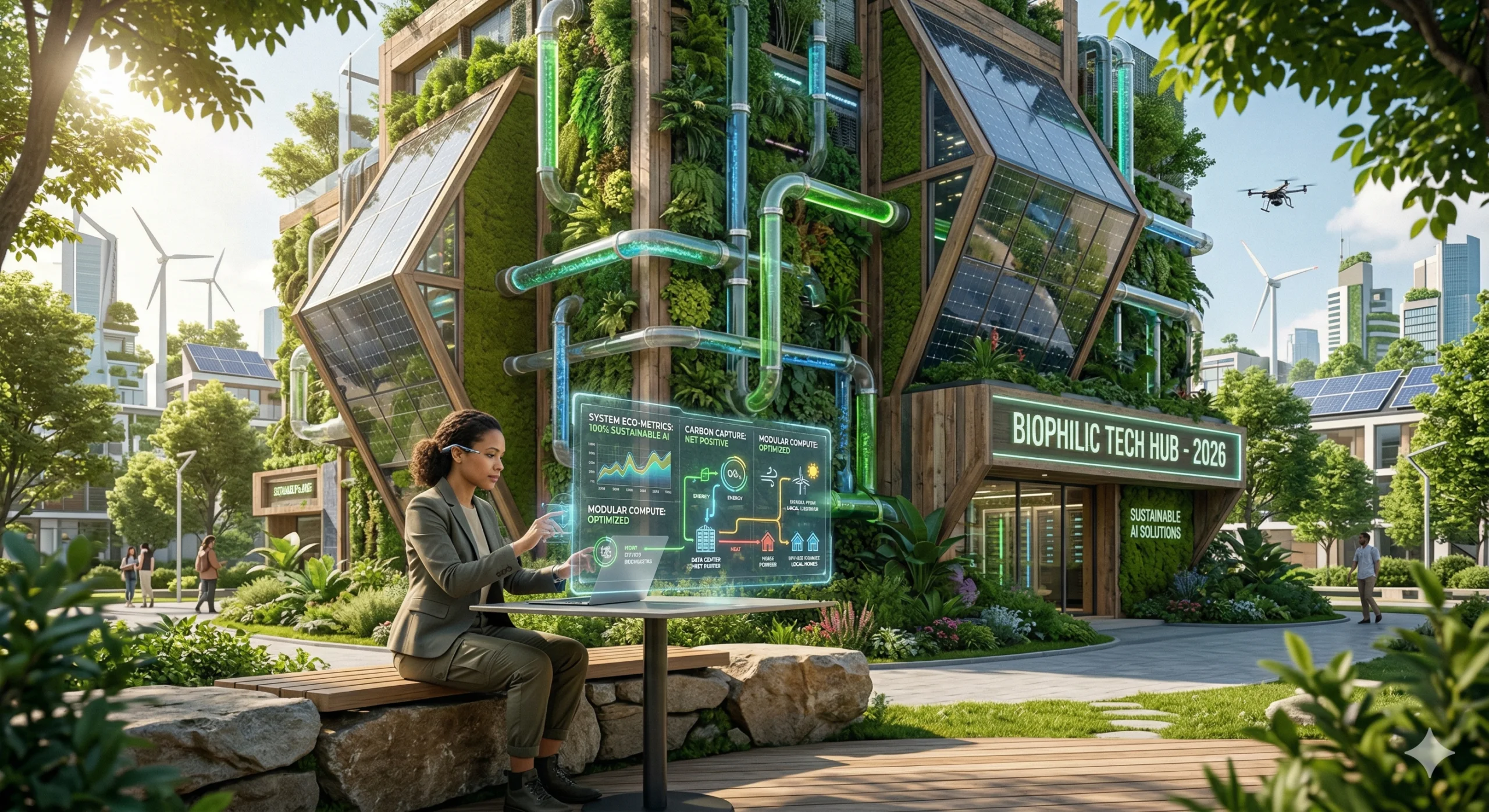
Image Generation: A hyper-realistic, wide-angle shot of a “Biophilic Tech Hub” in 2026. The scene features a sleek, minimalist structure made of reclaimed timber and solar-glass, partially covered in vertical moss gardens. In the foreground, a professional sits on a natural stone bench using a holographic interface that shows a “Net Zero” energy reading. The background shows a clean, futuristic city skyline under a clear blue sky, with small wind turbines integrated into the architecture. The lighting is warm and natural, suggesting a harmony between advanced computation and the natural environment.
For more insights on the latest in technology and sustainable innovation, visit: devnoxatech.com