
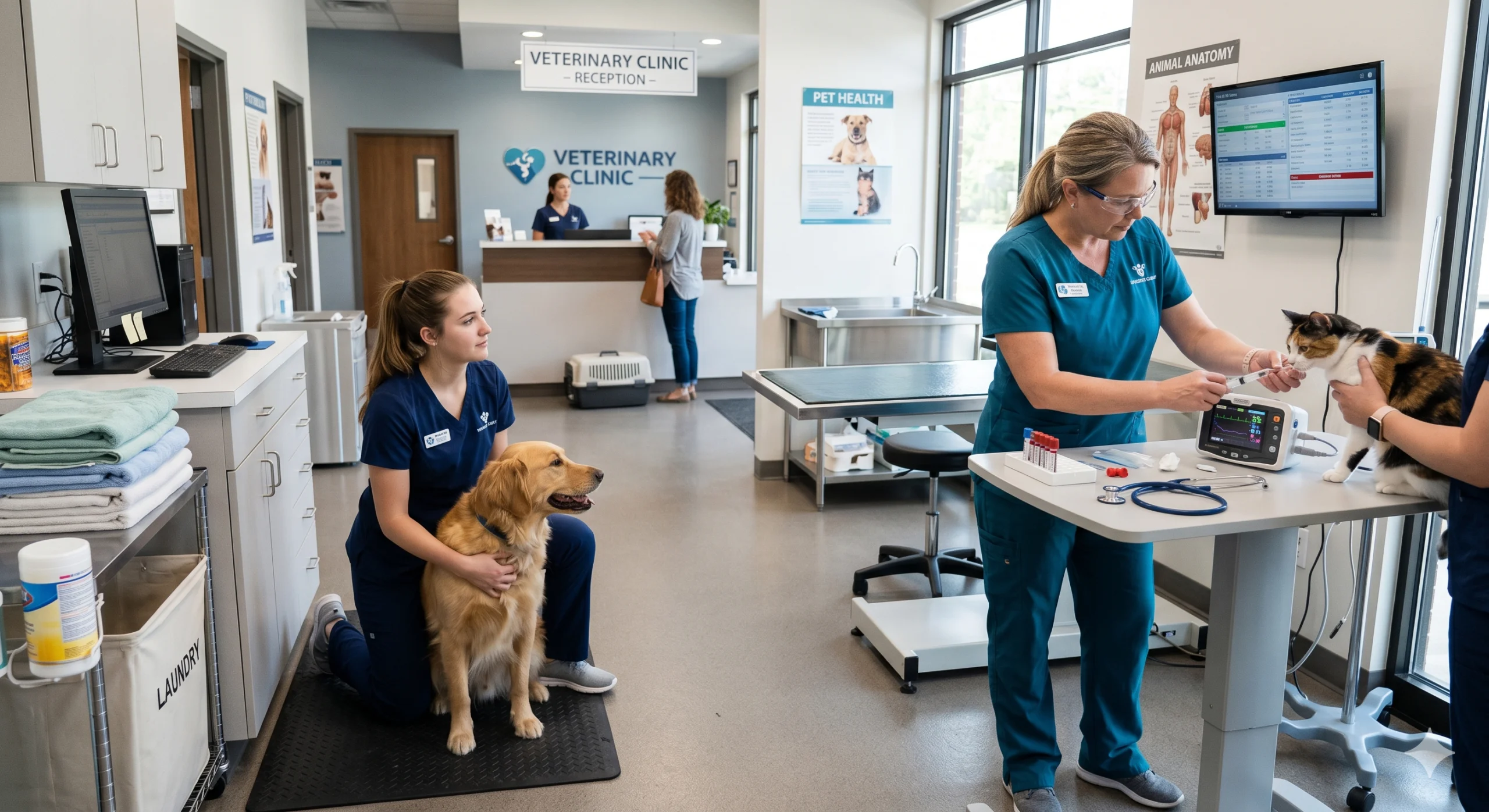

The world of veterinary medicine is a fast-paced environment where teamwork is the cornerstone of patient care. In any given clinic, you will find a variety of professionals working together to ensure that pets receive the best possible treatment. Two of the most common roles you will encounter are the veterinary technician and the veterinary assistant. To the casual observer, their jobs might look similar. Both handle animals, assist in exam rooms, and talk to clients. However, when you look under the surface, the distinctions become clear. These differences primarily lie in the depth of their medical training, the complexity of the tasks they are allowed to perform, and the long-term career path each role offers.
The Veterinary Assistant: The Foundation of Support
To start, let’s look at the veterinary assistant. This role is often considered the entry-level position within a clinic. A veterinary assistant is primarily responsible for the “front-end” and “support-side” tasks that keep a clinic running smoothly. Their duties are often focused on animal husbandry, hygiene, and basic clinical support. On a typical day, an assistant might spend their time cleaning kennels, feeding and watering patients, exercising dogs, and restraining animals while a veterinarian or technician performs an exam or draws blood.
The education required for a veterinary assistant is generally less intensive than that of a technician. Many assistants start their careers with a high school diploma and receive on-the-job training. While there are certificate programmes available for those who want to stand out, they are not always mandatory. This makes the assistant role an excellent “foot-in-the-door” for people who are passionate about animals but aren’t yet ready to commit to several years of college. It allows them to experience the reality of a clinic environment, learn the terminology, and see if a career in medicine is truly for them. However, because their training is less formal, their medical responsibilities are legally restricted. They generally cannot perform invasive procedures, administer certain medications, or monitor anaesthesia.
The Veterinary Technician: The Nursing Professional
On the other side of the spectrum is the veterinary technician. If a veterinary assistant is comparable to a nurse’s aide in human medicine, a veterinary technician is the equivalent of a registered nurse. Becoming a technician requires a significant investment in formal education. Most technicians must complete a two- or four-year degree in veterinary technology from a programme accredited by the American Veterinary Medical Association. During this time, they dive deep into subjects like pharmacology, anatomy, physiology, microbiology, and surgical nursing.
After graduation, technicians must pass a rigorous national exam, known as the Veterinary Technician National Examination (VTNE), to earn their credentials. Depending on the state, they may be known as a Registered Veterinary Technician (RVT), Licensed Veterinary Technician (LVT), or Certified Veterinary Technician (CVT). This credentialing is what separates them from assistants in a legal sense. Because of their specialised knowledge, technicians are authorised to perform much more complex medical tasks. They are trained to induce and monitor anaesthesia, perform dental cleanings and extractions, take and process radiographs, and place intravenous catheters. They also play a major role in laboratory work, analysing blood samples, urine, and faecal matter under a microscope to help the veterinarian reach a diagnosis.
Complexity and Responsibility in the Operating Room
The level of responsibility held by a technician is significantly higher. In a surgical setting, while the veterinarian focuses on the procedure itself, the technician is responsible for the patient’s life. They must monitor heart rates, oxygen levels, and blood pressure, making split-second decisions to adjust anaesthetic gases if the patient shows signs of distress. This requires a high level of critical thinking and a solid foundation in medical theory. While an assistant helps keep the animal still, the technician is the one interpreting the animal’s physiological data.
Communication is another area where both roles shine, but in different ways. Assistants are often the first point of contact for clients. They might be the ones checking patients in, weighing them, and gathering basic history about why the pet is visiting. They provide a friendly face and help manage the flow of the lobby. Technicians, however, often handle the more technical side of client education. They explain how to administer complex medications at home, discuss the results of lab work under the doctor’s guidance, and provide post-operative care instructions. They act as a bridge between the veterinarian’s high-level diagnosis and the pet owner’s need for practical, everyday advice.
Career Growth and Long-Term Outlook
In terms of career longevity and salary, the veterinary technician role typically offers more growth. Because of their specialised training and licensure, technicians generally command higher wages than assistants. They also have the opportunity to specialise in fields such as emergency and critical care, anaesthesia, internal medicine, or even zoo medicine. These specialities require additional years of experience and further examination but can lead to leadership roles within large referral hospitals or research facilities.
Veterinary assistants, while often earning less, have the benefit of flexibility. Some choose to remain assistants for their entire careers, becoming “master assistants” who know the clinic’s operations better than anyone else. Others use the experience as a stepping stone. It is very common for veterinary assistants to eventually enrol in a technician programme once they have a feel for the industry. Some even go on to become veterinarians.
Which Path Should You Choose?
Deciding which path to take depends largely on an individual’s goals and current life situation. If you want to start working with animals immediately and prefer a role that focuses on care, comfort, and clinic maintenance, being an assistant is a fantastic choice. It allows you to be in the middle of the action without the burden of heavy student loans or the high-stress responsibility of medical decision-making.
However, if you are drawn to the science of medicine, enjoy technical challenges, and want to be directly involved in the clinical treatment of patients, the technician route is the way to go. It is a more demanding path, both academically and professionally, but it offers a deeper level of engagement with the medical aspects of animal health.
Regardless of the title, both roles require a specific set of “soft skills”. Compassion is non-negotiable. Both technicians and assistants deal with sick animals and worried owners every day. They must be able to remain calm under pressure, communicate clearly, and possess a high level of physical stamina. Veterinary medicine is physically taxing; it involves standing for long hours, lifting heavy dogs, and moving quickly in emergencies.
Conclusion: A Unified Team
In conclusion, the difference between a vet tech and a vet assistant comes down to education and the scope of practice. The assistant is the vital support system that keeps the facility clean and organised and the patients comfortable. The technician is the skilled medical professional who carries out the veterinarian’s orders and manages the technical aspects of patient care. Both are indispensable. A clinic cannot function efficiently without assistants, and it cannot provide high-level medical care without technicians. Together, they form the backbone of the veterinary team, working tirelessly to ensure that our animal companions live long, healthy lives. https://devnoxatech.com/