
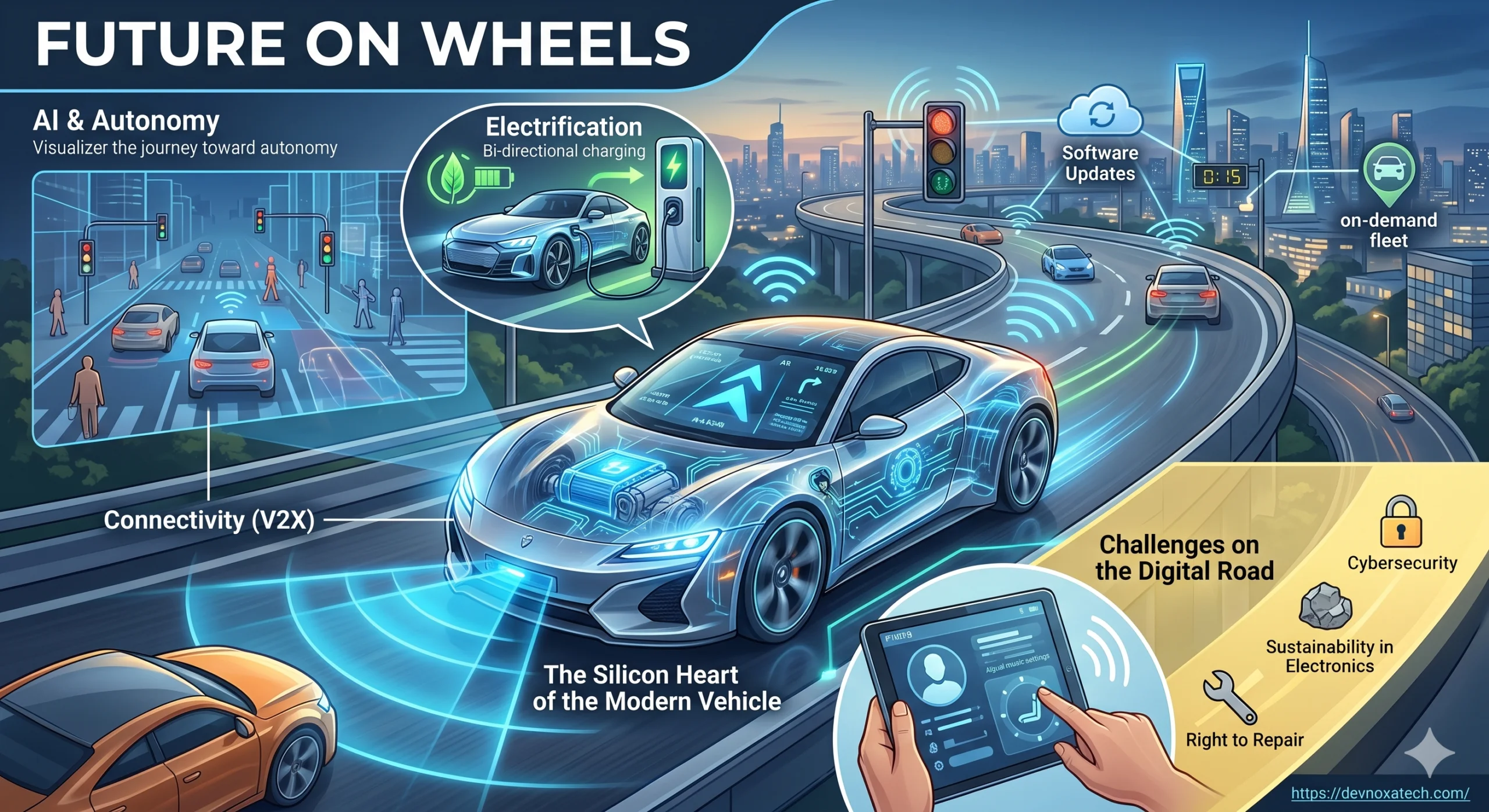

The automotive industry is currently undergoing its most significant transformation since Henry Ford first introduced the moving assembly line. For over a century, the car was a mechanical marvel—a symphony of gears, pistons, and exploding gasoline. Today, the vehicle is evolving into a sophisticated, mobile supercomputer. This shift into the era of “Hi-Tech Auto” isn’t just about adding bigger screens to the dashboard; it represents a total fundamental reimagining of how we move, how we interact with our environment, and how we define the concept of ownership.
The Silicon Heart of the Modern Vehicle
At the center of this revolution is the transition from hardware-defined vehicles to software-defined vehicles. In the past, if you wanted your car to perform better or gain a new feature, you usually had to buy a new part or a new car altogether. Now, much like your smartphone, cars receive over-the-air updates that can improve battery efficiency, refine braking distances, or introduce entirely new infotainment capabilities overnight.
This digital backbone is powered by a massive increase in computing power. High-end modern vehicles now contain upwards of 100 million lines of code. To put that in perspective, a Boeing 787 Dreamliner runs on about 14 million. This software manages everything from the micro-adjustments in suspension for a smoother ride to the complex algorithms that interpret data from cameras, radar, and LiDAR sensors.
Electrification: More Than Just a Battery
While electric vehicles (EVs) are often praised for their environmental benefits, the “hi-tech” appeal lies in their simplicity and integration. Internal combustion engines are incredibly complex, with thousands of moving parts that require constant maintenance. An electric drivetrain is elegant, consisting of a fraction of those parts.
This simplicity allows engineers to rethink vehicle architecture. We are seeing “skateboard” platforms where the battery and motors sit low in the chassis, providing a lower center of gravity and freeing up massive amounts of interior space. Furthermore, the integration of bi-directional charging means your car is no longer just a mode of transport; it is a mobile power bank that can back up your home during a blackout or sell energy back to the grid during peak hours.
The Journey Toward Autonomy
Perhaps the most discussed aspect of hi-tech auto is autonomous driving. While we haven’t quite reached the “lounge on wheels” stage where the steering wheel disappears entirely, the building blocks—Advanced Driver Assistance Systems (ADAS)—are already saving lives. Features like lane-keep assist, adaptive cruise control, and automatic emergency braking are becoming standard.
The push toward full autonomy relies on “sensor fusion.” This is the process where the car’s brain merges data from various sources to create a 360-degree map of the world.
- LiDAR: Uses laser pulses to create high-resolution 3D maps.
- Radar: Excellent for detecting the speed and distance of objects in poor weather.
- Computer Vision: Cameras that “see” and interpret traffic lights, signs, and pedestrians.
The goal isn’t just convenience; it is safety. Human error accounts for over 90 percent of road accidents. By removing the distracted or tired human element, hi-tech autos promise a future where traffic fatalities could become a rarity rather than a daily statistic.
The Connected Cockpit
Inside the cabin, the “user experience” has become the new battleground for manufacturers. We have moved far beyond FM radio and basic GPS. The modern cockpit is an immersive environment featuring:
- Augmented Reality (AR) Head-Up Displays: Projecting navigation arrows directly onto the windshield so they appear to sit on the actual road ahead.
- AI Assistants: Voice-controlled systems that learn your habits, adjusting the climate control or suggesting your favorite podcast before you even ask.
- V2X Communication: “Vehicle-to-Everything” technology allows cars to talk to traffic lights, parking garages, and even other cars. Imagine a world where your car knows a light is turning red three blocks away and adjusts its speed to ensure you never have to hit the brakes.
Challenges on the Digital Road
However, the road to a high-tech automotive future isn’t without its potholes. As cars become more like computers, they inherit computer-like vulnerabilities. Cybersecurity is now a top priority for automakers. If a car can be updated remotely, it could, in theory, be hacked remotely. Ensuring that the digital gates are locked tight is essential for consumer trust.
There is also the question of sustainability in electronics. While EVs reduce tailpipe emissions, the mining of lithium, cobalt, and rare earth metals for high-tech components carries its own environmental and ethical weight. The industry is currently racing to develop solid-state batteries and more efficient recycling programs to address these concerns.
Finally, we must consider the digital divide. As cars become more advanced, they also become more expensive to purchase and repair. The “right to repair” movement is gaining steam as consumers push back against proprietary software that prevents independent mechanics from fixing modern vehicles.
The Shift in Ownership
Hi-tech auto is also changing the very nature of how we “consume” transportation. We are seeing the rise of Transportation as a Service (TaaS). In urban centers, the need to own a depreciating asset that sits parked 95 percent of the time is fading. Instead, autonomous ride-hailing fleets could provide on-demand transport at a fraction of the cost of owning a car.
For those who still choose to own, the experience is becoming more personalized. Digital profiles follow you from car to car. If you rent a vehicle in a different city, the moment you log in, the seat adjusts to your preference, your Spotify playlists appear, and the suspension tunes itself to the driving style you prefer.
A New Era of Mobility
The hi-tech auto movement is more than a collection of gadgets; it is a fundamental shift in the human experience. It represents the intersection of sustainable energy, artificial intelligence, and telecommunications. We are moving toward a world where the “driver” is becoming a “passenger,” and the “car” is becoming a “living space.”
As we look toward the next decade, the lines between our digital lives and our physical travels will continue to blur. The car will not just be a tool to get from point A to point B, but a partner in our daily productivity and safety. It is an exciting, albeit complex, time to be on the road. The engine’s roar may be fading, but the hum of innovation is louder than ever. devnoxa tech