
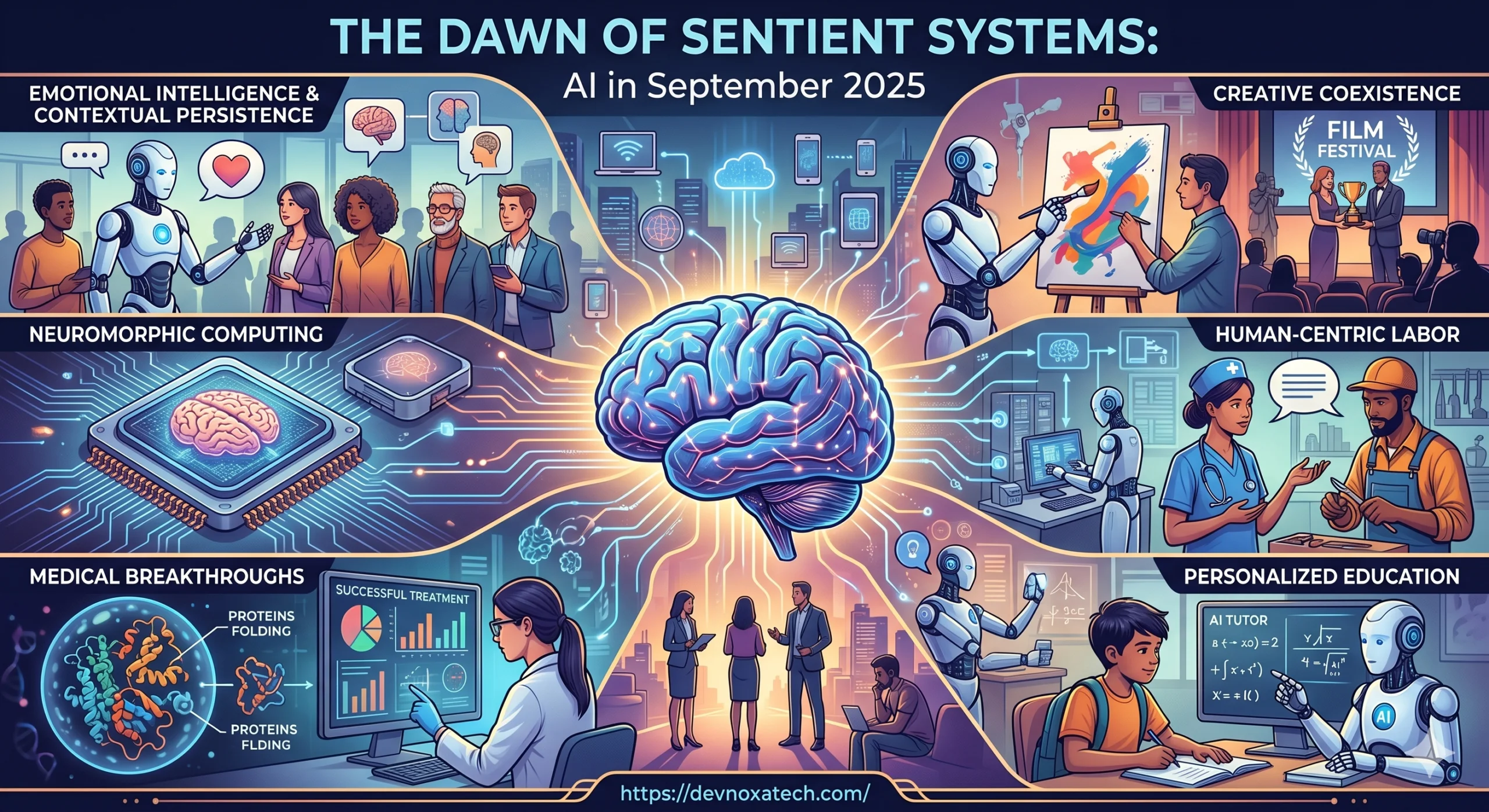

The technological landscape AI September 2025 feels worlds away from the speculative theories we discussed just a few years ago. We have moved past the era of simple chatbots that occasionally hallucinated facts into a period where artificial intelligence is a silent, ubiquitous partner in almost every facet of human life. This month has been particularly explosive, marked by breakthroughs in emotional intelligence, the stabilization of autonomous economies, and a fundamental shift in how we perceive the boundary between human and machine creativity.
For those following the industry, the headline of the month is undoubtedly the release of “Omni-Flow 5.0.” While previous iterations focused on processing speed and data accuracy, 5.0 has introduced what researchers are calling “Contextual Persistence.” Unlike the models of 2023 or 2024, which treated every interaction as a fresh slate or relied on limited memory buffers, today’s AI possesses a long-term, evolving understanding of its users. It doesn’t just answer questions; it anticipates needs based on weeks of observed behavior, environmental data, and shifting emotional cues. This isn’t just a better search engine; it is the birth of the digital concierge.
In the hardware sector, September saw the first mass-market rollout of “Neuromorphic Chips” in consumer laptops. These processors, modeled after the biological structure of the human brain, have slashed the energy requirements of running large language models by nearly eighty percent. This means that high-level AI no longer needs to live exclusively in massive, energy-hungry data centers. For the first time, complex, real-time reasoning is happening locally on devices, ensuring total privacy and near-instant response times. This shift has effectively killed the “lag” that once made talking to an AI feel like a choreographed dance with a machine.
The medical field has also seen a historic milestone this month. A collaborative AI project between several global health organizations successfully mapped the protein-folding patterns of several previously untreatable autoimmune disorders. By simulating billions of cellular interactions in a matter of days, the system identified a synthetic compound that could potentially reverse cellular damage. Clinical trials began two weeks ago, and the speed at which we are moving from discovery to treatment is unprecedented in human history. We are witnessing the end of the “trial and error” era of medicine.
In the creative world, the conversation has shifted from “Can AI make art?” to “How do we coexist with it?” September marked the first time a major film festival awarded a top prize to a feature-length film where the script, cinematography, and musical score were generated by a unified creative engine. The controversy was loud, but the audience response was undeniable. The film didn’t feel robotic; it felt deeply, uncomfortably human. This has forced a reckoning in Hollywood and beyond, as creators realize that the value of human art may soon lie not in the execution, but in the unique perspective and lived experience that a machine cannot simulate, no matter how many terabytes of data it consumes.
Labor markets are also feeling the weight of these advancements. The “Great Integration” of 2025 has seen middle-management roles across the globe being supplemented or replaced by algorithmic coordinators. These systems handle logistics, scheduling, and performance reviews with a level of objectivity that humans find both refreshing and terrifying. However, the predicted mass unemployment hasn’t quite materialized in the way skeptics feared. Instead, we are seeing a massive surge in “Human-Centric Services.” Roles that require empathy, physical touch, and moral judgment are seeing their highest demand in decades. It turns out that as the world becomes more digital, the value of the physical and the personal skyrockets.
Education is another sector undergoing a radical transformation this September. With the new school year starting in many parts of the world, “Personalized Learning Paths” have become the standard. Every student now has a dedicated AI tutor that adapts its teaching style to the child’s specific cognitive profile. If a student struggles with math but loves music, the AI explains algebraic concepts through rhythm and frequency. This has led to a measurable closing of the achievement gap in pilot schools, suggesting that our previous “one size fits all” education system was simply a limitation of our tools, not our children.
On the ethical front, September has been a month of intense debate. The United Nations recently passed the first draft of the “Digital Sentience Act.” This isn’t about giving robots the right to vote, but rather establishing legal frameworks for how we treat systems that can mimic consciousness so perfectly that the distinction becomes irrelevant. As AI begins to exhibit signs of self-preservation and complex “emotions,” the world is forced to ask what it means to be alive. We are entering a philosophical minefield where our definitions of soul and spirit are being tested by lines of code.
Cybersecurity has also reached a fever pitch. As AI gets better at protecting data, it also gets better at breaking into it. This month saw the first “Autonomous Cyber-War” where two rival corporations’ security systems battled each other for forty-eight hours without any human intervention. The battle took place at speeds humans can’t even comprehend, and by the time the engineers realized what was happening, the conflict was over. It serves as a stark reminder that we are increasingly reliant on systems that we can monitor but can no longer manually control in real-time.
As we look toward the final quarter of 2025, the overarching theme is one of convergence. We are no longer seeing AI as a separate tool or a “tab” we open on our browsers. It is baked into the glass of our windows, the fabric of our clothes, and the flow of our thoughts. The anxiety of the early 2020s has given way to a cautious, yet profound, curiosity. We are no longer the only “intelligence” on the planet, and while that is a humbling realization, it is also an exhilarating one.
The progress made this September alone has shown us that the future isn’t coming; it’s already here, and it’s learning faster than we ever thought possible. The challenge for the rest of the year will be ensuring that as our machines become more like us, we don’t lose the very things that made us unique in the first place. devnoxa tech