
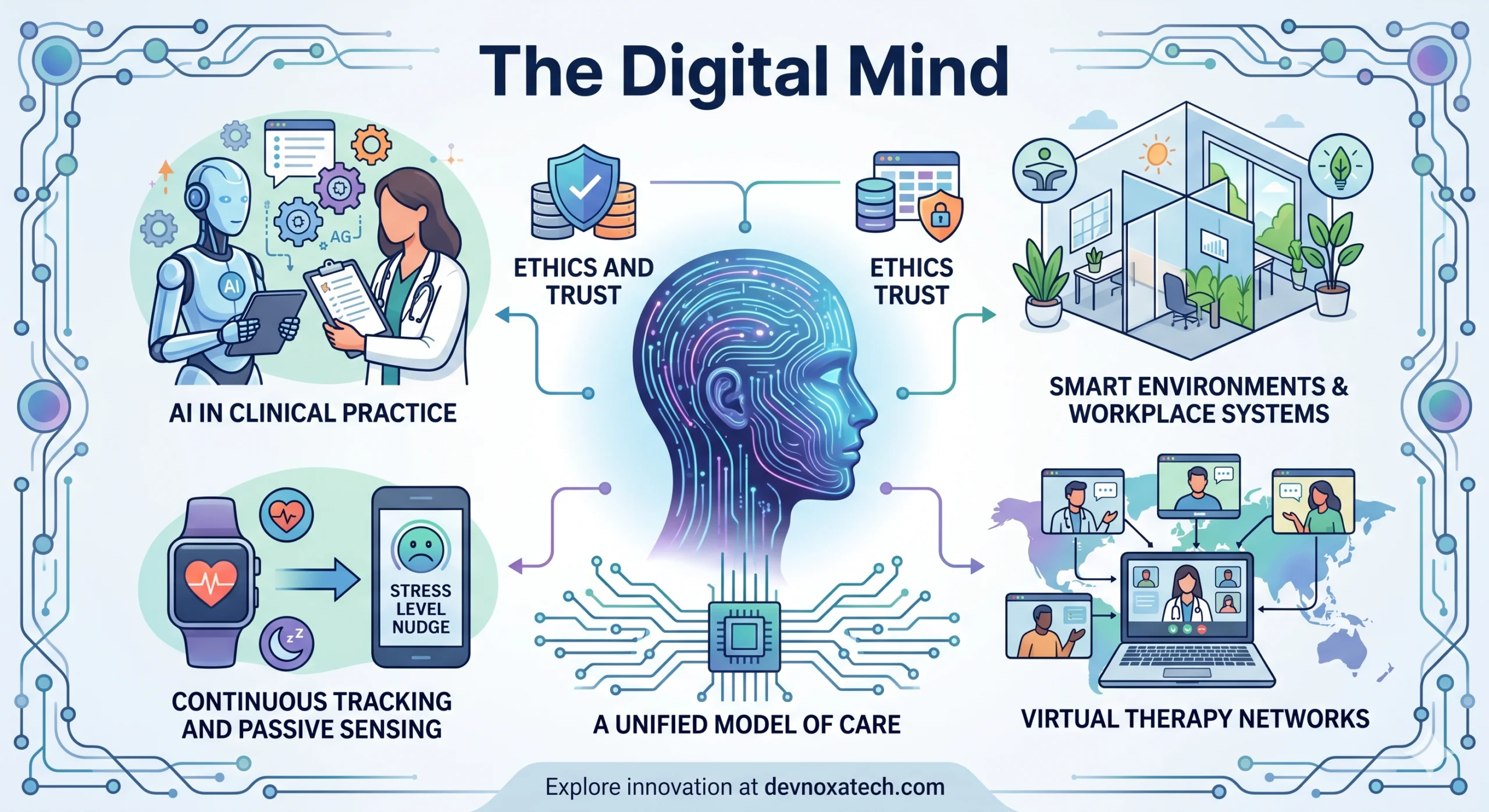

The landscape of mental health care is undergoing a profound transformation. For decades, the system relied almost entirely on traditional fifty-minute counseling sessions and self-reported patient updates. Today, a wave of digital innovation is rewriting that script. Advanced artificial intelligence, continuous biometric tracking, and virtual-first care networks are merging to create a highly connected and proactive ecosystem.
This shifts the focus from managing crises after they occur to providing ongoing, personalized support. As these technologies move out of experimental labs and into daily clinical practice, they are radically changing how we understand, monitor, and treat psychological distress.
AI Shift in Clinical Practice
Artificial intelligence has evolved from a futuristic concept into a practical tool embedded directly within clinical workflows. Rather than attempting to replace human therapists, these smart systems function as essential co-pilots. One of the most significant contributions of clinical AI is the reduction of administrative burdens. Providers now utilize advanced natural language processing tools to automatically transcribe and summarize session notes. This small automation saves hours of paperwork each week, allowing therapists to focus their energy entirely on the person sitting across from them or appearing on screen.
Beyond paperwork, machine learning algorithms are actively helping clinicians identify patterns that the human eye might miss. By securely analyzing linguistic shifts, behavioral logs, and patient text interactions, AI can flag early signs of cognitive decline or sudden mood drops. This acts as an early warning system, prompting therapists to intervene before a patient hits a point of severe crisis. The goal is a highly refined approach where data insights make human care much more precise and timely.
Continuous Tracking and Passive Sensing
The era of episodic mental health care is giving way to continuous, real-time insights. Historically, a therapist only knew how a patient was doing during their scheduled appointments. If a individual experienced an anxiety spike or a depressive episode mid-week, it often went unrecorded or unaddressed until the next session. Modern wearable devices and smartphone applications are bridging this critical gap.
By leveraging passive sensing, consumer wearables can track subtle biometric shifts such as heart-rate variability, sleep disruptions, and physical activity levels. A sustained drop in sleep quality combined with a volatile heart rate can indicate elevated cortisol and rising stress levels. These applications do not just collect data; they translate it into immediate support. Digital platforms can push timely, automated nudges—such as a brief breathing exercise or a reminder to practice mindfulness—exactly when a person’s physiological data reflects intense pressure. This turns everyday technology into an active shield against emotional exhaustion.
The Evolution of Virtual Therapy Networks
Telehealth is no longer a temporary alternative to in-person visits; it has become the standard foundation for care delivery. Modern virtual networks have matured far beyond simple video calls. The current generation of teletherapy platforms integrates seamless asynchronous communication, allowing patients to send secure text messages or voice notes to their care team between formal sessions. This continuous access helps individuals process emotional hurdles in the exact moments they occur, rather than waiting days for an open calendar slot.
Importantly, virtual platforms are breaking down massive systemic barriers. Individuals living in rural regions, older adults with limited mobility, and multilingual families who previously struggled to find culturally competent local care can now connect with specialized providers instantly. Furthermore, by partnering directly with major insurance networks and state Medicaid programs, these tech-driven practices are making professional psychiatric care genuinely affordable for communities that were historically locked out of the private healthcare system.
Smart Environments and Workplace Systems
The places where we live and work are also becoming active participants in mental wellness. The concept of neuro-regulated environments is gaining massive traction, particularly within corporate spheres. Forward-thinking companies are deploying adaptive workspaces that utilize sensory modulation. These architectural and digital systems read real-time biometric indicators from willing employees and dynamically adjust lighting, ambient soundscapes, and visual elements to mitigate cognitive fatigue and counter digital overstimulation.
This trend directly addresses the modern challenge of quiet burnout—a state where employees appear productive and fully engaged on the surface but are privately running on empty. By utilizing anonymous pulse surveys and environmental feedback loops, leadership teams can gauge collective stress levels without invading individual privacy. Instead of waiting for an individual to request mental health leave, corporate systems are building micro-rest intervals and proactive recovery practices into the actual rhythm of the workday.
Navigating Ethics and Trust
While the rapid expansion of digital mental health tools offers unprecedented access, it also introduces substantial risks that require careful management. The most urgent concern revolves around user privacy and the commercialization of sensitive emotional data. As general-purpose artificial intelligence tools become popular, many individuals are turning to consumer chatbots for informal counseling. This creates a dangerous grey area where clinical safety, data confidentiality, and medical accuracy are completely unverified.
Public health organizations and leading research institutions emphasize that technology must remain anchored to strict ethical guardrails. Algorithms are only as good as the information they are trained on, and if a system is fed biased data, it can misinterpret distress signals across diverse populations. True progress in this field requires a clear, uncompromising separation between commercial consumer gadgets and clinically validated platforms built on rigorous medical trust. Technology should always serve to amplify and extend human empathy, never to replace it.
A Unified Model of Care
We are moving away from an isolated view of mental health toward a deeply systemic model. Brain health is now understood as a lifelong journey shaped by a delicate matrix of biology, environment, and social connection. Modern technology serves as the connective tissue linking these distinct areas together. By integrating physical biometrics, environmental design, and clinical expertise into a single accessible network, digital tools are giving people the agency to understand and protect their own minds. The future of psychological support is interactive, continuous, and remarkably human.
To discover more about how innovative software solutions and advanced engineering are shaping modern digital landscapes, explore the developments at devnoxa tech