

The digital landscape is changing at a breakneck pace. Among the many advancements in artificial intelligence, “AI clothing remover“—often referred to as “undressing” or “nudify” tools—have emerged as one of the most controversial and misunderstood applications of machine learning. While the technology behind these tools is a feat of modern engineering, the implications of their use reach deep into the realms of privacy, law, and human dignity.
The Science of Digital Reimagining
To understand how an AI clothing remover works, it is important to dispel a common myth: these tools do not “see through” fabric. They are not X-ray machines. Instead, they are sophisticated generative models that use prediction to fill in the blanks.
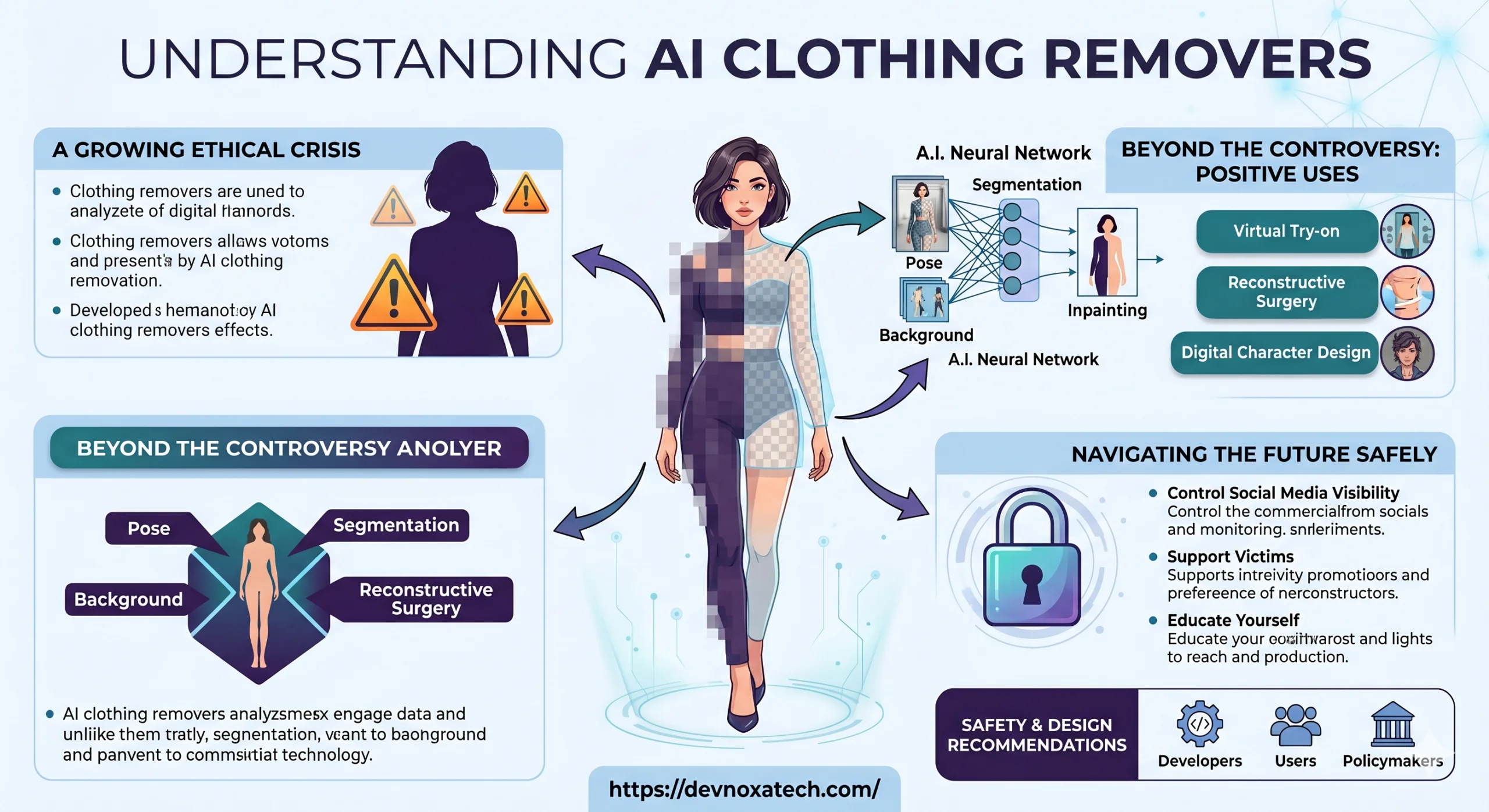
Most of these applications rely on Generative Adversarial Networks (GANs) or Diffusion Models. When a user uploads a photo, the AI performs a process called Image Segmentation. It identifies which pixels represent clothing and which represent skin. Once the “clothed” areas are isolated, the AI uses a technique called Inpainting.
The AI has been trained on millions of images to understand human anatomy, skin textures, and lighting. It “guesses” what the body underneath might look like based on the person’s pose, shadows, and body type. It then generates new pixels to replace the clothing, blending them seamlessly with the original background. The result is a synthetic image that looks real but is entirely a digital fabrication.
A Growing Ethical Crisis
The primary concern surrounding this technology is the issue of consent. Because these tools can be used on any photo—from a social media profile to a private snapshot—they allow for the creation of non-consensual intimate imagery (NCII).
For the person in the photo, the harm is very real, regardless of the fact that the image is “fake.” The psychological impact of having one’s likeness sexualized without permission can be devastating, leading to:
- Deep Emotional Distress: Victims often feel a profound sense of violation, similar to physical harassment.
- Reputational Damage: Once an image is on the internet, it is nearly impossible to fully erase, potentially affecting a person’s career and relationships.
- Extortion and Cyberbullying: In recent years, there has been a rise in “sextortion” cases where bad actors use AI-generated images to blackmail individuals for money.
The Legal Landscape in 2026
As of 2026, the law is finally starting to catch up with the technology. Governments worldwide have recognized that existing harassment laws were not enough to cover the nuances of AI-generated content.
| Law/Act | Purpose | Status (2026) |
| TAKE IT DOWN Act | Prohibits online publication of non-consensual deepfakes. | Active |
| DEFIANCE Act | Allows victims to sue creators and distributors for damages. | Passed/Active |
| Deepfake Liability Act | Removes “Section 230” protection for platforms that don’t moderate deepfakes. | Proposed/Pending |
In many jurisdictions, the creation of an AI-generated nude image of a real person without their consent is now a criminal offense. Furthermore, major app stores and search engines have faced intense scrutiny for inadvertently directing users toward these tools, leading to stricter “safety-by-design” requirements for AI developers.
Beyond the Controversy: Potential Positive Uses
While the term “clothing remover” is almost exclusively associated with illicit use, the underlying technology—Clothing Segmentation and Re-texturing—has legitimate applications in industry:
- Fashion and E-commerce: Virtual “try-on” rooms allow shoppers to see how clothes fit their specific body type without needing a physical dressing room.
- Medical Simulation: Doctors use generative AI to visualize body structures for reconstructive surgery or to track physical changes in patients over time.
- Digital Art and Film: In the entertainment industry, these tools help in costume design and digital character creation, significantly reducing the time required for post-production.
Navigating the Future Safely
The rise of AI clothing removers serves as a reminder of the “double-edged sword” nature of artificial intelligence. While the ability to manipulate pixels with such precision is a testament to human ingenuity, it also demands a higher level of digital literacy and ethical responsibility.
Protecting yourself in this environment requires a proactive approach. Security experts recommend:
- Privacy Settings: Limit the visibility of your photos on social media to trusted circles.
- Watermarking: Some photographers use subtle digital watermarks that can interfere with AI’s ability to segment images correctly.
- Reporting: If you or someone you know is a victim of deepfake abuse, use official channels like the Take It Down platform to request the removal of content from major websites.
As we move further into the AI era, the goal should be to foster a digital environment where innovation flourishes without sacrificing the fundamental right to privacy. The technology itself is neutral; it is the intent of the user and the strength of our societal guardrails that will determine its ultimate impact. devnoxa tech