
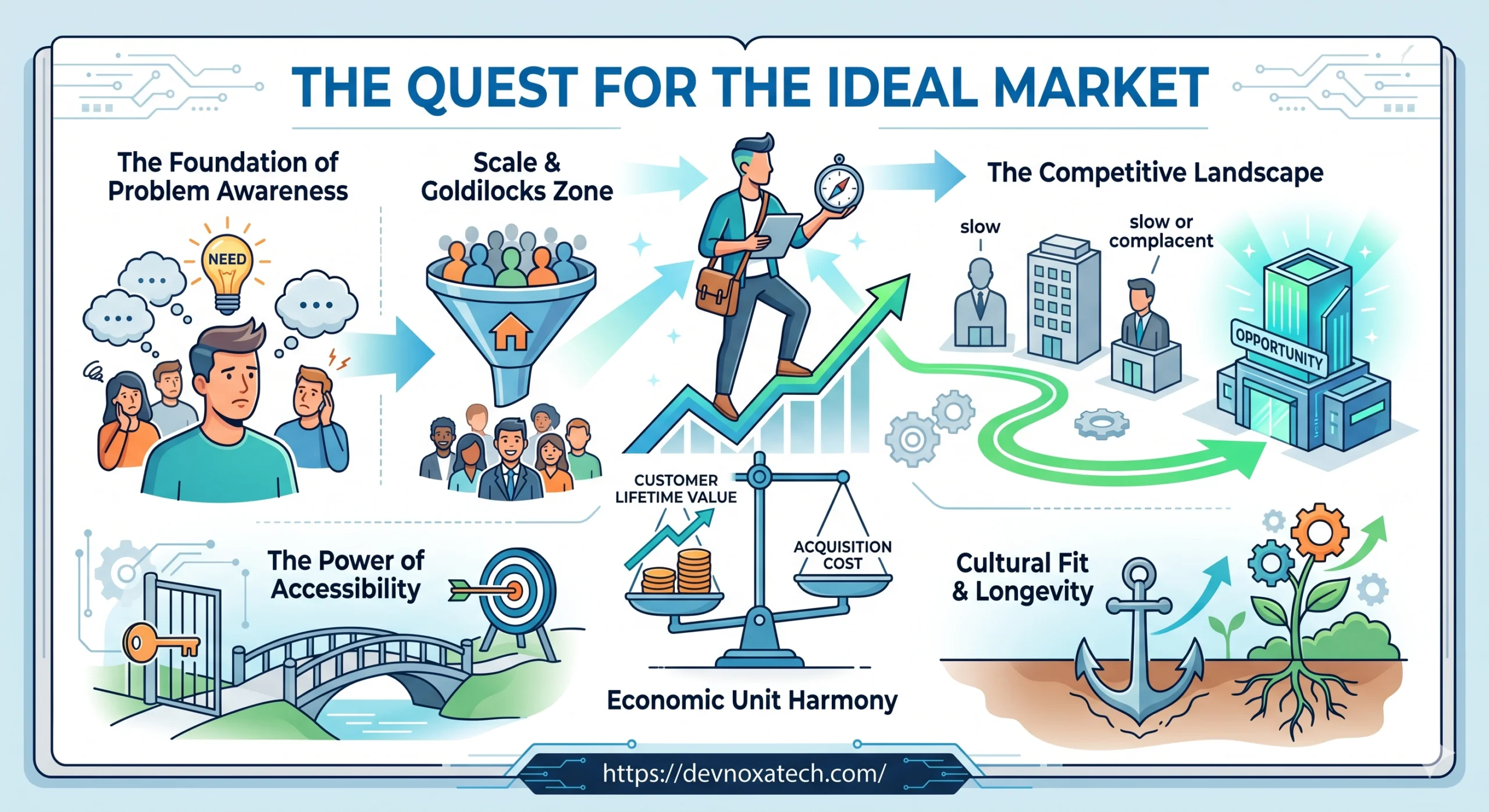

The concept of an ideal market often feels like a corporate mirage. We talk about it in hushed tones during boardroom meetings and sketch it out on whiteboards as if we are mapping a lost city of gold. Business schools teach us that it is a place where demand is infinite and competition is non-existent. But in the real world, the ideal market is less about finding a vacuum and more about finding a resonance. It is the perfect alignment between a deep human need and a solution that feels like it was designed by someone who actually listens.
To understand what makes a market ideal, we have to look past the spreadsheets and the compound annual growth rates. We have to look at the people. Markets are not just statistics; they are collections of human desires, frustrations, and habits. Finding the right one is an exercise in empathy as much as it is an exercise in economics.
The Foundation of Problem Awareness
An ideal market begins with a problem that people actually know they have. There is a specific kind of professional purgatory reserved for entrepreneurs who try to sell a solution to a problem that the public hasn’t recognized yet. You can have the most innovative product in the history of Silicon Valley, but if you have to spend eighty percent of your budget just explaining to people why they should be unhappy with their current situation, you are not in an ideal market. You are in an uphill battle.
In an ideal scenario, the customer is already looking for you. They are waking up at 3:00 AM wondering how to fix a specific leak in their life or business. When you show up, you aren’t a salesperson; you are a relief. This “pull” dynamic is the hallmark of a healthy market. It means the cost of acquisition stays low because the gravity of the problem does the heavy lifting for you.
Size, Velocity, and the Goldilocks Zone
Scale is the next pillar. If a market is too small, you have a hobby, not a business. If it is too large and generic, you are a single drop of water in an ocean of noise. The ideal market sits in a “Goldilocks Zone.” It is large enough to sustain significant growth and provide a comfortable ceiling, yet specific enough that you can speak a language the customers recognize as their own.
Velocity is equally important. Some markets are massive but stagnant. They move with the glacial pace of legacy industries where “we’ve always done it this way” is the standard response to innovation. An ideal market has momentum. It is a space where things are changing—perhaps due to new technology, shifting cultural values, or regulatory updates. When a market is in motion, it creates gaps. Those gaps are where the most profitable opportunities live.
The Competitive Landscape: Friends and Foes
There is a common misconception that the ideal market has no competition. This is almost never true. Total lack of competition usually signals a lack of customers. If no one else is trying to solve a problem, it might be because the problem isn’t worth the cost of the solution.
The ideal competitive landscape is one where there is “proven demand but poor execution.” You want to see competitors because they validate that people are willing to open their wallets. However, you want those competitors to be complacent. You are looking for a market served by giants who have grown too slow to care or by small players who lack the vision to scale. When you find a group of customers who are paying for a service but complaining about it the whole time, you have found a goldmine. Their dissatisfaction is your roadmap.
Economic Unit Harmony
We cannot discuss markets without touching on the math. In an ideal market, the “Unit Economics” make sense from day one. This means the value of a customer over their lifetime is significantly higher than what it costs to find them.
Some markets are “noisy” and expensive. If you are selling a product that everyone else is selling, you end up in a bidding war for attention. This drives marketing costs up until the profit margins disappear. In contrast, an ideal market allows for high margins because the value provided is unique or the niche is specialized enough that price becomes secondary to the result. If you can solve a ten thousand dollar problem for five thousand dollars, you don’t have to argue about your pricing. The value is self-evident.
The Cultural Fit and Longevity
A market might look perfect on paper but be a nightmare in practice if it doesn’t align with the soul of the company entering it. The ideal market is one where the provider has a “Founder-Market Fit.” This is the intuitive understanding of the customer’s world. It’s the ability to anticipate a trend before it shows up in a data report.
Furthermore, an ideal market isn’t a fad. We have seen countless businesses rise and fall on the back of “viral” markets that vanish as quickly as they appeared. A truly great market is built on a durable human need. People will always need to communicate, they will always need to feel secure, and they will always look for ways to save time. The technology used to meet those needs will change, but the market itself remains rooted in the human condition.
The Power of Accessibility
Accessibility is often the silent killer of great ideas. An ideal market is one you can actually reach. If the gatekeepers to a market are too powerful—think of industries governed by intense lobbying or impenetrable distribution networks—then the market isn’t ideal for a newcomer.
The internet has leveled many of these walls, but new ones have taken their place. Today, accessibility means being able to target your audience with precision. An ideal market is one where the customers gather in predictable places, whether that is a specific subreddit, a trade show, or a certain corner of the software world. If you know where they live, you can talk to them. If they are scattered and anonymous, your marketing budget will bleed out before you find your footing.
Building for the Future
Ultimately, the ideal market is a partnership. It is a symbiotic relationship where the business grows because the customer is genuinely better off. It is not about exploitation or “capturing” value; it’s about creating it. When you find a group of people with a shared pain, a willingness to pay, and a clear path for you to reach them, you aren’t just looking at a business opportunity. You are looking at the foundation of a legacy.
Finding this space requires patience. It requires the willingness to say “no” to a dozen mediocre opportunities while waiting for the one that actually clicks. It requires looking at the world not as it is, but as it could be if a certain friction were removed. The ideal market is waiting for someone to notice the quiet frustration of a specific group of people and decide that they deserve better.
In the end, the most “ideal” thing about a market is the potential for evolution. A market that stays the same eventually becomes a commodity. A market that grows, shifts, and challenges you to be better every day is the one worth winning. devnoxa tech