
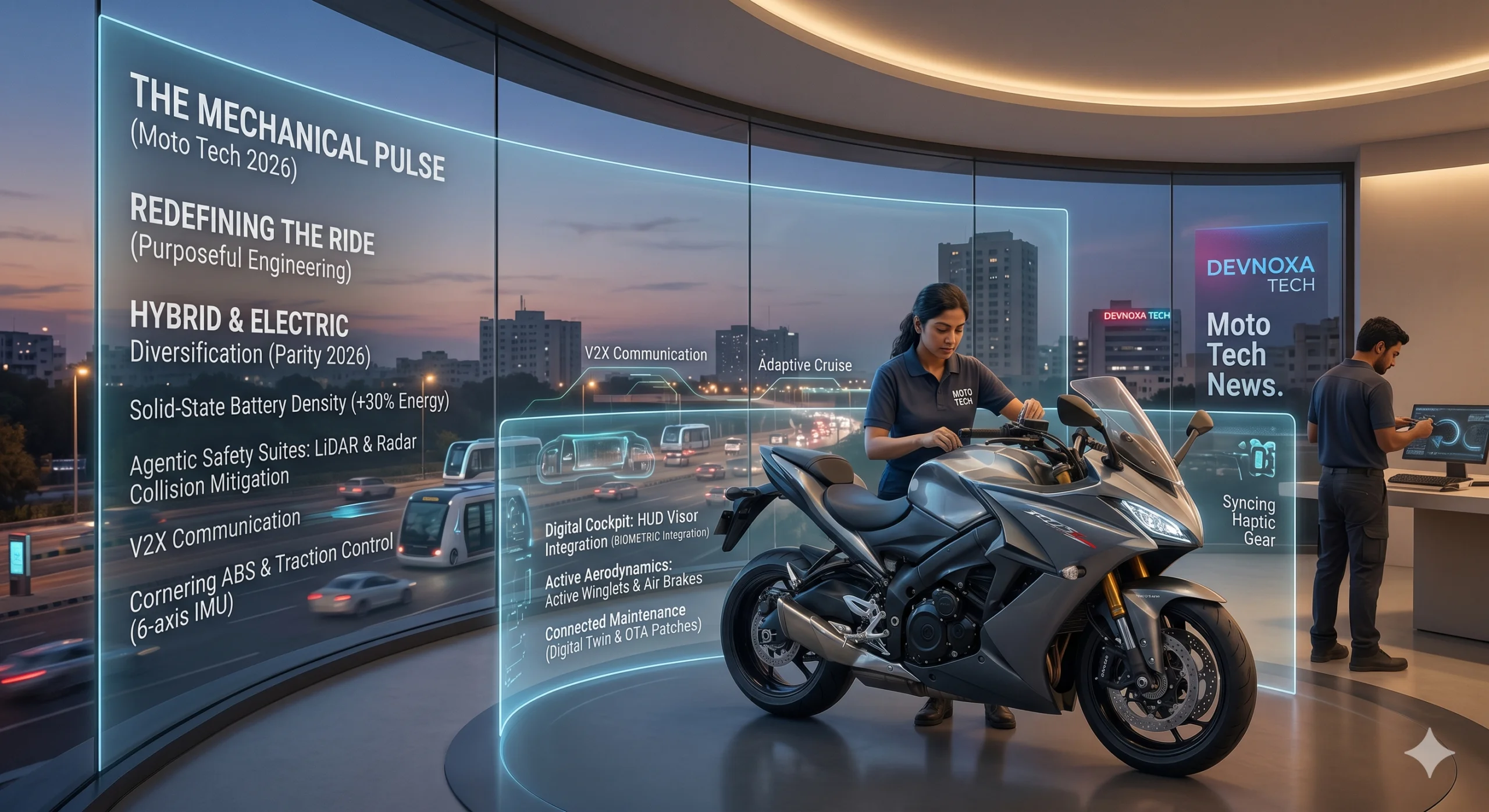

For over a century, the bond between a rider and their motorcycle was purely mechanical. It was a world of throttle cables, carburetors, and the visceral smell of gasoline. But as we move through 2026, we are witnessing a profound “Renaissance” in motorcycle technology. Today, “Moto Tech” is no longer just about the engine between two wheels; it is about an integrated ecosystem of intelligence, safety, and sustainable power.
Whether you are navigating the dense urban traffic of Karachi or carving through mountain passes, the modern motorcycle has evolved into a high-performance computer that just happens to lean. This evolution isn’t stripping away the soul of riding; it is using purposeful engineering to make every journey safer, faster, and more intuitive.
The Heart of the Machine: Beyond Internal Combustion
The most significant shift in moto tech this year is the diversification of the powertrain. While the roar of a high-compression internal combustion engine (ICE) still holds a romantic appeal, 2026 marks the point where electric and hybrid alternatives have reached “functional parity.”
Electric Performance and Battery Density
We have moved past the era of “range anxiety.” New solid state battery technology has allowed manufacturers to pack 30% more energy into the same physical footprint. This means electric motorcycles can now comfortably handle 300-kilometer trips on a single charge. More importantly, the “instant torque” characteristic of electric motors has redefined acceleration, allowing mid-weight commuters to outperform liter-class superbikes in off-the-line speed.
The Hybrid Compromise
For the long-distance tourers, 2026 has introduced the “Rotary Hybrid” system. These bikes use a small, ultra-efficient rotary engine acting solely as a generator to charge a compact battery. This setup provides the silent, torque-rich experience of an EV with the “fill and go” convenience of traditional fuel, representing a masterclass in transitional engineering.
Agentic Safety: The Invisible Co-Pilot
In 2026, the “Tech Tale” of motorcycle safety has shifted from passive protection (like better helmets) to active intervention. The introduction of Agentic AI Safety Suites has fundamentally lowered the barrier to entry for new riders while protecting veterans from the unpredictable nature of modern roads.
- Adaptive Cruise and Collision Mitigation: Using a combination of LiDAR and high-frequency radar, modern bikes can now maintain safe distances from vehicles ahead and, in emergency scenarios, pre-load the braking system to ensure maximum stopping power the moment the rider touches the lever.
- Cornering ABS and Traction Control 2.0: These systems now utilize 6-axis Inertial Measurement Units (IMUs) that calculate the bike’s lean angle 100 times per second. If the rear tire begins to slip while leaned over, the AI subtly modulates power output—not by cutting it abruptly, but by “smoothing” the torque curve to keep the bike upright.
- V2X Communication: “Vehicle-to-Everything” technology allows your motorcycle to “talk” to the cars around it. If a car three vehicles ahead slams on its brakes, your dashboard alerts you before you can even see the brake lights, providing those crucial extra seconds of reaction time.
The Digital Cockpit: Augmenting the Reality
The way riders interact with their machines has moved away from analog needles to “Augmented Interfaces.” In 2026, the dashboard is merely one part of a larger sensory experience.
Smart Helmets and HUDs
The most exciting development is the mainstream adoption of Head-Up Displays (HUDs) integrated into helmet visors. Instead of looking down at a screen, riders see their speed, turn-by-turn navigation, and blind-spot alerts projected directly into their line of sight. This keeps eyes on the road and reduces cognitive load during high-speed maneuvers.
Biometric Integration
Advanced moto tech now includes haptic feedback built into the handlebars and seat. If the system detects a vehicle in your blind spot, a subtle vibration on the corresponding side of the handlebar provides an intuitive “nudge” to the rider. Some high-end gear even monitors the rider’s heart rate and fatigue levels, suggesting a “coffee break” if it detects the slow reaction times associated with exhaustion.
Aerodynamics and Active Geometry
In 2026, we are seeing professional racing technology trickle down to the street at an unprecedented rate. Aerodynamics is no longer just about top speed; it’s about stability.
Active Winglets
Inspired by MotoGP, many 2026 street bikes feature active aerodynamic winglets. At high speeds, these wings adjust their angle to provide downforce, keeping the front wheel planted during hard acceleration. Conversely, during heavy braking, they flip to act as “air brakes,” increasing stability and reducing the physical strain on the rider.
Semi-Active Suspension
Electronic suspension has evolved into “predictive” suspension. By using cameras to scan the road surface meters ahead, the bike can adjust its damping settings for a pothole before the tires even hit it. This creates a “magic carpet” ride quality that was once thought impossible for a two-wheeled vehicle.
Maintenance in the Connected Era
The role of the “moto tech” (the technician) has also transformed. Much like the “Net Techs” managing digital infrastructure, modern motorcycle mechanics are now part-time software engineers.
- Over-the-Air (OTA) Updates: Manufacturers can now “patch” a motorcycle’s fuel map or traction control settings via Wi-Fi, improving the bike’s performance while it sits in your garage.
- Digital Twins: Every high-end motorcycle now has a “Digital Twin” stored in the cloud. When you take your bike in for service, the technician can compare your bike’s real-world data against the “perfect” model to isolate mechanical wear or sensor drift with surgical precision.
Conclusion: The Soul of the New Machine
As we look at the state of moto tech in 2026, it is clear that we aren’t losing the essence of the “open road.” Instead, we are giving the rider more “bandwidth” to enjoy the experience. By removing the stress of mechanical failure and the fear of hidden road hazards, technology allows us to focus on what truly matters: the lean into the corner, the wind in our face, and the freedom of the journey.
This is the “Renaissance” of the ride—a purposeful blend of human instinct and silicon intelligence. Whether you are a weekend warrior or a daily commuter, the future of motorcycling is brighter, safer, and more thrilling than ever before.
For those looking to build their own technical foundations or seeking a partner to navigate the high-stakes world of digital growth and IT transformation, the journey begins with understanding the framework of the future. devnoxa tech