
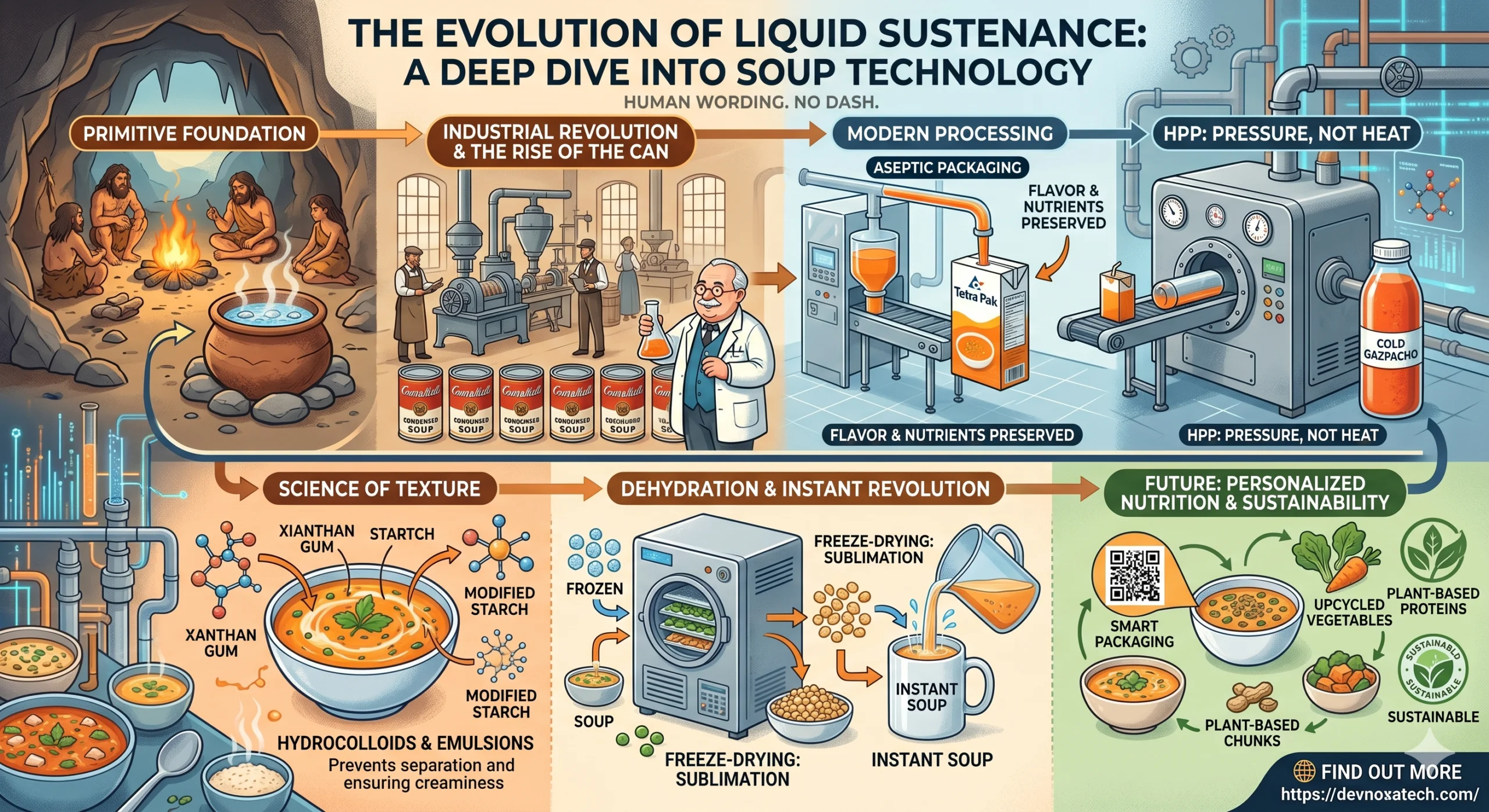

When we think of “technology,” our minds usually drift toward sleek silicon chips, humming data centers, or the latest smartphone. We rarely point a spoon at a bowl of steaming minestrone and think, this is a feat of engineering. Yet, the history and modern production of soup represent one of the most sophisticated intersections of chemistry, physics, and industrial design in the culinary world. From the first prehistoric clay pots to modern-day aseptic packaging, soup technology has been a primary driver of how humanity survives, stores nutrients, and scales nutrition for billions.
The Primitive Foundation: Heat and Vessel
The fundamental “tech” of soup began with the mastery of fire and the invention of waterproof, heat-resistant containers. Before the advent of pottery, early humans utilized animal hides or even large shells to boil water by dropping fire-heated stones into the liquid—a process known as “stone boiling.” This was the first major leap in food processing. It allowed humans to extract calories from tough fibers, bones, and grains that were otherwise indigestible.
Once pottery emerged, the game changed. A clay pot allowed for sustained, indirect heat, leading to the discovery of the Maillard reaction in a liquid medium. This chemical transformation, where amino acids and reducing sugars react under heat, creates the complex, savory flavors we associate with a deep broth. This wasn’t just cooking; it was a biological hack to make nutrients more bioavailable.
The Industrial Revolution and the Rise of the Can
The mid-19th century marked the birth of modern soup technology through the lens of preservation. Nicolas Appert, often called the “father of canning,” discovered that heat-processing food in sealed glass jars prevented spoilage. However, it was the transition to tin-plated steel cans and the refinement of the “condensing” process that turned soup into a global commodity.
In 1897, Dr. John T. Dorrance, a chemist working for the Campbell Soup Company, developed a method to remove the water from the can. This reduced shipping costs significantly and made soup affordable for the masses. This era introduced the world to thermal processing—using precise pressure and temperature (the retort process) to kill pathogens while maintaining the integrity of the food. It was a rigorous application of microbiology that transformed a kitchen staple into a shelf-stable marvel.
Modern Processing: Beyond the Retort
Today, soup technology has moved far beyond the simple tin can. The industry now focuses on maintaining “fresh-tasting” profiles through aseptic processing and High-Pressure Processing (HPP).
Aseptic Packaging
Unlike traditional canning, where the food is cooked inside the container, aseptic technology sterilizes the soup and the packaging separately. The soup is flash-heated and cooled in seconds, preserving delicate vitamins and flavors that would otherwise be “cooked out” in a traditional retort. It is then filled into sterilized cartons (like Tetra Paks) in a sterile environment. This technology allows for a shelf life of up to a year without refrigeration, all while maintaining a flavor profile closer to a homemade batch.
High-Pressure Processing (HPP)
For the premium, “raw” soup market, HPP is the gold standard. Instead of using heat, which can alter the taste of fresh vegetables like gazpacho, the soup is subjected to extreme pressure—up to 6,000 bar (roughly six times the pressure at the bottom of the ocean). This pressure crushes the cell walls of bacteria and spoilage organisms but leaves the flavor molecules and nutrients intact. This is why you can now find “fresh” soups in the refrigerated aisle that stay vibrant for weeks.
The Science of Texture: Hydrocolloids and Emulsions
The mouthfeel of a soup—the creaminess of a bisque or the thickness of a chowder—is a result of sophisticated ingredient technology. Traditionally, chefs used a roux (flour and fat), but industrial soup technology utilizes a suite of hydrocolloids.
Ingredients like xanthan gum, guar gum, and modified food starches are engineered to provide stability. They prevent the “weeping” of water (syneresis) and ensure that fats don’t separate during the freeze-thaw cycle. Modern food scientists use rheology—the study of the flow of matter—to ensure that a cream of mushroom soup pours perfectly from a container every single time, regardless of the temperature.
Dehydration and the Instant Revolution
The pinnacle of convenience in soup technology is the “instant” variety. This relies on two primary technologies: spray drying and freeze-drying.
Freeze-drying (lyophilization) is perhaps the most impressive. The soup is frozen, and then placed in a vacuum where the ice turns directly into vapor (sublimation). This preserves the structural integrity of the ingredients—that’s why the peas in your instant noodles look like actual peas once hydrated. It’s a high-energy process, but it results in a product that is incredibly lightweight and nutritionally dense, making it the tech of choice for hikers and astronauts alike.
The Future: Personalized Nutrition and Sustainability
As we look forward, soup technology is pivoting toward sustainability and personalization. We are seeing the rise of “smart packaging” that can tell a consumer if the product has been exposed to improper temperatures. Furthermore, there is a push toward plant-based protein integration, using extrusion technology to create “meat-like” chunks from peas or soy that hold their texture even after months in a liquid base.
Sustainability is also driving the “upcycling” movement. Technology now allows manufacturers to rescue “ugly” vegetables or nutrient-rich byproduct peels and stems, processing them into high-quality broths and purees. This reduces food waste while maximizing caloric output.
Conclusion
Soup is often dismissed as a simple comfort food, but it is actually a triumph of human ingenuity. It is a medium through which we have mastered heat transfer, microbial control, and molecular stability. From the stone-boiled water of our ancestors to the high-pressure, aseptic cartons of today, soup technology remains a vital pillar of our global food system. It ensures that no matter where we are, a nutritious, flavorful, and safe meal is only a simmer away.
For more insights into the intersection of technology and industry, visit devnoxa tech