
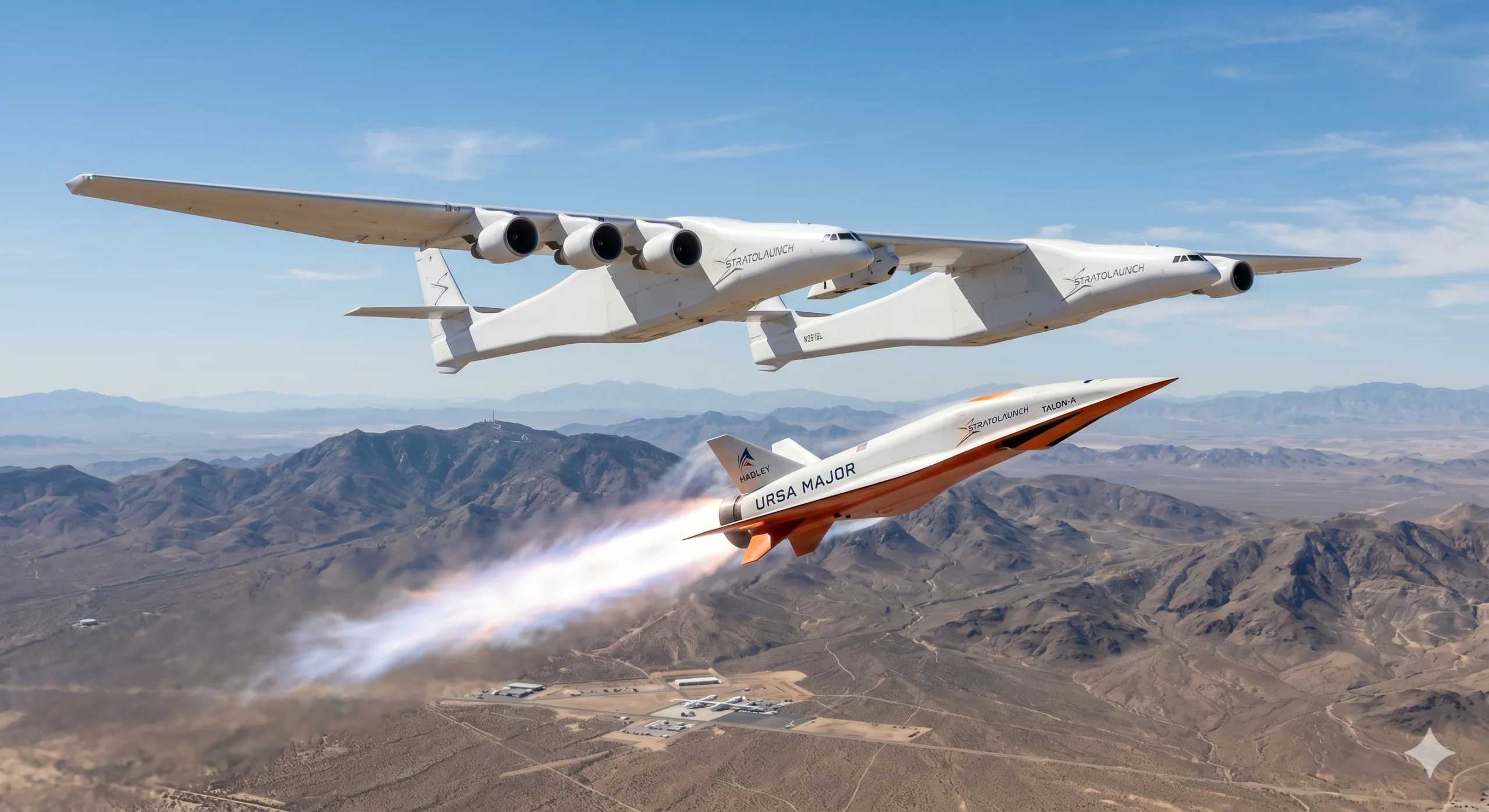

The race for the sky has shifted from how high we can go to how fast we can get there. For decades, the sound barrier was the ultimate benchmark, but today, the frontier is hypersonic. In the heart of the Mojave Desert and the foothills of Colorado, two companies,Ursa Major,Stratolaunch are rewriting the rules of aerospace. By combining the world’s largest aircraft with cutting edge 3D printed rocket engines, they aren’t just testing planes; they are building the infrastructure for a future where Mach 5 is the new standard.
The Giants of the Desert
Stratolaunch is a name that commands attention, largely because of “Roc.” Roc is the world’s largest flying aircraft, a twin fuselage behemoth with a wingspan longer than a football field. While it looks like something out of a science fiction novel, its purpose is deeply practical. Roc serves as a mobile, reusable launch pad in the sky.
Traditionally, reaching hypersonic speeds (speeds exceeding Mach 5, or five times the speed of sound) requires massive ground based boosters or experimental setups that are expensive and difficult to recover. Stratolaunch changes the math. By carrying a hypersonic vehicle like the Talon-A to an altitude of 35,000 feet before releasing it, the company eliminates the need for the thickest part of the atmosphere and the massive fuel loads required for a ground launch. This “air launch” method provides a flexible, repeatable way to test high speed technologies without the billion dollar price tag of traditional missile programs.
The Heart of the Machine
If Stratolaunch provides the wings, Ursa Major provides the fire. Based in Berthoud, Colorado, Ursa Major has taken a radical approach to rocket science. Instead of relying on the slow, artisanal manufacturing processes of the past, they use additive manufacturing, better known as 3D printing, to build their engines.
Their star performer in the hypersonic arena is the Hadley engine. Hadley is a liquid oxygen and kerosene rocket engine designed specifically for high performance and reliability. Because it is largely 3D printed, Ursa Major can iterate designs in weeks rather than years. This speed of innovation is critical in a field where the physics of air at Mach 5—which behaves more like a plasma than a gas—is still being understood.
The partnership between these two is a perfect synergy. Stratolaunch needed a reliable, high thrust engine for its Talon-A vehicles, and Ursa Major needed a platform to prove that their 3D printed hardware could handle the extreme pressures of sustained hypersonic flight.
Reusability and the 10 Flight Milestone
In the world of hypersonics, “one and done” has long been the norm. Most hypersonic vehicles are missiles that destroy themselves upon impact, making every test flight an expensive loss of data and hardware. Stratolaunch and Ursa Major set out to break this cycle.
By April 2026, the partnership achieved a historic milestone: ten successful flights of the Hadley engine, including multiple missions where the engine powered the Talon-A to sustained hypersonic speeds. More importantly, these tests demonstrated reusability. Several of these flights used engines that had flown before, proving that liquid rocket technology can be recovered, refurbished, and put back into the air quickly.
This shift toward reusability is the “holy grail” of aerospace. It lowers the cost per flight and allows engineers to examine the hardware after it has faced the “hellish” conditions of Mach 5. By seeing how the metal holds up against the friction and heat of the atmosphere, they can refine designs with a level of precision that was previously impossible.
Beyond Speed: National Security and Innovation
The push for hypersonic technology isn’t just about breaking records; it’s a matter of national defense. Hypersonic weapons and vehicles are incredibly difficult to track and intercept because they move so fast and can maneuver within the atmosphere. To defend against these threats, the United States needs a way to test its own defensive systems and sensors.
The Missile Defense Agency (MDA) and the Air Force Research Laboratory (AFRL) have both recognized the value of the Stratolaunch and Ursa Major partnership. By providing a “test bed” in the sky, these companies allow the government to test new materials, communication systems, and sensors at actual hypersonic speeds.
Furthermore, Ursa Major is already looking toward the next generation with the Draper engine. While Hadley is a cryogenic engine (using super-cooled liquid oxygen), Draper uses storable propellants. This means it can sit in a silo or on a wing for years and be ready to fire in an instant, offering the storability of a solid rocket with the maneuverability and throttle control of a liquid engine.
The Human Element of High Tech
What makes this story compelling isn’t just the titanium and the liquid oxygen; it’s the speed of the human ingenuity involved. We are seeing a move away from the “Old Space” way of doing things—characterized by decades-long development cycles and massive government overhead—toward a “New Aerospace” model.
In this new model, small, agile companies use 3D printing and digital twin modeling to bypass the traditional bottlenecks of manufacturing. They “fail fast” on the test stand so they can “fly fast” in the atmosphere. The collaboration between Ursa Major and Stratolaunch is a blueprint for how modern engineering should work: collaborative, iterative, and relentlessly focused on the end goal.
Looking Toward the Horizon
As we move deeper into 2026, the cadence of these flights is expected to increase. The goal is no longer just to reach Mach 5, but to make Mach 5 routine. We are standing at a threshold similar to the early days of jet engines. Soon, the data gathered from the Talon-A and the Hadley engines will inform not just military systems, but potentially the future of high speed commercial travel and rapid space access.
The sky is no longer the limit; it’s the laboratory. Through the massive wings of Stratolaunch and the 3D printed hearts of Ursa Major, the “hypersonic gap” is closing, and a new era of American aerospace is taking flight.
For more insights into the future of technology and innovation, visit: devnoxa tech