
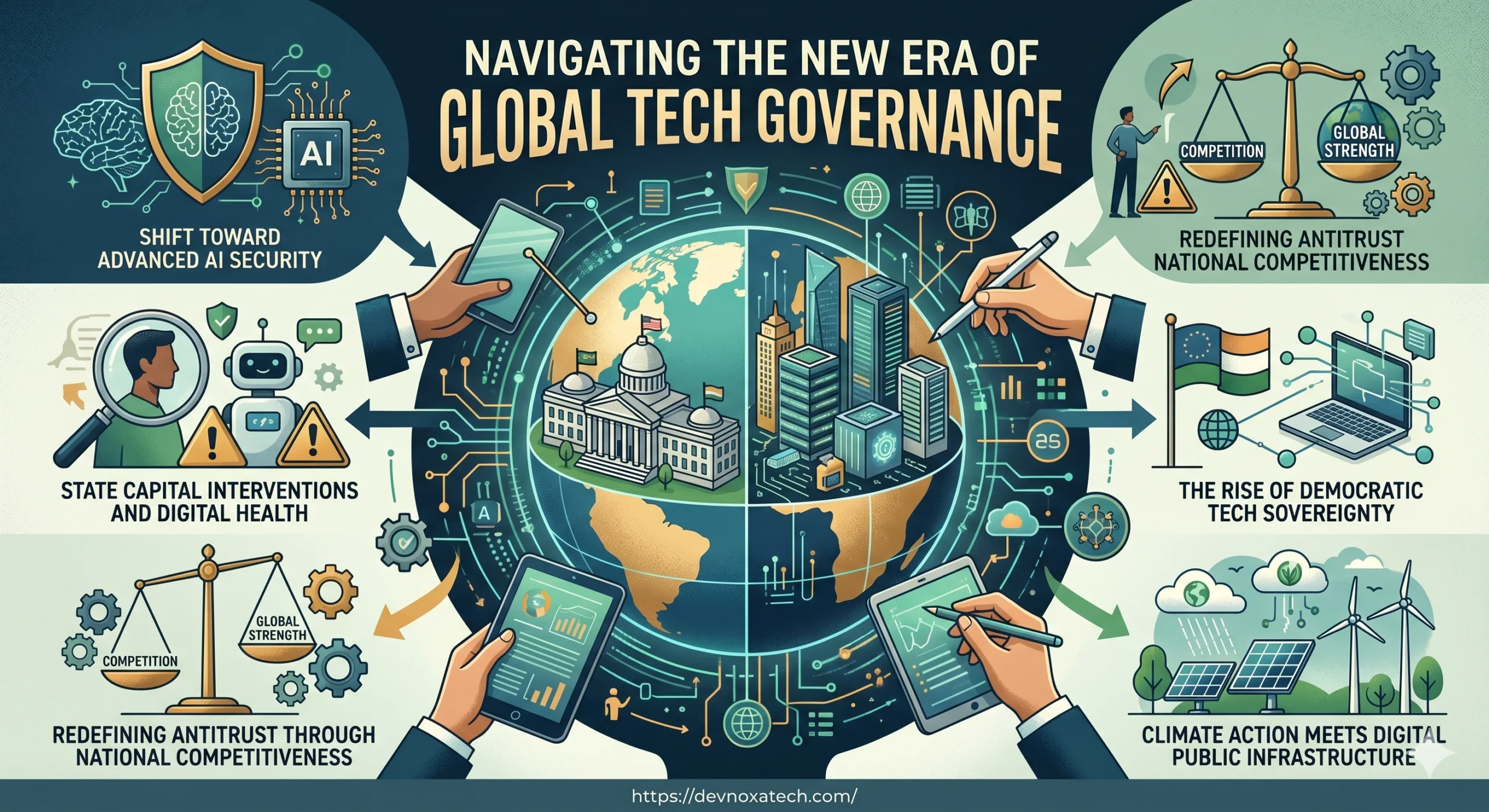

The global technology landscape is undergoing a massive shift. For years, the digital world operated with minimal oversight, allowing tech giants to scale rapidly across borders. Today, that era of hands-off growth has officially ended. Governments worldwide are aggressively asserting control over the digital sphere, treating technology policy not just as market regulation, but as a core pillar of national security, economic survival, and sovereign identity.
From the halls of Washington to the legislative chambers of Brussels and local state capitals, policymakers are scrambling to rewrite the rules of the internet. This evolution is driven by the explosive rise of generative artificial intelligence, mounting geopolitical tensions, and an urgent demand to protect vulnerable populations online. For businesses and consumers alike, understanding these shifting regulatory tides is no longer optional.
The Shift Toward Advanced AI Security
Artificial intelligence remains at the absolute center of global policy discussions. The latest legislative movements show a clear transition from general ethical guidelines to hard, enforceable security mandates. In the United States, recent federal directives have placed a heavy emphasis on securing what regulators call frontier models—the most powerful, cutting-edge AI systems capable of advanced reasoning.
The federal government is increasingly treating advanced AI as a matter of national defense. New executive frameworks have established strict benchmarking systems to evaluate the cyber capabilities of these massive models. Tech developers are facing growing pressure to grant federal agencies pre-release access to their systems to screen for potential national security risks, insider threats, and intellectual property theft.
At the same time, the legal focus is shifting away from how AI models were originally trained. Instead, prosecutors and lawmakers are zeroing in on how these models are deployed. Federal law enforcement agencies are actively prioritizing the prosecution of cybercriminals who weaponize AI agents to breach critical networks or automate identity theft, signaling that accountability will fall heavily on those who misuse autonomous code.
State Capital Interventions and Digital Health
While federal authorities focus on high-level national security, local state legislatures are stepping in to manage the everyday societal impacts of artificial intelligence. A wave of localized bills is targeting consumer transparency and digital well-being, catching many tech companies off guard.
One major trend is the rise of mandatory AI disclosures. Several states now require professionals in regulated occupations, such as healthcare workers or legal advisors, to explicitly inform clients if they are using generative AI during an interaction. Even outside of these specialized fields, businesses are increasingly required to provide clear, conspicuous notices whenever a customer is interacting with an automated system rather than a living human.
Furthermore, lawmakers are heavily regulating companion AI services—chatbots designed to simulate ongoing human relationships and emotional bonds. Because these systems retain deep conversational logs across multiple sessions, regulators worry about potential psychological manipulation, especially among minors. New state laws require companion AI platforms to actively monitor for signs of self-harm, display permanent safety protocols, and build mandatory “cool-down” breaks into their interfaces to prevent tech dependency among children.
Redefining Antitrust Through National Competitiveness
The approach to technology antitrust enforcement is also experiencing a major tactical pivot. The previous strategy of challenging tech dominance based purely on the size of a corporation is giving way to an approach tied directly to industrial policy and national economic strength.
Regulators are increasingly evaluating corporate mergers and tech acquisitions through a lens of global competitiveness. Instead of simply asking whether a business deal might raise consumer prices in the short term, enforcement agencies are looking at how transactions impact domestic jobs, supply chain resilience, and long-term innovation. If a corporate marriage helps a domestic company maintain a competitive edge against foreign rivals in critical fields like semiconductors or cloud infrastructure, it may face a smoother regulatory path than it would have in the past.
This focus on national interest is creating a widening gap between domestic regulators and foreign competition authorities. Cross-border alignment is taking a back seat as different regions prioritize their own industrial survival. For major tech enterprises, navigating antitrust investigations now requires building a narrative that proves how their business practices directly strengthen local economic health and technological leadership.
The Rise of Democratic Tech Sovereignty
Across the Atlantic, the European Union is pushing forward with its own distinct vision for the future of digital governance. The focus in Europe has expanded from simply penalizing bad corporate behavior to actively reshaping the foundational architecture of the digital world, a concept known as technological sovereignty.
European policymakers have recognized that heavy reliance on external, foreign-controlled cloud services, semiconductors, and AI infrastructure poses a severe systemic risk. To counter this vulnerability, there is a growing political movement to treat critical digital systems as public infrastructure. The goal is to embed democratic values, data privacy protections, and strict interoperability requirements directly into the very code and physical hardware that powers modern society.
This sovereign approach means that foreign tech entities looking to operate within European borders must adapt to deeply integrated compliance standards. Western platforms are finding themselves under intense scrutiny for pre-installing proprietary AI software on popular communication apps, with European antitrust bodies using interim measures to halt practices that might lock out regional competitors.
Climate Action Meets Digital Public Infrastructure
Technology policy is also converging with global environmental strategies. At recent international climate summits, digital public infrastructure has emerged as a critical tool for achieving sustainability goals.
Global leaders are realizing that fragmented, isolated data pools hinder effective environmental policy. By building open-source, unified digital platforms, nations can better track carbon commitments, optimize renewable energy grids, and deploy sophisticated early warning weather systems. Tech policies are evolving to incentivize innovators who build open data systems that can bridge the gap between private enterprise and international climate initiatives, illustrating that the future of digital governance is deeply tied to global sustainability.
Preparing for a Structured Digital Future
The rapid changes occurring across the global policy landscape point toward a highly regulated, fragmented, and scrutinized digital environment. The days of operating in a legal vacuum are gone. Moving forward, the most successful technological advancements will be those built with compliance, transparency, and national value baked directly into their core architecture.
As governments continue to assert their authority over software, data, and infrastructure, organizations must remain agile and well-informed to navigate the complexities of this new legal landscape. To explore more about the intersection of technology development and the evolving digital ecosystem, visit Devnoxa Tech.