
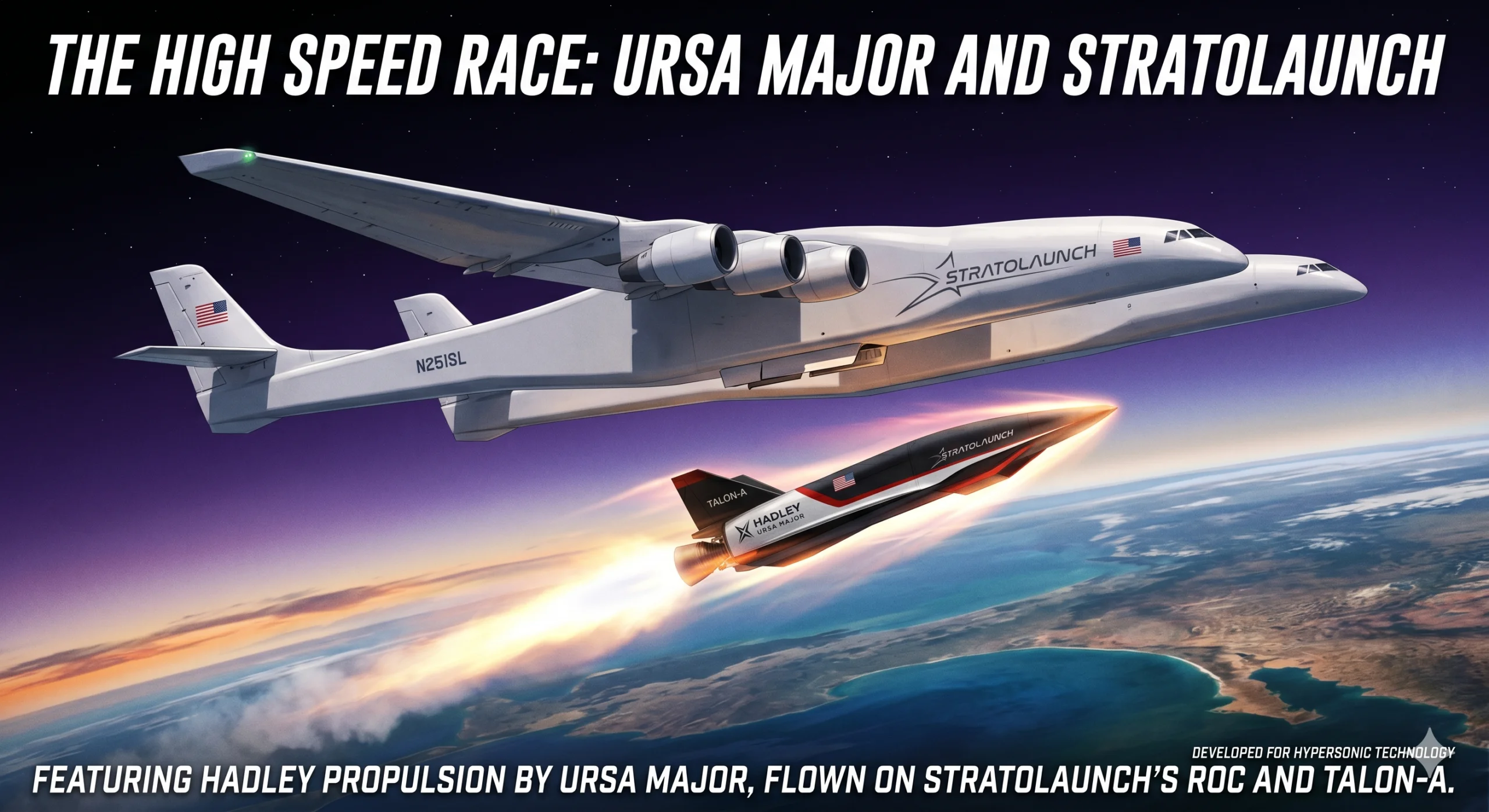

The sky has always been a place for dreamers, but lately, it has become a high-stakes laboratory for the next era of flight. If you look toward the Mojave Desert or the research hubs of Colorado, you will find two names constantly surfacing in conversations about the future of defense and aerospace ursa major stratolaunch hypersonic technology, five times the speed of sound.
This isn’t just about going fast for the sake of a record. It is about creating a reliable, reusable, and affordable way to test the physics of extreme environments. For decades, hypersonic research was the playground of superpowers with massive budgets and one-time-use missiles. Today, the partnership between Ursa Major’s propulsion and Stratolaunch’s massive carrier aircraft is turning hypersonics into a repeatable service.
The World’s Largest Launchpad
To understand this technology, you first have to look at Roc. Owned by Stratolaunch, Roc is the largest aircraft ever built by wingspan, measuring a staggering 385 feet. It looks like something out of a science fiction movie, with two separate fuselages and six massive jet engines. But Roc isn’t designed to carry passengers; it is a flying launchpad.
In the past, testing a hypersonic vehicle required a massive ground-based rocket to get it up to speed. This was expensive and logistically a nightmare. Stratolaunch’s approach is “air-launch.” Roc carries a smaller, autonomous vehicle called the Talon-A high into the atmosphere. Once it reaches the right altitude, the Talon-A is dropped. Seconds later, its rocket engine ignites, propelling it into the hypersonic regime.
This method allows for more frequent testing. If a flight goes wrong, or if engineers want to test a new sensor, they don’t have to wait months for a new launch window at a traditional range. They can simply land Roc, prep another Talon, and go again.
The Heart of the Machine: Hadley
A vehicle like the Talon-A is only as good as the fire in its belly. This is where Ursa Major comes in. Based in Colorado, Ursa Major is a pure-play propulsion company. They don’t build the planes; they build the engines that make them scream. Their star performer in the Stratolaunch partnership is the Hadley engine.
The Hadley is a liquid rocket engine that is remarkably compact yet powerful. It produces about 5,000 pounds of thrust and runs on liquid oxygen and kerosene. What makes Hadley special is its construction. Ursa Major uses advanced 3D printing (additive manufacturing) to build the engine. This allows them to create complex cooling channels and internal parts that would be impossible to manufacture with traditional methods.
More importantly, Hadley is built for reusability. In early 2026, Ursa Major announced a major milestone: the Hadley engine successfully completed its 10th consecutive flight with Stratolaunch. Several of these missions involved engines that had already flown, proving that hypersonic flight doesn’t have to be a “one and done” expensive gamble.
Breaking the Mach 5 Barrier
When the Talon-A separates from Roc and the Hadley engine kicks in, the vehicle enters a world of extreme physics. At Mach 5 and beyond, air doesn’t just flow over a wing; it becomes a searing plasma. Temperatures can exceed 3,000 degrees Fahrenheit, and the aerodynamic pressure is enough to crush standard materials.
By using the Hadley-powered Talon-A, the Department of Defense and commercial partners can test new thermal protection systems, communication arrays, and navigation sensors in these exact conditions. Because the Talon-A is designed to be recovered and flown again, it acts as a “wind tunnel in the sky.” It provides data that a computer simulation simply cannot replicate with 100% accuracy.
The Next Frontier: Draper and HAVOC
While the Hadley engine has proven its worth as a testbed motor, Ursa Major is already looking toward the next step: tactical application. They have recently developed the Draper engine, which builds on the lessons learned from the Stratolaunch flights.
Unlike Hadley, which uses cryogenic (super-cold) oxygen, the Draper engine uses storable liquid propellants. This is a game-changer for the military. A missile powered by a Draper engine can sit in a silo or on a ship for years and be ready to launch in seconds, just like a solid rocket motor. However, unlike a solid rocket, the Draper can be throttled and restarted.
This maneuverability is what sets modern hypersonic technology apart. Traditional ballistic missiles follow a predictable arc—like a fly ball in baseball. A liquid-powered hypersonic vehicle, however, can zig-zag, change altitude, and dodge interceptors while traveling at over 3,800 miles per hour. This makes them nearly impossible to stop with current missile defense systems.
In early 2026, Ursa Major unveiled the HAVOC missile system. This uses the Draper engine technology to create a medium-range hypersonic weapon that is modular and, most importantly, affordable. By moving away from the “bespoke” model of aerospace manufacturing and toward 3D-printed, mass-produced engines, they are attempting to do for hypersonics what Henry Ford did for the automobile.
Why This Partnership Matters
The collaboration between Stratolaunch and Ursa Major represents a shift in the American aerospace industry. For a long time, the “Big Aerospace” companies moved slowly, with massive government contracts and decade-long development cycles.
Now, we see a more agile “New Space” approach. Stratolaunch provides the infrastructure—the massive carrier plane and the reusable flight vehicles. Ursa Major provides the “commodity” propulsion—engines that can be swapped out, upgraded, and flown repeatedly.
This synergy has allowed the U.S. to rapidly increase its “flight cadence.” In the race for hypersonic supremacy, the winner isn’t necessarily the one who flies the fastest once; it’s the one who can fly, learn, and iterate the most often. By early 2026, Stratolaunch was hitting a rhythm of multiple hypersonic sorties per month, a pace that was unthinkable just five years ago.
Looking Ahead
As we look toward the rest of 2026 and into 2027, the focus is shifting from “Can we do it?” to “How fast can we scale it?” The Pentagon has expressed deep interest in these reusable testbeds to clear the backlog of hypersonic experiments. Meanwhile, Ursa Major is expanding its additive manufacturing facilities to churn out engines even faster.
The roar of a Hadley engine beneath the wing of the Roc is more than just a sound; it’s the sound of a new industry being born. From reusable testbeds to maneuverable tactical missiles, the marriage of Stratolaunch’s massive scale and Ursa Major’s precision propulsion is ensuring that the future of flight is not just fast, but sustainable and smart.
The era of the “one-hit-wonder” rocket is ending. The era of the hypersonic workhorse has begun. devnoxa tech