
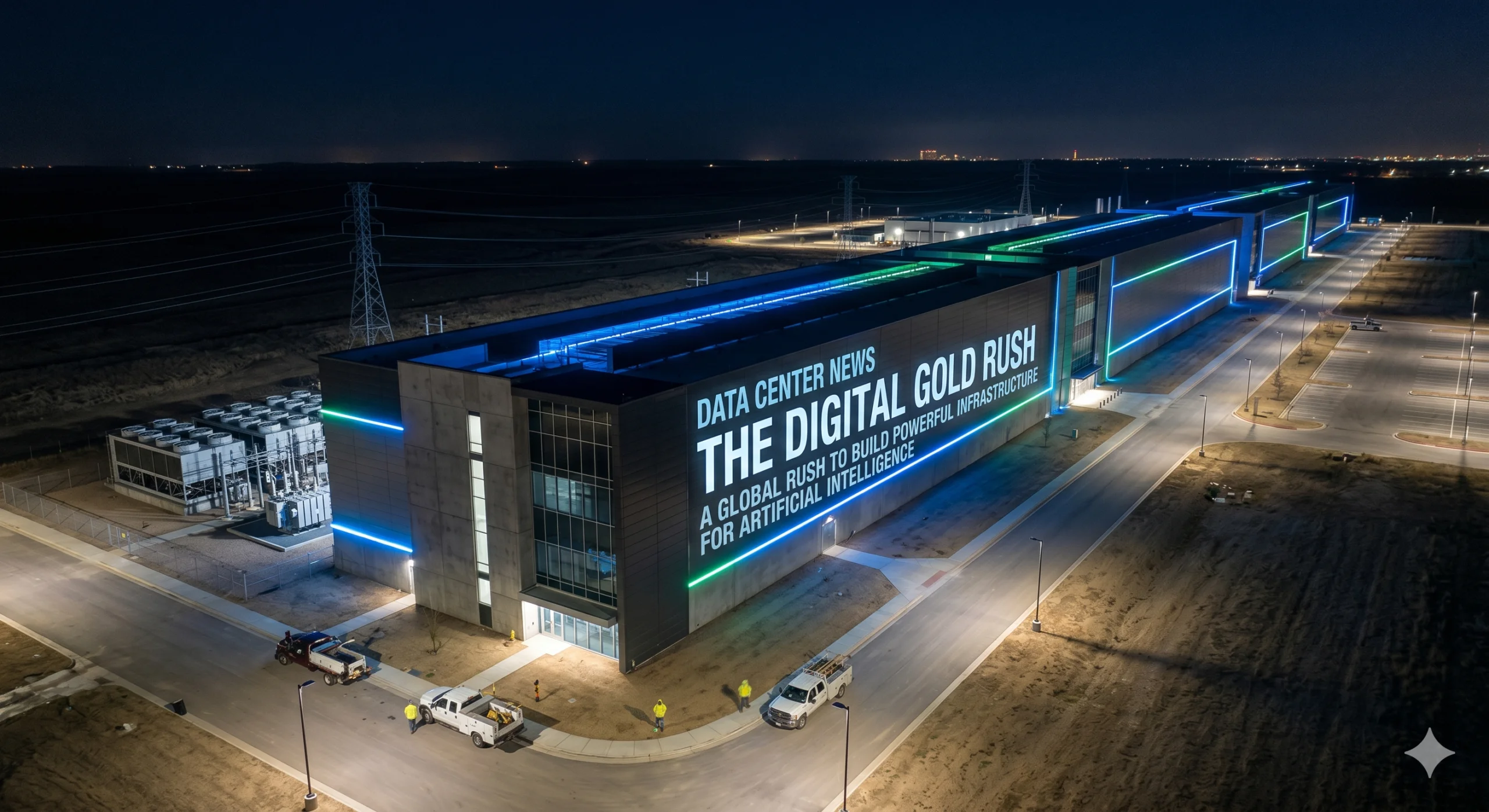

The skyline of the modern world is no longer just defined by glass skyscrapers and bustling city streets. Today, a new kind of architecture is rising—vast, windowless, and humming with a quiet but immense energy. These are the AI data centers, the literal engine rooms of the 21st century. As of mid-2026, the race to build these facilities has shifted from a steady sprint to an all-out global scramble, reshaping everything from local power grids to international diplomacy.
The scale of investment is difficult to wrap the mind around. The “Big Four”—Amazon, Microsoft, Alphabet, and Meta—are on track to spend a combined $710 billion this year alone on infrastructure. To put that in perspective, that is more than the annual GDP of many developed nations. This isn’t just about adding more servers; it is a fundamental rebuilding of the internet’s backbone to handle the crushing computational weight of generative AI.
The Power Paradox
If data is the new oil, then electricity is the new water—essential, increasingly scarce, and the primary bottleneck for growth. A standard data center rack used to pull about 5 to 10 kilowatts of power. A modern AI rack, packed with Nvidia’s latest chips or custom Google TPUs, demands 60 to 100 kilowatts.
This surge has created what experts call the “Power Paradox.” While tech giants have spent a decade pledging to go carbon-neutral, the sheer hunger of AI is forcing a pragmatic, and sometimes controversial, pivot in energy strategy.
- Nuclear Renaissance: Microsoft has recently made headlines by helping to restart dormant reactors, viewing nuclear energy as the only “always-on” carbon-free source capable of meeting their needs.
- The Natural Gas Bridge: Despite green goals, many operators are turning to natural gas as a “bridge” fuel. In Virginia and Texas, new data centers are being built with on-site gas turbines to ensure they aren’t vulnerable to the instabilities of a crowded public grid.
- The Grid Stakeholder: Data centers are no longer just customers of the utility companies; they are becoming partners. We are seeing projects where tech firms co-invest in high-voltage transmission lines just to ensure they can get power to their sites.
Cooling the Heat
It is a basic rule of physics: high power leads to high heat. Traditional air-conditioned data centers, which rely on giant fans and chilled air, are reaching their physical limits. You simply cannot move enough air through a densely packed AI server to keep it from melting.
Because of this, 2026 has become the year liquid cooling went mainstream. We are seeing a shift toward “direct-to-chip” cooling, where liquid coolant is piped directly to a cold plate sitting on top of the processor. Even more futuristic is immersion cooling, where entire server blades are dunked into specialized non-conductive fluids. These liquids absorb heat much more efficiently than air, allowing companies to pack more “brainpower” into smaller physical footprints.
A Global Map of Silicon
The geography of the internet is also changing. For years, Northern Virginia was the undisputed center of the data world. But as land prices skyrocket and power grids there hit their limits, the industry is looking elsewhere.
In the United States, places like New Mexico, Iowa, and Ohio are becoming the new tech hubs, offering vast tracts of land and access to wind energy. Globally, the expansion is even more dramatic. Google recently broke ground on massive projects in India and Austria, while Oracle is rethinking its entire approach with microgrid-powered campuses in the Middle East.
There is also a growing trend of “Sovereign AI.” Countries like Singapore and Brazil are increasingly treating data centers as vital national infrastructure, similar to ports or power plants. They are passing laws to ensure that the data—and the processing power—of their citizens remains within their borders, leading to a localized boom in regional data center construction.
The Human Element
While these buildings are mostly filled with machines, the human impact is significant. The construction boom has created a massive demand for skilled trades. There is a global shortage of electricians, cooling technicians, and specialized engineers.
Interestingly, we are seeing a “Tide Turn” for trade careers. High salaries and the high-tech nature of these facilities are drawing Gen Z workers into vocational training at record rates. Working in a data center is no longer seen as a “backroom” job; it is a front-line role in the digital economy.
The Shadow of the Bubble
Despite the optimism, a question looms over every ribbon-cutting ceremony: is this a bubble? Some economists worry that the hundreds of billions being spent on hardware haven’t yet translated into hundreds of billions in revenue.
However, the industry’s leaders argue that we are in a “build it and they will come” phase. They point to the fact that AI inference—the actual use of AI by consumers—is growing at 30% annually. To them, these data centers aren’t just buildings; they are the factories of the future. Just as the 19th century was built on steel and the 20th on oil, the 21st is being built on silicon and electricity.
The Road Ahead
As we look toward the end of 2026, the “Industrialization of AI” shows no signs of slowing down. We are moving away from general-purpose data centers toward highly specialized, modular “factories” designed for specific types of machine learning.
The challenges of energy, cooling, and regulation are real, but they are also driving a wave of innovation that will likely benefit other industries. The quest for more efficient AI cooling might lead to better residential HVAC systems; the push for smaller, on-site nuclear reactors could revolutionize how we power remote cities. In the end, the news coming out of the data center world isn’t just about computers—it’s about the very infrastructure of human progress. devnoxa tech