
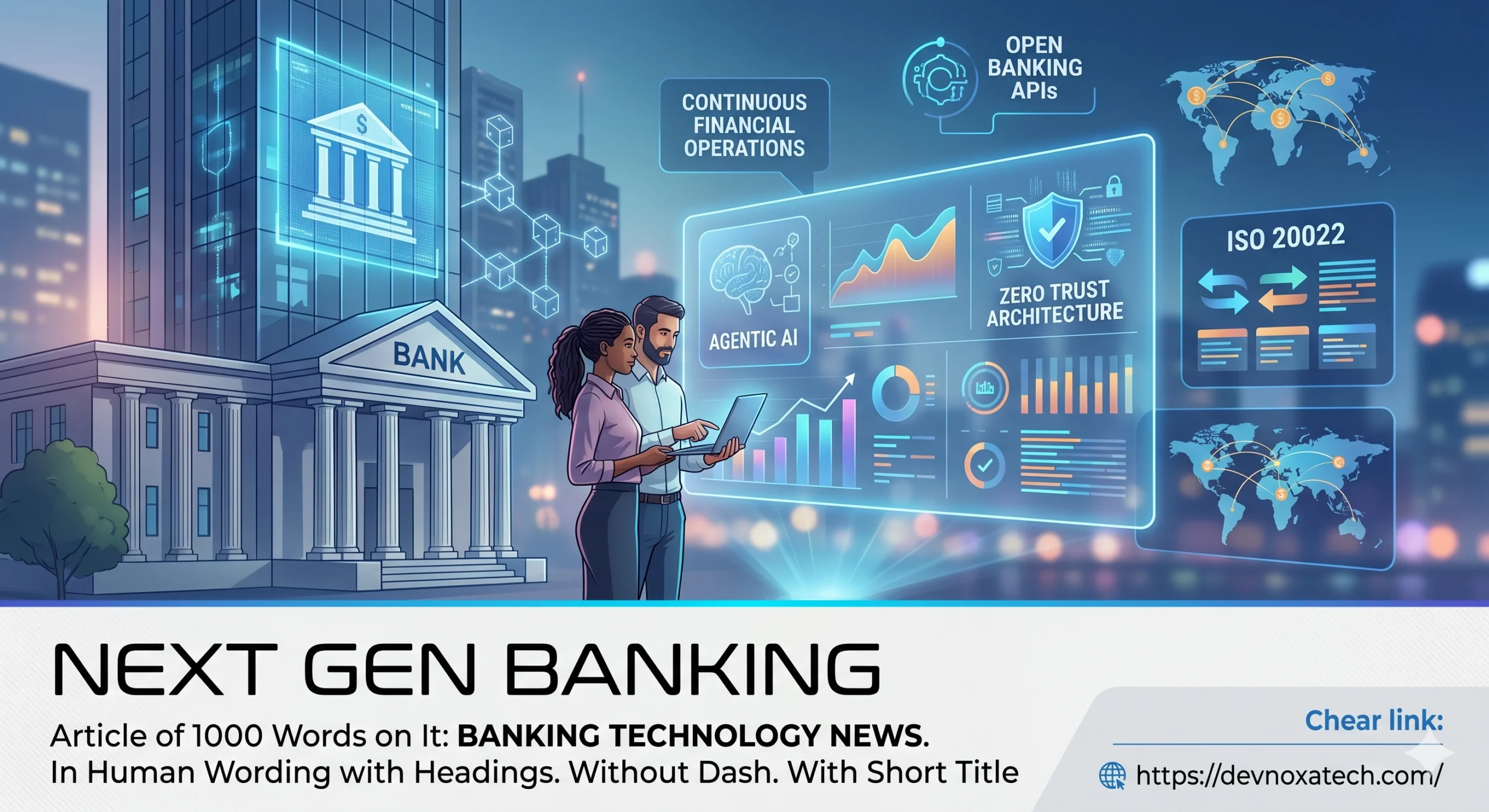

The financial sector is moving beyond basic digital accounts. The modern landscape of banking technology has fundamentally shifted from traditional transaction logging to proactive, intelligent financial support. Financial institutions are overhauling their core legacy systems to handle the demands of automated workflows, complex cross border networks, and real time data streams. This evolution is reshaping how customers interact with their money, how risk is measured, and how security is maintained.
The Rise of Agentic Artificial Intelligence
Artificial intelligence in financial apps has evolved past basic chatbots that simply answer frequently asked questions or display account balances. Today, the focus is squarely on agentic AI, which refers to automated systems designed to execute complex, multi step operational workflows without continuous human intervention.
In modern lending, for instance, these intelligent assistants orchestrate the complete verification process. Instead of forcing loan officers to manually collect files over several weeks, the system pulls digital bank statements, employer records, payroll data, and tax transcripts simultaneously. It cross references the information, flags inconsistencies, and builds a comprehensive financial profile in minutes.
The same level of automation is transforming regulatory compliance. Compliance agents read updating regulatory texts, map new legal requirements to internal banking policies, pinpoint operational gaps, and track remediation tasks automatically. By taking over these heavy administrative burdens, the technology allows bank staff to focus entirely on human judgment and complex advisory services.
Transitioning to Continuous Financial Operations
For decades, banking has operated in distinct snapshots. A person’s creditworthiness was checked at the exact moment of a loan application, fraud was analyzed after a suspicious charge occurred, and account risk was calculated in nightly batches. Technology has shifted the entire landscape toward continuous financial monitoring.
Modern infrastructure relies on event driven data architecture to analyze activity as it happens. Rather than waiting for a monthly statement, predictive systems observe real time spending patterns, lifestyle changes, and income flows to provide immediate, contextual guidance.
For commercial clients, this means continuous underwriting. Businesses can maintain rolling access to capital because the bank’s systems dynamically evaluate their inventory data, accounting software, and sales transactions. If an economic shift occurs, both the client and the financial institution know the exact impact immediately, eliminating the friction of rigid, point in time reviews.
Security via Zero Trust Architecture
As data flows constantly between banks, third party financial applications, and embedded merchant platforms, the traditional method of securing the perimeter of a bank is no longer sufficient. Security teams are aggressively migrating to zero trust architecture, an infrastructure philosophy operating on a simple principle: never trust, always verify.
In this framework, inside access is not automatically granted just because a request originates within a bank’s internal network. Every user, device, and API transaction must be continuously authenticated and validated. Security systems use behavioral biometrics to monitor how a user interacts with their device, analyzing typing speed, swipe patterns, and navigation habits to detect account takeovers in real time.
Furthermore, data modernization efforts ensure that data is encrypted both at rest and during transit across cloud environments. This protects sensitive consumer data against advanced threats while significantly reducing false alarms during fraud detection.
Modernizing Rail Networks and Faster Payments
The global plumbing of money movement is experiencing a massive upgrade. Financial institutions worldwide are adopting the ISO 20022 messaging standard for payments. This standard allows banks to attach massive amounts of structured data to every single transaction, replacing the restrictive, text heavy payment messages of old.
With richer data attached to every payment, businesses can automate their reconciliation processes instantly. Invoices, tax details, and legal descriptions travel directly alongside the funds.
Concurrently, instant cross border payment rails are dismantling geographic barriers. By utilizing cloud native payment engines, international money transfers that previously took several business days and accrued heavy intermediary fees now settle in seconds. This systemic shift allows global corporate treasurers and everyday retail consumers to manage international liquidity with the exact same ease as a domestic cash transfer.
The Growth of Interconnected Ecosystems
Banking is no longer a standalone destination. It is rapidly turning into an invisible, embedded service integrated into the software applications people use every single day. Through open banking APIs, financial institutions are linking directly with retail, healthcare, and enterprise management platforms.
This structural evolution, often called ecosystem banking, allows consumers to access financing precisely when they need it. For instance, a small business can secure a line of credit directly inside their inventory tracking software at the moment they restock goods.
Similarly, consumers can access tailored insurance or payment options directly at checkout without navigating away to a separate banking portal. Rather than defending closed, proprietary systems, progressive banks are actively collaborating with fintech platforms to expand their market reach, transforming their operations into scalable digital utilities.
Finding Balance in the Digital Era
Despite the aggressive rush toward automation, leading institutions recognize that digital optimization cannot entirely replace human relationships. The primary goal of current technology design is to marry digital convenience with genuine human empathy.
While everyday tasks like trading, card management, and account updates are migrating completely to high performance mobile platforms, physical branch networks are being reimagined. Branches are shifting away from routine teller transactions and transforming into advisory spaces for major life events, such as estate planning, corporate restructuring, or navigating financial distress.
When digital self service tools encounter an exceptional or emotionally complex problem, smart routing systems smoothly transition the customer to a human representative, ensuring that the user’s history and context move with them.
Building the Technical Foundation
To support this highly integrated, real time environment, financial institutions are prioritizing core system modernization. Fragmented, siloed databases are being replaced with unified enterprise data platforms. By cleaning up their underlying data pipelines, banks ensure that their AI models operate on accurate, compliant information.
Treating technology as an essential driver of trust and growth, rather than an operational cost center to control, has become the defining characteristic of successful institutions. The organizations modernizing their technical foundations today are successfully positioning themselves to navigate a highly competitive, fast moving financial future.
For more insights on the technical systems driving modern business transformation, visit devnoxa tech