
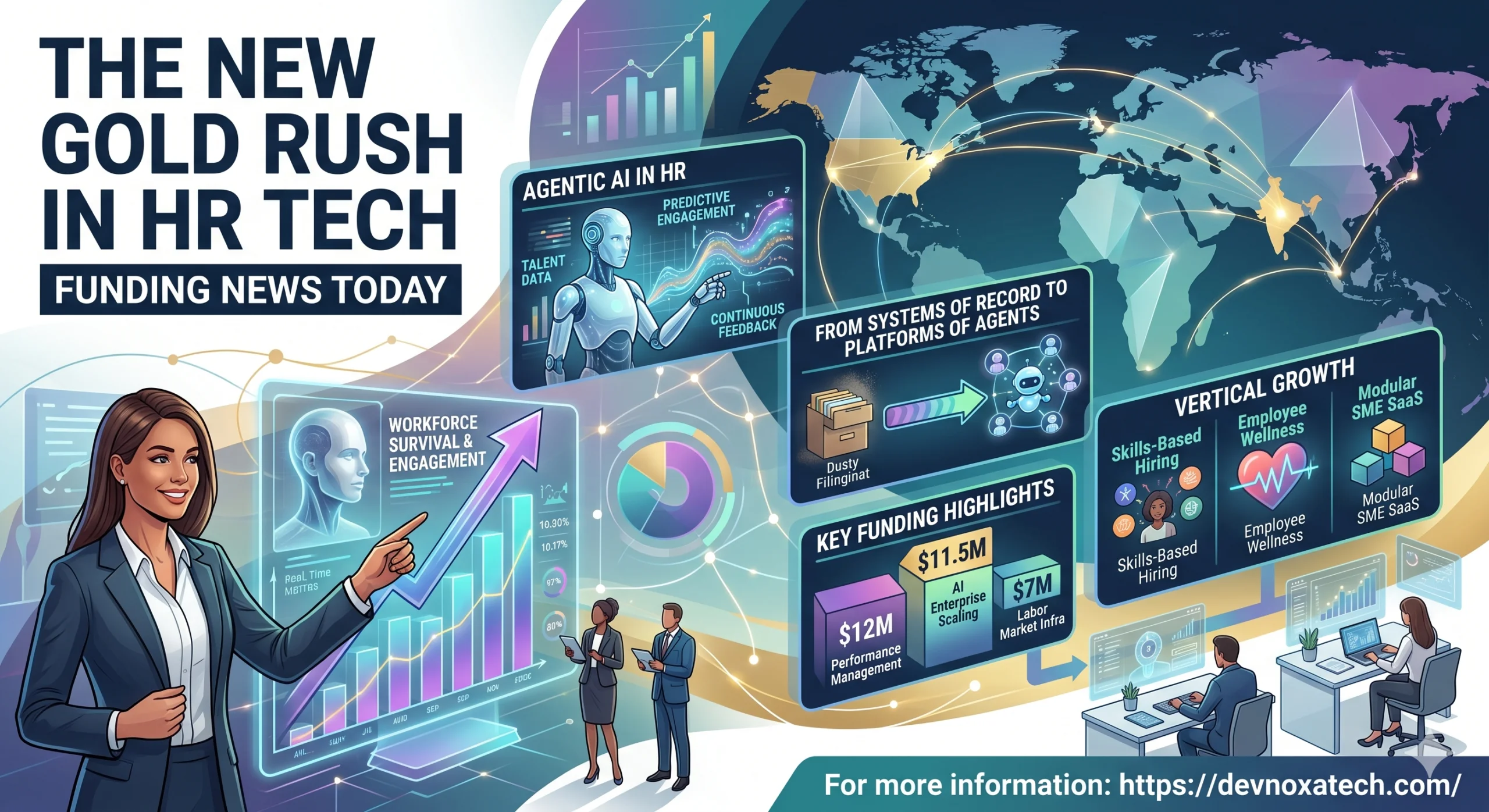

The landscape of Human Resources has shifted from filing cabinets and spreadsheets to a high-stakes arena of venture capital and cutting-edge artificial intelligence. As of May 2026, the Gold Rush in HR Tech sector is experiencing a massive resurgence in funding, driven by the realization that “managing people” is no longer a back-office task—it is the primary engine of business survival. Investors are no longer just looking for digital versions of old processes; they are hunting for “Agentic AI” and tools that can predict human behavior before it happens.
The numbers tell a compelling story. The global HR tech market is projected to surpass $47 billion this year, growing at a steady clip as companies abandon fragmented legacy systems. But the real story isn’t just the size of the market; it’s the velocity of the deals happening right now.
Recent Funding Highlights and Breakthroughs
In the last few days, several key players have closed significant rounds, signaling where the smart money is moving.
One of the standout stories comes from Windmill, an HR tech startup that recently closed a $12 million funding round. Windmill isn’t your average performance management tool. It focuses on AI-driven performance analysis, moving away from the dreaded “annual review” toward a continuous feedback loop. Investors are betting that Windmill’s ability to combine real-time feedback with AI-assisted analysis will solve the chronic engagement issues that have plagued large enterprises for decades.
Meanwhile, in the specialized infrastructure space, HrFlow.ai secured $7 million in Pre-Series A funding. Their mission is ambitious: building the global AI infrastructure for the labor market. Led by 115K and EmergingTech Ventures, this deal highlights a shift toward “API-first” HR architecture. Instead of buying one giant, clunky software suite, companies are increasingly looking for specialized layers of AI that can plug into their existing data to make sense of the millions of resumes and job data points they handle daily.
We also see vertical-specific AI gaining traction. Clarasight, though straddling the line between corporate travel and HR operations, recently raised $11.5 million. Their focus on using AI to scale enterprise products shows that investors are eager for tools that bridge the gap between employee movement and operational efficiency.
From Systems of Record to Platforms of Agents
The funding news today reflects a deeper philosophical change in the industry. For years, HR tech was built on “Systems of Record”—databases that simply stored information. If you wanted to know an employee’s start date or their salary, you looked it up.
In 2026, the money is flowing toward “Platforms of Agents.” Industry giants like Workday are leading this charge, having recently integrated nearly $3 billion worth of acquisitions—including HiredScore and Paradox—to reposition themselves. The goal is to create autonomous AI agents that don’t just store data but act on it. These agents can screen candidates, schedule interviews, and even predict which employees are at risk of burning out, all without a human having to click a button.
This shift is why we see such high valuations for startups that offer “Agentic AI.” According to recent market insights, over 98% of organizations are accelerating their AI integration. The “tipping point” has been reached; AI is no longer a feature—it is the foundation.
Where the Money is Heading: Key Categories
If you follow the trail of venture capital in May 2026, it leads to four specific areas:
1. Skills-Based Hiring and Internal Mobility
Degree-based hiring is dying. Investors are pouring capital into platforms that can extract “verified skills” from a person’s work history. The goal is to create internal talent marketplaces. If a company needs a project manager, the AI should be able to scan the current workforce and find a developer who has the exact leadership skills required, even if they’ve never held the title.
2. Employee Wellness and Benefits Administration
This segment is expanding at a 12.34% CAGR. After years of workforce volatility, companies are desperate for tech that proves they care about their people. Funding is hitting startups that offer hyper-personalized benefits packages and mental health support powered by data, not just generic perks.
3. Automated Recruitment and “The Human in the Loop”
Recruitment marketing tools like Hirex are gaining momentum by automating the entire journey from job posting to offer. However, a new trend in funding is “Governance Tech.” Investors are backing tools that ensure AI hiring isn’t biased or unethical. As one expert noted, “What a person struggles to find, agents find easily,” which creates a massive need for security and privacy layers within HR software.
4. Small and Medium Enterprise (SME) Solutions
While large enterprises like the Fortune 500 take up most of the headlines, the fastest growth is actually happening in the SME sector. Startups that provide “modular SaaS”—where a small business can toggle on payroll or recruiting as they grow—are seeing a surge in Series A and B rounds.
The Geography of Investment
North America remains the largest market, accounting for nearly 46% of revenue, but the “fastest-growing” title belongs to the Asia-Pacific region. India and Singapore have become massive hubs for HR tech innovation, with local startups attracting global VC interest. The demand for automation in manufacturing and retail sectors in these regions is driving a new wave of localized HR solutions that are often more agile than their Western counterparts.
Challenges Amidst the Boom
It’s not all sunshine and unicorns. Despite the rush of funding, there is a growing caution regarding “vendor consolidation.” Many companies are tired of managing 20 different HR apps. This is leading to a wave of M&A (mergers and acquisitions) activity. Larger players are snapping up specialized AI firms to create “all-in-one” platforms.
Furthermore, there is a significant hurdle in “change management.” While a startup might raise $50 million to build a revolutionary AI coach, the actual adoption of that tech by a traditional HR department can take years. VCs are now looking for startups that don’t just have great code, but also have a clear strategy for “human-AI collaboration.”
The Bottom Line for 2026
The HR tech funding news today tells us that the “Human” in Human Resources is getting a massive digital upgrade. We are moving away from the era of “automated forms” and into the era of “intelligent agents.” For startups, the message is clear: if your tech doesn’t solve a specific problem using predictive data or agentic automation, the window of opportunity is closing. For employers, the message is equally stark: the tools to build a world-class workforce are here, and they are more powerful—and more funded—than ever before.
As we move through the second half of 2026, expect to see even more specialized AI “wrappers” and a continued focus on making work more human through the very technology that once threatened to make it mechanical.
For more information on the latest in technology and innovation, visit: devnoxa tech