
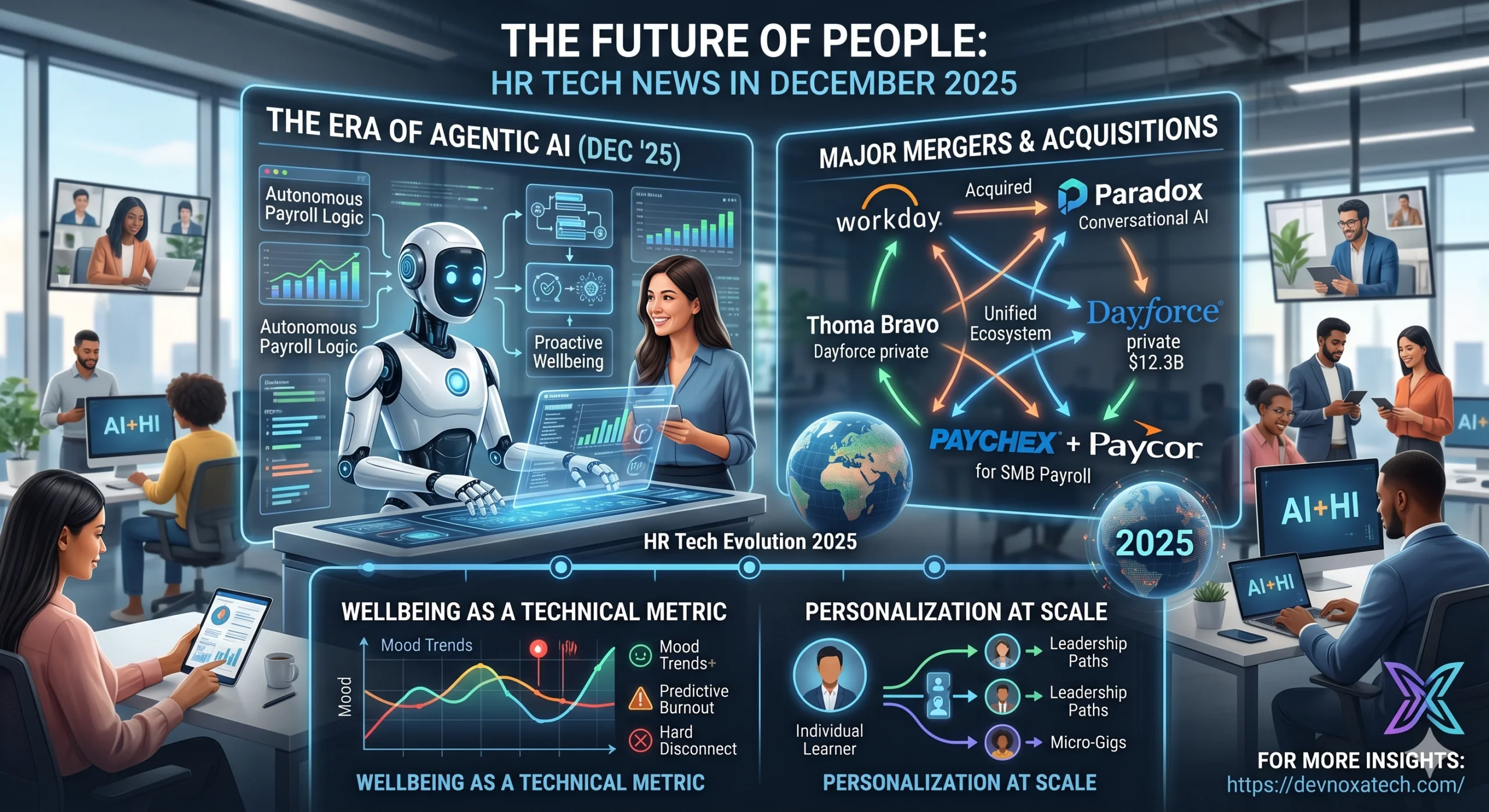

As we wrap up 2025, the HR tech news landscape looks drastically different than it did just twelve months ago. The “year of the agent” has lived up to its name, moving past the initial hype of simple chatbots into a sophisticated era of autonomous systems that handle everything from complex payroll logic to proactive employee wellbeing.
In December 2025, the news cycle is dominated by massive industry consolidations, the rise of agentic AI, and a shift toward “human-centric” automation. Here is a look at the major headlines and trends defining the workforce technology space this month.
The Era of Agentic AI
The biggest story this December is the widespread deployment of agentic AI. Unlike the generative AI of 2024, which primarily drafted emails or summarized meetings, agentic AI systems are now making 15% of day-to-day work decisions autonomously.
According to recent reports from Gartner and SHRM, these agents aren’t just answering FAQs; they are navigating complex workflows. For example, an AI agent can now detect a payroll discrepancy, cross-reference it with local tax laws, and initiate a correction without a human HR manager ever touching a spreadsheet. This shift is freeing HR professionals to focus on “high-touch” tasks like conflict resolution and organizational strategy.
The Trust Gap Challenge
Despite the excitement, a “trust gap” remains a significant hurdle. A December survey by EY revealed that while 84% of desk workers are excited about using these tools, over half still worry about long-term job security. Leading CHROs are responding by rebranding AI as AI+HI (Artificial Intelligence + Human Intelligence), emphasizing that technology is an “additive” force rather than a replacement.
Major Mergers and Acquisitions
The end of the year has seen a flurry of M&A activity as legacy providers race to acquire cutting-edge AI capabilities.
| Company | Acquisition | Strategic Impact |
| Paychex | Paycor ($4.1B) | Massive consolidation in the SMB payroll space, expanding AI-driven HCM suites. |
| Workday | Paradox | Integration of conversational AI to streamline high-volume, frontline hiring. |
| Thoma Bravo | Dayforce ($12.3B) | Dayforce went private to accelerate its transition into a “generational AI” company. |
| SAP | SmartRecruiters | Strengthening talent acquisition within the SuccessFactors ecosystem. |
These moves signal a shift away from disjointed software tools toward unified cloud platforms. The goal for 2026 is clear: a “one-pane-of-glass” experience where payroll, recruitment, and performance management live in a single, AI-powered ecosystem.
Wellbeing as a Technical Metric
December 2025 has also seen the maturation of “Emotion AI” and real-time mood tracking. HR platforms are no longer just repositories for data; they are becoming diagnostic tools for mental health.
New software launches this month from companies like Workhuman and Achievers focus on “predictive burnout.” By analyzing patterns in communication, vacation usage, and even “digital exhaust” (the metadata of our digital work), these tools can alert managers when a team member is at high risk for turnover or exhaustion before it happens.
The Mobile-Work Loop
A December report from Adobe highlighted a growing concern: the “always-on” nature of mobile HR apps. Employees are now spending an average of 21 working days per year doing their jobs from their phones. In response, 2025 year-end software updates are including “Hard Disconnect” features—automated settings that suppress all notifications after hours to protect employee boundaries.
Decentralized Data and Blockchain
A quieter but equally significant trend this month is the integration of blockchain for credentialing. As the hiring market remains competitive, companies are turning to decentralized employee profiles.
These profiles allow candidates to own their verified skills and work history. When a new hire is onboarded, the HR system can instantly verify their degree or past certifications via the blockchain, reducing the background check process from weeks to seconds. This “tamper-proof” record-keeping is becoming the new standard for compliance-heavy industries like healthcare and finance.
Personalization at Scale
The “one-size-fits-all” employee handbook is officially dead. The final software releases of 2025 have introduced Hyper-Personalized Experience Platforms. These systems use machine learning to adapt to an individual’s specific learning style and career goals.
For instance, if an employee expresses interest in a leadership role, the system doesn’t just show them a generic video; it curates a specific path of internal micro-gigs, mentoring opportunities, and adaptive learning modules based on their current skill gaps.
Final Thoughts for 2025
As we look toward 2026, the theme is resilience through technology. The HR tech world has moved beyond the “efficiency for efficiency’s sake” phase. Today, it is about building a workforce that is flexible, supported, and data-informed.
The successful HR leaders of this era are those who treat AI adoption not as a technical IT project, but as a cultural transformation. They are using these tools to bring more humanity back into the office—even if that office is a hybrid, metaverse-enabled, or mobile-first environment.
For more insights into how technology is reshaping modern business operations and development, visit: devnoxa tech